 NL·0233
Herbarium of the Nature Library
- Name
- Tachyspiza badia
- Family
- Accipitridae
- Native to
- Sub-Saharan Africa and from southern Central Asia and Iran through Pakistan, India and Sri Lanka to southern China and Southeast Asia
- Habitat
- Open woodland, Urban, Farmland, Savanna
On eBird ↗
Shikra
Live sightings near you, the range map, bar charts of when it is seen, and Macaulay Library photos and recordings.
Shikra
Tachyspiza badia
Also calledShikra (Urdu/Hindi) · Hè ěr yīng 褐耳鹰 (Chinese) · Accipiter badius (former name)
A small, pale grey hawk that hunts lizards and birds in gardens and groves across South Asia and Africa. Its name comes from the same root as 'shikar', the hunt, and it was flown by falconers in the subcontinent.
The shikra is a small bird of prey in the family Accipitridae found widely distributed in Asia and Africa where it is also called the little banded goshawk. The African forms may represent a separate species but have usually been considered as subspecies of the shikra. The shikra is very similar in appearance, as well as behavior, at least to some degree, to other species including the Chinese sparrowhawk, Eurasian goshawk and Eurasian sparrowhawk. They have a sharp two-note call and exhibit the flap-and-glide flight style typical of Tachyspiza and Accipiter hawks. Their calls are imitated by drongos and the common hawk-cuckoo resembles it in plumage. This species was formerly placed in the genus Accipiter. Wikipedia
What it can do
- iAmbushes prey from a hidden perch with a short, fast dash
- iiTakes many lizards and large insects from the ground, as well as small birds
- iiiLives quietly in city parks and gardens, often unnoticed
In the field
Field marks
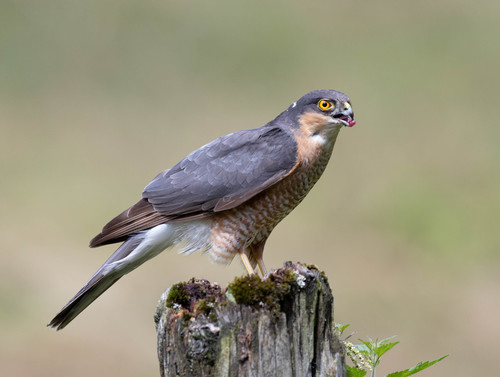
- aSmall hawk with short rounded wings and a medium tail
- bAdult pale blue-grey above with fine rufous barring below
- cThin dark stripe down the centre of the throat
- dRed (male) or yellow (female) eye; yellow legs
- Voice
- A loud, shrill 'ti-tui' or 'kik-ki', repeated; often heard before it is seen
- Not to be confused with
- Eurasian sparrowhawk (winter in Pakistan and the Himalaya) has a longer tail and darker grey back; Besra is darker with a bold throat stripe and heavier barring; Shikra's pale grey back and fine rufous bars are distinctive.
- Where to see it
- City parks, orchards and canal-side trees across Pakistan and India
- When
- Resident year-round
Listen
Looking for field recordings…
Life & habits
- Diet
- Lizards, small birds, rodents, large insects and frogs
- Habitat
- Open woodland, groves, gardens and farmland
- Size
- About 26–30 cm long
Sits in a leafy tree and launches a short, rapid attack, flying low and fast; small birds give sharp alarm calls when it appears, and Black drongos imitate its call.
Where it lives
Recorded sightings
—
geo-referenced records in GBIF, from museums, herbaria and field observers.
Native range
Sub-Saharan Africa and from southern Central Asia and Iran through Pakistan, India and Sri Lanka to southern China and Southeast Asia
Drag the globe to turn it. Dots are where records exist, not a range map; darker means more records.
In the stacks
Searching the stacks…
Every page naming Tachyspiza badia in the Biodiversity Heritage Library →
Marginalia
Shikras were trained for small-game hawking in Mughal and later Indian falconry, and the English word 'shikra' was taken directly from Hindustani.
Curiosity
A 2024 genetic study broke up the old genus Accipiter, and the Shikra was moved into the revived genus Tachyspiza.
Kinship




Photographs: iNaturalist contributors under the licences shown. Records: GBIF.org. Historical plates: Source Library (CC BY-SA 4.0; originals public domain). Summary text: Nature Library editors and Wikipedia (CC BY-SA). Medicinal and edibility notes are historical and educational, not advice. iNaturalist taxon 1583224.