On eBird ↗
Red-billed Oxpecker
Live sightings near you, the range map, bar charts of when it is seen, and Macaulay Library photos and recordings.
Red-billed Oxpecker
Buphagus erythroryncha
The red-billed oxpecker (Buphagus erythrorynchus) is a passerine bird in the oxpecker family, Buphagidae. It is native to the eastern savannah of sub-Saharan Africa, from the Central African Republic east to South Sudan and south to northern and eastern South Africa. It is more widespread than the yellow-billed oxpecker in Southern Africa, where their ranges overlap.
From the article Red-billed oxpecker on Wikipedia (CC BY-SA), quoted section by section
Description
A juvenile oxpecker is darker brown than its parents. Its bill is dark olive at first, but gradually takes on adult colouration after four months. Its flight is strong and direct, and their call is a hissy crackling trik-quisss.
Range & habitat
The red-billed oxpecker is a native of the savanna of sub-Saharan Africa. It ranges across Ethiopia and Somalia through Kenya, Tanzania, Malawi, and Zambia to southern Africa, Botswana, Zimbabwe, southern Mozambique, and north-eastern South Africa.
Wikipedia: “Distribution”
What it does
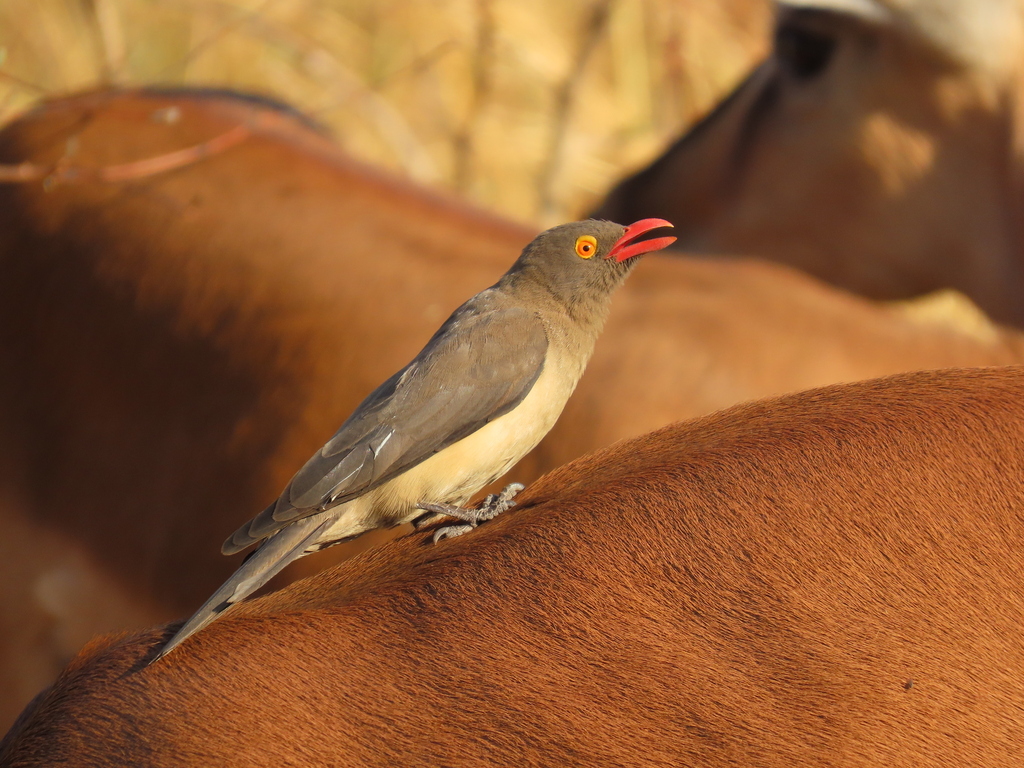
The red-billed oxpecker nests in tree holes lined with hair plucked from livestock. It lays two to five eggs, with three being the average. Outside the breeding season it forms large, chattering flocks. The preferred habitat is open country, and the red-billed oxpecker eats insects. Both the English and scientific names arise from this species' habit of perching on large wild and domesticated mammals such as cattle and eating ticks. This species's relationship with rhinoceros gives the Swahili name Askari wa kifaru meaning "the rhino's guard". An adult will take nearly 100 blood-engorged female Rhipicephalus (Boophilus) decoloratus ticks, or more than 12,000 larvae in a day. However, their preferred food is blood, and while they may take ticks bloated with blood, they also feed on it directly, pecking at the mammal's wounds to keep them open. Field observations in rhinoceros have shown oxpeckers warning the nearsighted rhinoceros of danger.
Wikipedia: “Behaviour”
Listen
Looking for field recordings…
Where it lives
Recorded sightings
—
geo-referenced records in GBIF, from museums, herbaria and field observers.
Drag the globe to turn it. Dots are where records exist, not a range map; darker means more records.
In the stacks
Searching the stacks…
Every page naming Buphagus erythroryncha in the Biodiversity Heritage Library →
This page is assembled live from iNaturalist, GBIF, Wikipedia, the Source Library and the Internet Archive. It is not yet part of the hand-edited codex. iNaturalist taxon 1584479.