- Plants
- ›Vascular Plants
- ›flowering plants
- ›Dicots
- ›Heathers, Balsams, Primroses, and Allies
- ›primrose family
- ›Cape Myrtle subfamily
- ›Ardisia
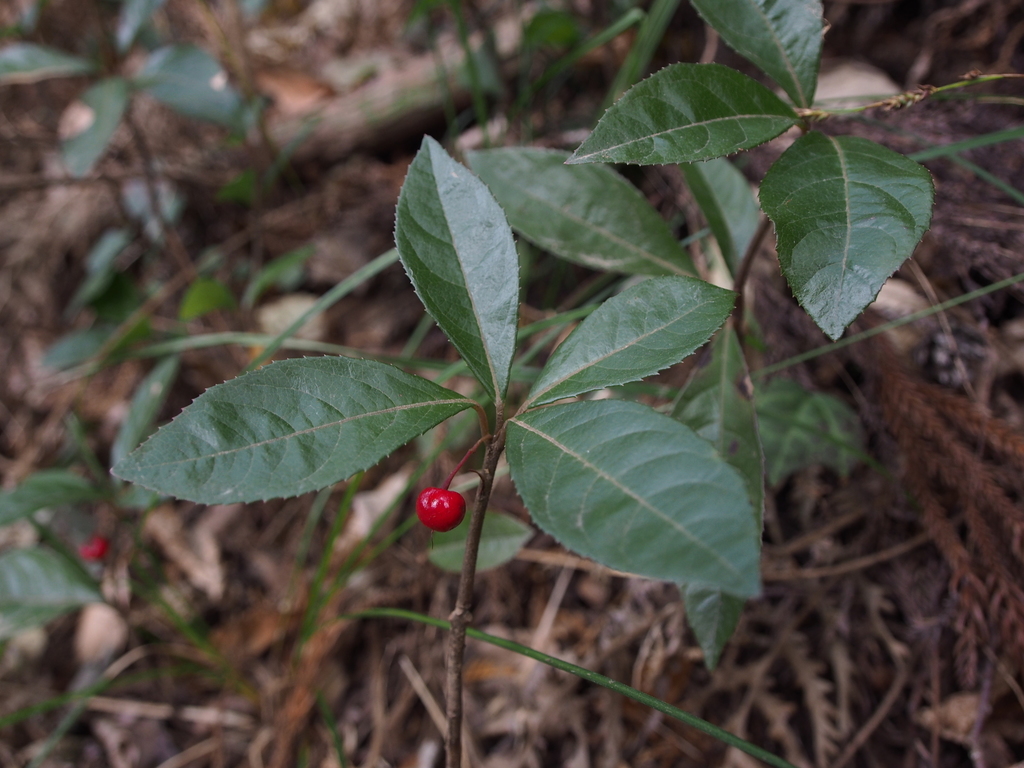
Japanese ardisia
Ardisia japonica
Ardisia japonica, known as marlberry, is a species of plant in the primrose family native to eastern Asia, in eastern China, Japan and Korea.
From the article Ardisia japonica on Wikipedia (CC BY-SA), quoted section by section
Description
It is a low-growing, spreading very quickly evergreen shrub 20–40 cm tall. The leaves are opposite or in whorls, ovate, 4–7 cm long and 1.5–4 cm broad, with a sharply serrated margin and an acute apex. The fruit is a drupe 5–6 mm diameter, red maturing dark purple-black in early winter. The flowers are 4–10 mm diameter, with five (rarely six) white to pale pink petals; they are produced in racemes in late spring. The plant flowers from August to September. A. japonica grows in dark, damp places in mixed forests and bamboo forests within 1200 metres of sea level.
At the table
A number of cultivars have been selected for growing as ornamental plants, including 'Hakuokan' and 'Ito Fukurin' with variegated leaves, 'Hinotsukasa', with pale cream-coloured leaves, and 'Matsu Shima' with pink stems and variegated leaves. A. japonica is one of the plants used in koten engei, a traditional form of Japanese horticulture. At least a dozen cultivars of the species are grown in this tradition, with varying shapes and coloration of leaves. The plant is called Jūryō (十両) in Japanese. Because of the red berries and the word play of its name it is used during Japanese New Year for chabana decoration, normally along winter jasmine.
Medicinal uses. It is used as a medicinal plant in traditional Chinese medicine, where it is called zǐjīn niú (Chinese: 紫金牛), or aidicha (矮地茶) and is considered one of the 50 Fundamental Herbs. Large doses of the plant as medicine can be toxic to the kidneys.
Weed problems. It has escaped from cultivation and established itself in the wild in the United States, in Gainesville, Florida, and possibly as far as South Carolina and Texas.
Wikipedia: “Uses”
Where it lives
Recorded sightings
—
geo-referenced records in GBIF, from museums, herbaria and field observers.
Drag the globe to turn it. Dots are where records exist, not a range map; darker means more records.
In the old herbals & bestiaries


In the stacks
Searching the stacks…
Every page naming Ardisia japonica in the Biodiversity Heritage Library →
This page is assembled live from iNaturalist, GBIF, Wikipedia, the Source Library and the Internet Archive. It is not yet part of the hand-edited codex. iNaturalist taxon 158589.