- Plants
- ›Vascular Plants
- ›flowering plants
- ›Dicots
- ›Legumes, Milkworts, and Allies
- ›Legumes
- ›orchid trees and redbuds
- ›Bauhinieae
- ›Bauhinia
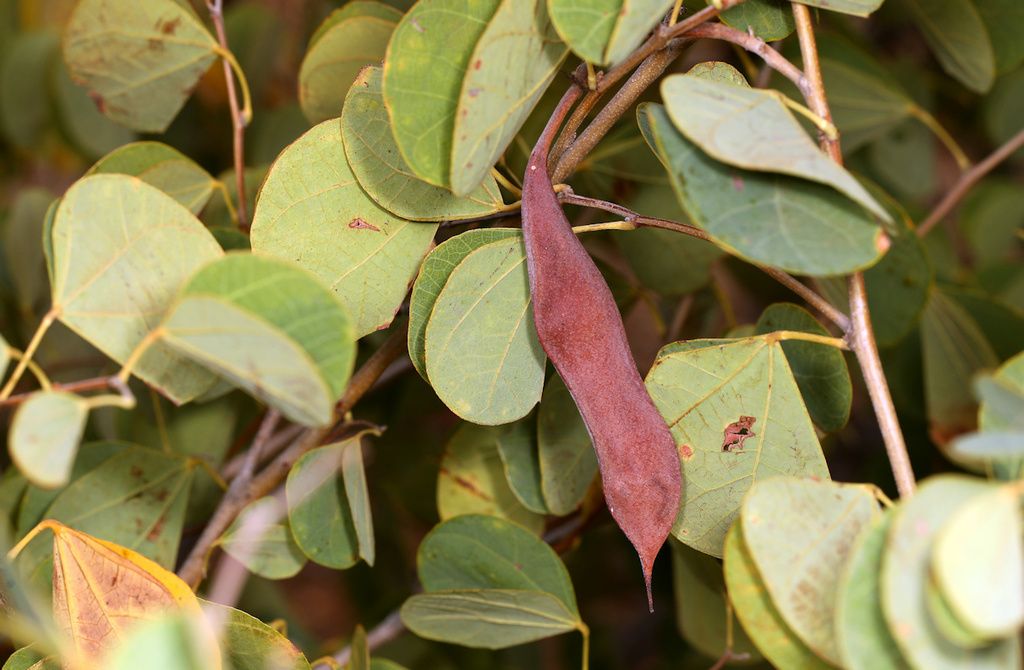
Pride-of-de-Kaap
Bauhinia galpinii
Bauhinia galpinii is a species of shrub in the family Fabaceae. It is endemic to parts of eastern and southern Africa. The species name commemorates E. E. Galpin, a South African botanist and banker. Its common names include South African orchid bush, red bauhinia and Nasturtium bush.
It is native to Angola, to Mozambique, Zimbabwe, Eswatini, and to KwaZulu Natal and the Northern Provinces of South Africa.
From the article Bauhinia galpinii on Wikipedia (CC BY-SA), quoted section by section
Description
The leaves are bilobed, each having a symmetrical pair of rounded lobes joined symmetrically about a midrib, with a small, soft mucronule in the notch at the tip. The resulting shape gave rise to the Afrikaans popular name "kameelpoot", meaning "camel's foot". The mucronule is fragile and frequently is missing as a result of minor damage. The flowers in the wild generally are a handsome brick red, but some cultivars have pink or orange-red flowers.
What it does
Its flowers are of value to pollinators, including birds, and the sheltering shrubby habit renders it popular as a nesting site for small birds. Sheep and goats can safely browse the leaves and twigs.
Wikipedia: “Ecology and uses”
How it is grown
The species is widely cultivated as a fairly drought-hardy, non-xerophytic ornamental in the warm zones of the United States and Mexico where it has escaped cultivation and naturalised in some locations, but without any significant tendency towards invasiveness.
Wikipedia: “Cultivation”
Where it lives
Recorded sightings
—
geo-referenced records in GBIF, from museums, herbaria and field observers.
Drag the globe to turn it. Dots are where records exist, not a range map; darker means more records.
In the stacks
Searching the stacks…
Every page naming Bauhinia galpinii in the Biodiversity Heritage Library →
This page is assembled live from iNaturalist, GBIF, Wikipedia, the Source Library and the Internet Archive. It is not yet part of the hand-edited codex. iNaturalist taxon 159197.