- Plants
- ›Vascular Plants
- ›flowering plants
- ›monocots
- ›grasses, sedges, cattails, and allies
- ›Bromeliads
- ›Bromelioids
- ›Billbergia
Fool Proof Plant
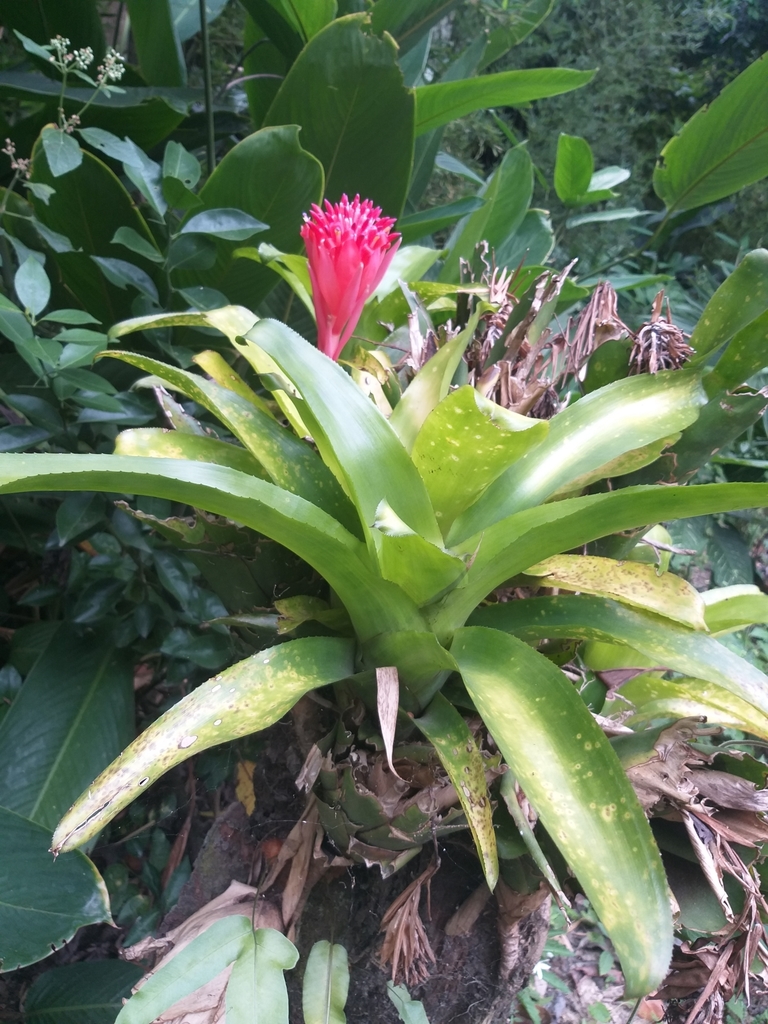
Billbergia pyramidalis
Billbergia pyramidalis, commonly known as the Flaming torch, is a species of bromeliad that is native to Brazil, Venezuela, French Guiana, the Lesser Antilles and Cuba. It is reportedly naturalized in Puerto Rico, the Dominican Republic and on the Island of Mauritius in the Indian Ocean.
From the article Billbergia pyramidalis on Wikipedia (CC BY-SA), quoted section by section
Description
A perennial, clump-forming stemless bromeliad plant, it is adaptable, growing well as a terrestrial or epiphytic plant. When on the ground, plants quickly create large clumps, and when planted at the base of a tree, they will slowly climb the trunk. The strap-like, green-coloured, overlaying, leathery leaves are arranged in jar-shaped basal rosettes, with a central cup that keeps water, organic debris and insects, thus providing extra nutrients to be absorbed by the plant.
Inflorescences. The thick, red or pink brush-shaped flowers on an individual plant last less than one month, but nearly all plants will come into bloom at the same time in the late summer or early autumn. In some latitudes, they bloom more frequently. The scarlet-coloured, erect, pyramidal flowers are laid in thistle-like inflorescences, which are made up of red, tube-shaped flowers with violet or yellow highlights.
Range & habitat
The species is found in moist humus rich soils or in composted leaf mould on the ground in humid areas, and as well as on rocks under shady forest trees, in countries such as, Cuba, Venezuela, Brazil, French Guiana, the Lesser Antilles and Cuba. It is reportedly naturalised in Puerto Rico, the Dominican Republic and on the Island of Mauritius in the Indian Ocean.
Wikipedia: “Range”
How it is grown
Requiring minimal care, the plant is used as groundcover in partial shade and in a protected position. It is drought and frost sensitive. Being epiphytic, these plants can also be grown in the branching of trees or on tree ferns. A slow-release fertiliser may be applied on the base of the plants in spring. Propagation is done by dividing off the immature parts of the plants in spring or autumn. This plant tolerates between USDA zones 10a to 12a and may not withstand temperatures below −1.1 °C.
Wikipedia: “Cultivation”
Where it lives
Recorded sightings
—
geo-referenced records in GBIF, from museums, herbaria and field observers.
Drag the globe to turn it. Dots are where records exist, not a range map; darker means more records.
In the stacks
Searching the stacks…
Every page naming Billbergia pyramidalis in the Biodiversity Heritage Library →
This page is assembled live from iNaturalist, GBIF, Wikipedia, the Source Library and the Internet Archive. It is not yet part of the hand-edited codex. iNaturalist taxon 159269.