- Plants
- ›Vascular Plants
- ›flowering plants
- ›Dicots
- ›Sunflowers, Bellflowers, Fanflowers, and Allies
- ›Sunflowers, Daisies, Asters, and Allies
- ›Asteroideae
- ›Sunflowers and Allies
- ›Cockleburs, Ragweeds, and Wild Quinines
- ›Euphrosyne
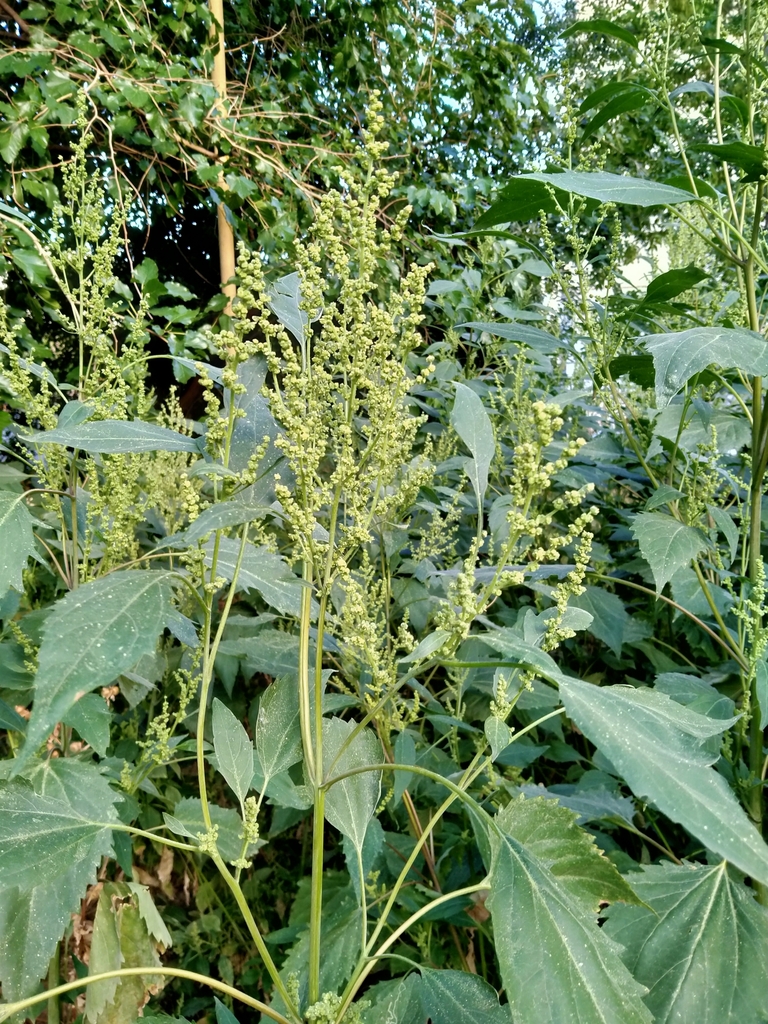
Marshelder
Euphrosyne xanthiifolia
Cyclachaena xanthiifolia (syn. Iva xanthiifolia), known as giant sumpweed, or rag sumpweed is a North American plant species in the sunflower family, Asteraceae. It is the only species in the genus Cyclachaena. Giant sumpweed is believed to be native to the Great Plains but is now found across much of southern Canada and the contiguous United States, though rarely in the Southeast.
It is an annual herb roughly 45–185 centimetres (18–72 inches) tall with stout, erect, branched stems. The stems are erect or ascending, finely ridged or grooved, and grayish-green. They are usually unbranched but sometimes have straight, upright branches. They are hairless near the base and are sparsely to moderately covered with fine curved or curled hairs above the base.
From the article Cyclachaena on Wikipedia (CC BY-SA), quoted section by section
Description
The leaf pattern of this herbaceous plant is opposite, sometimes becoming alternate towards the top of the plant. The leaves are long-stalked and double-toothed with rough hairs on the top, and light green and fuzzy on the bottom. Lower leaves are long-stalked, the stalks up to 70 mm (2+3⁄4 in) long or longer. Upper leaves are short-stalked, and the stalks are up to 10 mm (3⁄8 in) long or longer. The flowers are green to white in panicled spikes roughly 25 cm (10 in) long. Some flowers are pistillate and fertile while others are perfect but sterile. The flowers bloom from August–October. The individual flower heads droop at the end of a 5 to 6.5 mm (3⁄16 to 1⁄4 in) long or longer stalk. The whorl of bracts at the base of the flower head (involucre) is 2 to 3 mm (1⁄16 to 1⁄8 in) long. The disk is composed of 8 to 20, usually no more than 10, male (staminate) florets in the center and usually 5 female (pistillate) florets around the margin. The flowers bloom from August–October. The staminate florets have stamens with the filaments fused into a tube and the anthers free but closely arranged in a ring. The corolla is about 2 mm (1⁄16 in) long and white to pale yellow. The pistillate florets have stamens with the filaments into a tube and the anthers free but closely arranged in a ring. The corolla is sometimes absent. …
Range & habitat
Cyclachaena xanthiifolia grows in moist areas or previously disturbed sites. It can also be found in fields or along roadsides and streams.
Wikipedia: “Habitat and ecology”
Where it lives
Recorded sightings
—
geo-referenced records in GBIF, from museums, herbaria and field observers.
Drag the globe to turn it. Dots are where records exist, not a range map; darker means more records.
In the stacks
Searching the stacks…
Every page naming Euphrosyne xanthiifolia in the Biodiversity Heritage Library →
This page is assembled live from iNaturalist, GBIF, Wikipedia, the Source Library and the Internet Archive. It is not yet part of the hand-edited codex. iNaturalist taxon 1593093.