- Plants
- ›Vascular Plants
- ›flowering plants
- ›monocots
- ›grasses, sedges, cattails, and allies
- ›grasses
- ›Pooideae
- ›Bromeae
- ›Bromus
- ›Bromopsis
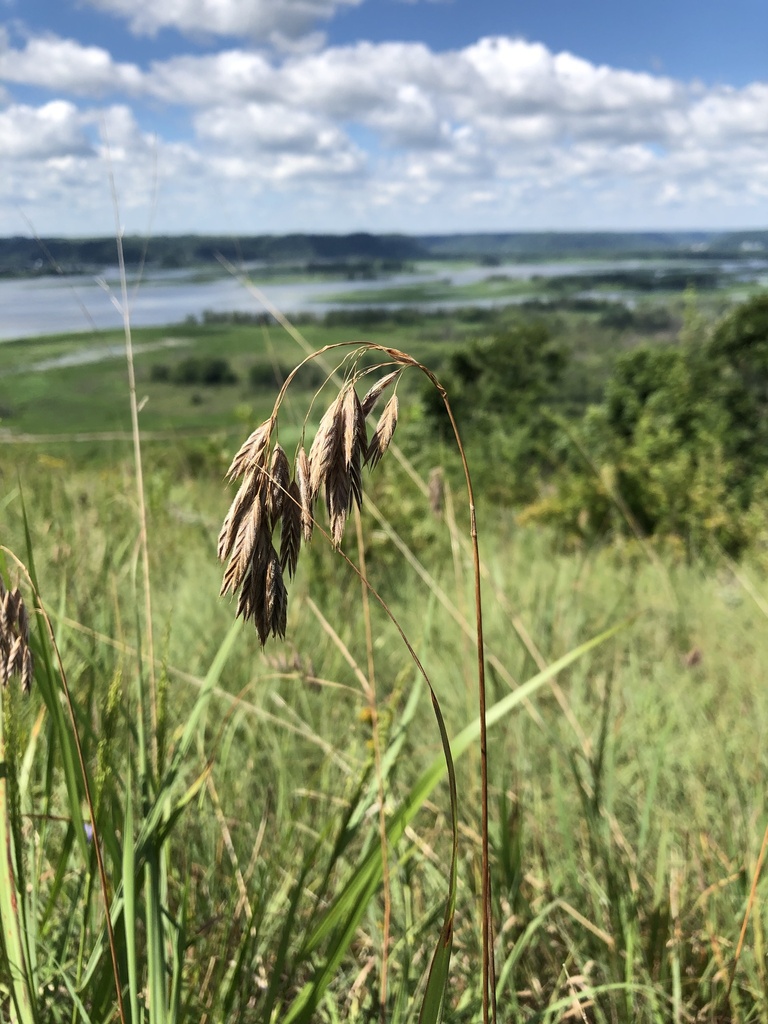
Prairie Brome
Bromus kalmii
Bromus kalmii, Kalm's brome, is a species of brome grass. It is a native bunchgrass in the North-central and Northeastern United States, the Great Lakes region, and eastern Canada. The specific epithet kalmii refers to its discoverer Pehr Kalm.
From the article Bromus kalmii on Wikipedia (CC BY-SA), quoted section by section
Description
Bromus kalmii is a perennial grass, with solitary or slightly tufted culms that grow 0.4–1.2 m (1 ft 4 in – 3 ft 11 in) tall. The culms are pubescent just below the nodes. The grass typically has three to five and occasionally six leaf blades. The firm and scabrous leaf blades are either pubescent or glabrous and are 7–17 cm (2.8–6.7 in) long and 4–10 mm (0.16–0.39 in) wide. The glabrous or sometimes shaggy sheaths are mostly shorter than the internodes and each have a V-shaped cleft. The ligule is typically 0.5 mm (0.020 in) long. The narrow, crowded panicle is 5–15 cm (2.0–5.9 in) long. The lower branches of the panicle are very slender and each bear one or two spikelets. The five to eleven flowered spikelets are 1.4–2.6 cm (0.55–1.02 in) long and 5–6 mm (0.20–0.24 in) wide. Both glumes have short, adpressed hairs. The lower glume is three-nerved and the upper glume is five-nerved. The densely hairy lemmas are oblong to elliptical in shape, and have straight awns 1–3 mm (0.039–0.118 in) long. The oblong and flat palea is slightly shorter than the glume. The anthers are approximately 2 mm (0.079 in) long. The grass flowers from July to through August.
Range & habitat
Bromus kalmii grows in dry or moist open areas or thickets, especially on calcareous soils.
== References ==
Wikipedia: “Habitat”
Where it lives
Recorded sightings
—
geo-referenced records in GBIF, from museums, herbaria and field observers.
Drag the globe to turn it. Dots are where records exist, not a range map; darker means more records.
In the stacks
Searching the stacks…
Every page naming Bromus kalmii in the Biodiversity Heritage Library →
This page is assembled live from iNaturalist, GBIF, Wikipedia, the Source Library and the Internet Archive. It is not yet part of the hand-edited codex. iNaturalist taxon 159461.