- Plants
- ›Vascular Plants
- ›flowering plants
- ›monocots
- ›grasses, sedges, cattails, and allies
- ›grasses
- ›Pooideae
- ›Bromeae
- ›Bromus
- ›Bromopsis
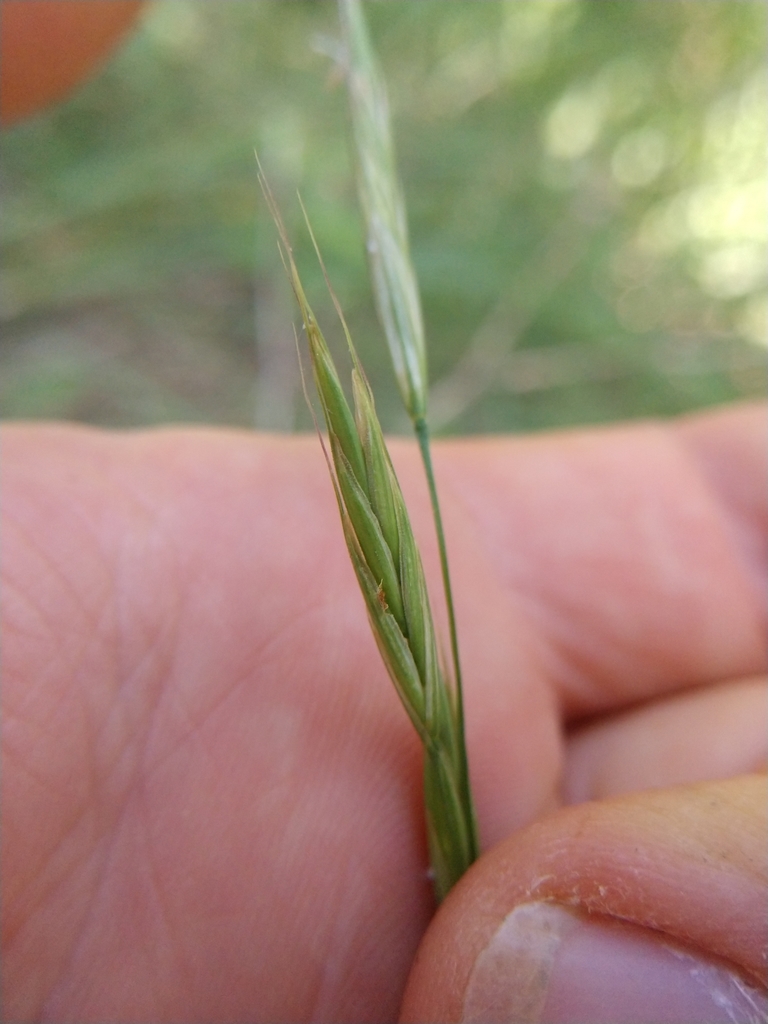
Texas Brome
Bromus texensis
Bromus texensis, the Texas brome, is an annual grass native to Texas.
From the article Bromus texensis on Wikipedia (CC BY-SA), quoted section by section
Description
The culms of Bromus texensis reach a height of 30–75 cm (12–30 in) in a spreading or erect fashion. The culms have three to five nodes with downward hairs. The leaves are hairy (pubescent to pilose), measuring 7–20 cm (2.8–7.9 in) long and 3–7 mm wide. The ligules of the leaves are 2–3 mm long with hairs on their back. The inflorescence is an erect or drooping panicle, 8–15 cm (3.1–5.9 in) long. The branches of the panicle are smooth and hairless, growing up to 9 cm (3.5 in) long. The spikelets are 2–3 cm (0.79–1.18 in) long and have four to seven minuscule florets. The first glume is 6–9 mm long with a single nerve, and the second glume is 8–10.5 mm long with three nerves. The lemmas are 9–15 mm long, with three or seven nerves. The lemmas are olive green and smooth, sometimes rough on their margins. The palea is shorter than the lemma and has rough nerves. Bromus texensis is the only grass in section Bromopsis that is a true annual.
Range & habitat
Bromus texensis is restricted to central and south-east Texas, occurring on rocky soils in Bexar, Duval, Goliad, Nueces, and Travis counties. The type locality is in Bexar county, and only one collection of the species has been made in the others. Although one specimen has been reported from Mexico, it was later discovered to be Bromus anomalus.
== References ==
Wikipedia: “Distribution and habitat”
Where it lives
Recorded sightings
—
geo-referenced records in GBIF, from museums, herbaria and field observers.
Drag the globe to turn it. Dots are where records exist, not a range map; darker means more records.
In the stacks
Searching the stacks…
Every page naming Bromus texensis in the Biodiversity Heritage Library →
This page is assembled live from iNaturalist, GBIF, Wikipedia, the Source Library and the Internet Archive. It is not yet part of the hand-edited codex. iNaturalist taxon 159476.