- Plants
- ›Vascular Plants
- ›flowering plants
- ›Dicots
- ›Sunflowers, Bellflowers, Fanflowers, and Allies
- ›bellflower family
- ›bellflower subfamily
- ›Campanula
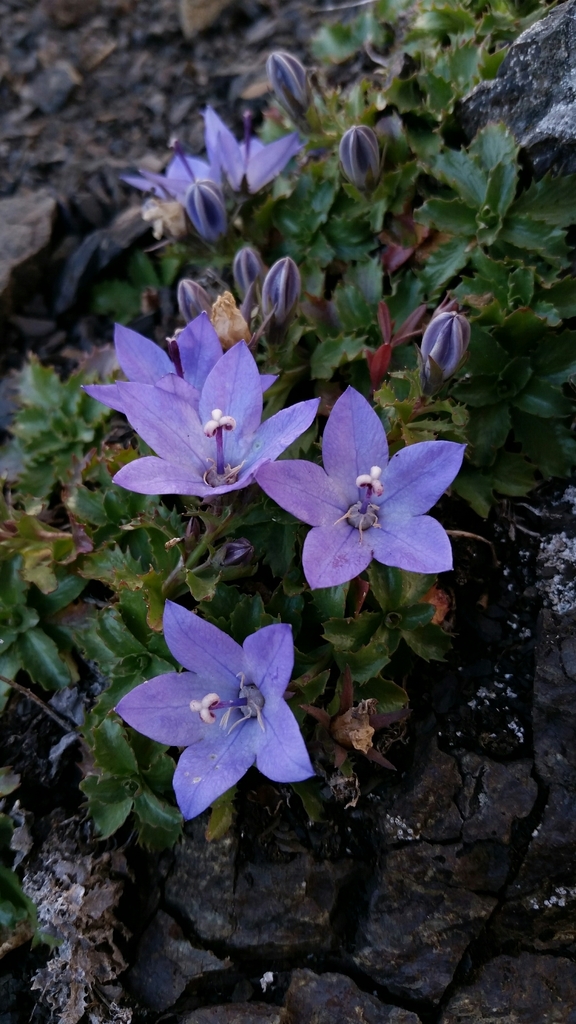
Olympic Bellflower
Campanula piperi
Campanula piperi (Olympic bellflower, Olympic harebell, Piper's bellflower) is a species of flowering plant in the bellflower family, Campanulaceae. It is native to the Olympic Mountains on the Olympic Peninsula in the U.S. state of Washington. It has also been noted on Vancouver Island, British Columbia.
From the article Campanula piperi on Wikipedia (CC BY-SA), quoted section by section
Description
This species is a perennial herb with stems up to 10 centimeters tall. It is hairless or with fine, rough hairs. The basal leaves are sharply toothed, widely lance-shaped blades up to 3 centimeters long. Leaves higher on the stem are similar and are alternately arranged. Flowers occur in July and August at the stem tips. Each has five toothed sepals and a saucer-shaped blue corolla with 5 lobes about 1.2 to 1.6 centimeters long. White flowers are known to occur at times.
Range & habitat
This plant grows in rocky, high-elevation habitat. It faced the potential threat of trampling by mountain goats, an introduced species in the range, but now extirpated.
Wikipedia: “Habitat”
How it is grown
This species is cultivated in alpine plant gardens. A number of cultivars have been bred.
Wikipedia: “Cultivation”
Where it lives
Recorded sightings
—
geo-referenced records in GBIF, from museums, herbaria and field observers.
Drag the globe to turn it. Dots are where records exist, not a range map; darker means more records.
In the stacks
Searching the stacks…
Every page naming Campanula piperi in the Biodiversity Heritage Library →
This page is assembled live from iNaturalist, GBIF, Wikipedia, the Source Library and the Internet Archive. It is not yet part of the hand-edited codex. iNaturalist taxon 159765.