- Plants
- ›Vascular Plants
- ›flowering plants
- ›Dicots
- ›Sunflowers, Bellflowers, Fanflowers, and Allies
- ›bellflower family
- ›bellflower subfamily
- ›Campanulastrum
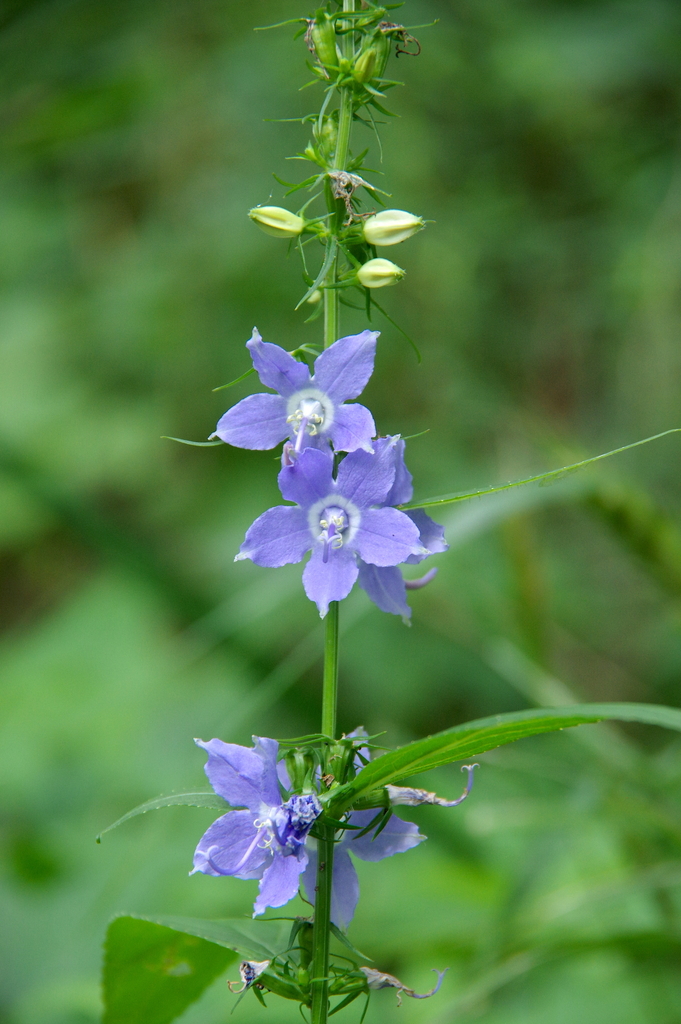
tall bellflower
Campanulastrum americanum
Campanula americana, the American bellflower, or tall bellflower, is an herbaceous wildflower and a member of the Campanulaceae family. Common binomial synonyms are Campanulastrum americana and Campanulastrum americanum. American bellflowers are native to the Eastern United States and Canada, often found growing along stream banks and woods. They bloom in the summer months with light blue to purple flowers. American bellflowers can be annual or biennial plants, depending on the season of germination.
From the article Campanula americana on Wikipedia (CC BY-SA), quoted section by section
Description
A large central flower stem shoots up from a basal rosette, which is a circular arrangement of leaves. Flowers grow off short stems connected to the central stalk, known as a raceme. The plant's overall height ranges from 3 to 6 feet (0.91 to 1.83 m). The central stem is light green, slightly grooved, and hairy. The primary root system is a taproot. It has alternate leaves 3–6 inches (7.6–15.2 cm) in length, that are lance-shaped to ovate-elliptic in shape, with rough/toothed edges. Leaves taper towards the soil and on upper stems. The top side of the leaf is rough.
American bellflower flowers range in color from light blue to violet with a pale white ring at the throat of the flower. The flowers primarily bloom in the summer months of June, July and August. It is an unusual bellflower in that its flowers are flat, rather than its namesake bell shape. Flowers are approximately 1 inch (2.5 cm) across and can occur singly or in clusters. Flowers are radially symmetrical with 4–5 petals, which have ruffled edges and a pointed tip. Its pistils have a recurved style and a three lobed anther and each flower has 5 stamen, 5 petals, and 5 sepals. The ovaries develop into 5 angled flat-topped seed pods.
Wikipedia: “Morphology”
Range & habitat
American bellflowers are native to the Eastern United States, with their habitat clustered latitudinally along the Mississippi. American bellflowers grow from the Great Lakes region in southern Ontario south to Florida and from the Dakotas east to New York. The species is found in the US states of Alabama, Arkansas, Florida, Georgia, Iowa, Illinois, Indiana, Kansas, Kentucky, Louisiana, Maryland, Minnesota, Maine, Missouri, Mississippi, North Carolina, Nebraska, New Jersey, New York, Ohio, Oklahoma, Pennsylvania, South Carolina, South Dakota, Tennessee, Virginia, Wisconsin and West Virginia.
American bellflowers thrive in partial shade and rich loamy soil. They live in circumneutral soil, with a pH ranging from 6.8 to 7.2. American bellflowers grow along woodland edges, in open woods, shaded meadows, stream banks and ditches. Because of their wide range, information on elevation range is not available, but American bellflowers grow within Zones 4–8 of the USDA Hardiness Zone.
Ecology. Long-tongued bees, including Bombus spp. and Megachilidae, are the primary pollinators of American bellflowers. This includes Megachile campanulae, which exclusively pollinates flowers in the genus Campanula. …
Wikipedia: “Distribution and habitat”
What it does
The American bellflower is self-compatible and exhibits sequential hermaphroditism as a protandrous plant. Mating strategies are plastic, meaning they can adapt with changes in the environment, and dependent on pollinator abundance. When there are pollinators present in substantial numbers, the American bellflower reproduces via out-crossing, a reproduction strategy of breeding between different individuals. When there are low numbers of pollinators visiting, the plants are able to self-pollinate. Pollen ranges in color from dark purple to light tan. The fruiting bodies are capsules, displayed from August to March, and contain many seeds. The seeds are oblong, with a pebbled surface, and a winged margin. Seeds are typically 1.3–1.6 mm long and 1.5–1.7 mm wide. The seeds of the American bellflower are not usually specifically predated upon. American bellflower seeds are light and small, suitable for their main form of dispersal by water. It has been put forth that ants may be another mode of seed dispersal. The amount of light and nutrients the maternal plant receives influences their offspring's germination timing. This germination timing from the maternal tissue in turn informs the life history strategy of the American bellflower, as it controls if the offspring will be an annual or biennial plant. …
Wikipedia: “Reproduction and Life History”
At the table
American bellflowers are popular for decorative landscaping purposes, and thrive in mass groupings. American bellflowers grow within Zones 4–8 of the USDA Hardiness Zone. Native American groups have used different parts of the American Bellflower for respiratory cures. Specifically, the Haudenosaunee group treated whooping cough with a root infusion. The Meskwaki treated coughing and tuberculosis with the leaves.
== References ==
Wikipedia: “Cultivation and uses”
Where it lives
Recorded sightings
—
geo-referenced records in GBIF, from museums, herbaria and field observers.
Drag the globe to turn it. Dots are where records exist, not a range map; darker means more records.
In the stacks
Searching the stacks…
Every page naming Campanulastrum americanum in the Biodiversity Heritage Library →
This page is assembled live from iNaturalist, GBIF, Wikipedia, the Source Library and the Internet Archive. It is not yet part of the hand-edited codex. iNaturalist taxon 159769.