- Plants
- ›Vascular Plants
- ›flowering plants
- ›monocots
- ›grasses, sedges, cattails, and allies
- ›Sedges
- ›Cyperoideae
- ›Cariceae
- ›Carex
- ›Vignea
- ›Macrocephalae
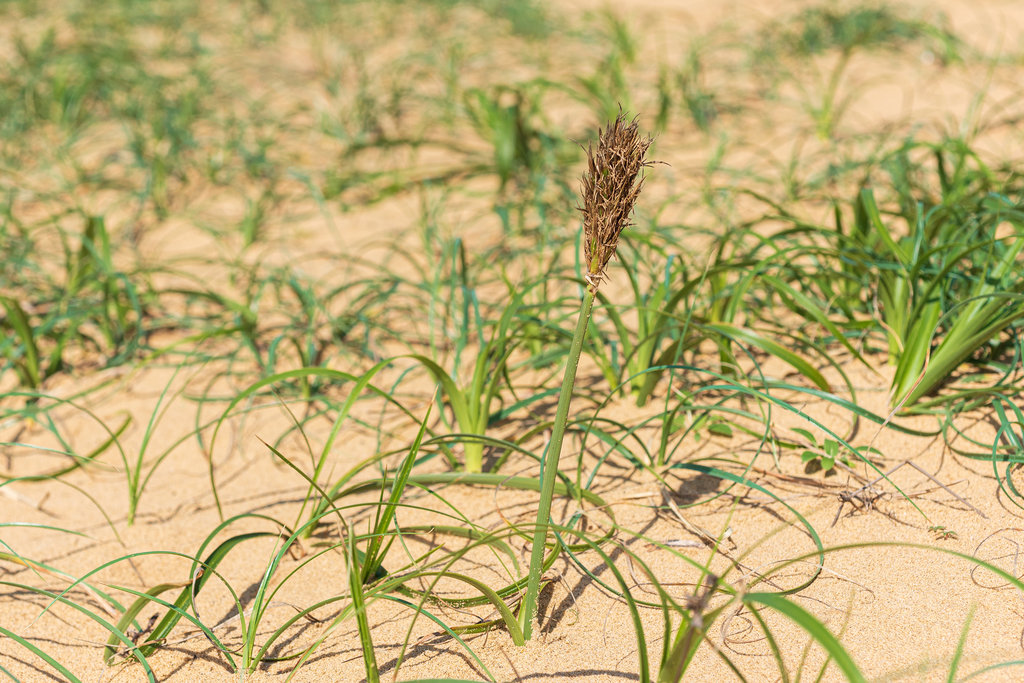
Japanese sedge
Carex kobomugi
Carex kobomugi is a species of sedge, known as the Japanese sedge or Asiatic sand sedge, that lives in sandy coastal areas of eastern Asia, and has become an invasive species in the north-eastern United States.
From the article Carex kobomugi on Wikipedia (CC BY-SA), quoted section by section
Description
Carex kobomugi is a low-growing sedge that extends along the ground with thick rhizomes. It produces flowering stems up to 30 centimetres (12 in) tall and 3–4 millimetres (0.12–0.16 in) in diameter, with male and female flowers generally produced on different plants (dioecious). The leaves are 3–8 mm (0.12–0.31 in) wide, and longer than the stems, and the lowest bracts are similar to the leaves. Male inflorescences are 40–50 mm (1.6–2.0 in) long and around 12 mm (0.47 in) wide, whereas the female inflorescences are slightly larger, 40–60 mm (1.6–2.4 in) long and around 30 mm (1.2 in) wide.
Range & habitat
Carex kobomugi inhabits sand dunes and other sandy sites along the coast. Its natural distribution extends along the coast of mainland Asia from China's Heilongjiang province, around the Korean Peninsula, and around the Yellow Sea as far south as Zhejiang province. It also occurs around the four main Japanese islands, and Taiwan, which is the southernmost distribution of the sedge.
Wikipedia: “Distribution and ecology”
Where it lives
Recorded sightings
—
geo-referenced records in GBIF, from museums, herbaria and field observers.
Drag the globe to turn it. Dots are where records exist, not a range map; darker means more records.
In the stacks
Searching the stacks…
Every page naming Carex kobomugi in the Biodiversity Heritage Library →
This page is assembled live from iNaturalist, GBIF, Wikipedia, the Source Library and the Internet Archive. It is not yet part of the hand-edited codex. iNaturalist taxon 159989.