- Plants
- ›Vascular Plants
- ›flowering plants
- ›monocots
- ›grasses, sedges, cattails, and allies
- ›Sedges
- ›Cyperoideae
- ›Cariceae
- ›Carex
- ›Vignea
- ›Carex elongata
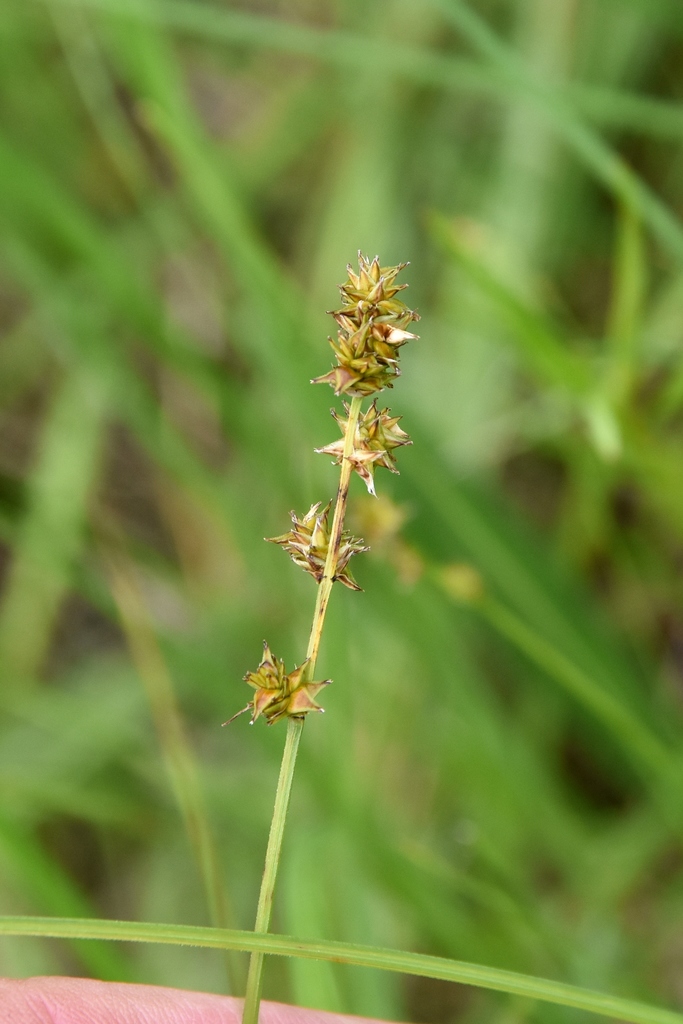
dioecious sedge
Carex sterilis
Carex sterilis, common names dioecious sedge, sterile sedge and Atlantic sedge, is a perennial plant native to North America.
From the article Carex sterilis on Wikipedia (CC BY-SA), quoted section by section
Description
Carex sterilis is a perennial, rhizomatous, tuft-forming plant growing up to 30 inches in height. Leaves are alternate, flat, smooth, up to 10 inches long, with tightly wrapped sheaths. Basal stems have brownish sheaths. The inflorescence takes the form of multiple spikes, with male and female spikes on separate plants. The fruit is an achene, appearing in June to July.
Range & habitat
This species favours wetland habitat, especially calcareous fenlands, marshes, meadows, around laves and rivers.
Conservation status in the United States. Although not believed to be of immediate concern on a global scale, Carex sterilis is listed as a special concern in Connecticut, as threatened in Maine, Massachusetts and Minnesota, as endangered in Pennsylvania, as historical in Rhode Island, and as endangered and possibly extirpated in Tennessee.
== References ==
Wikipedia: “Distribution and habitat”
Where it lives
Recorded sightings
—
geo-referenced records in GBIF, from museums, herbaria and field observers.
Drag the globe to turn it. Dots are where records exist, not a range map; darker means more records.
In the stacks
Searching the stacks…
Every page naming Carex sterilis in the Biodiversity Heritage Library →
This page is assembled live from iNaturalist, GBIF, Wikipedia, the Source Library and the Internet Archive. It is not yet part of the hand-edited codex. iNaturalist taxon 160110.