- Plants
- ›Vascular Plants
- ›flowering plants
- ›Dicots
- ›Mints, Plantains, Olives, and Allies
- ›broomrape family
- ›Pedicularideae
- ›Castilleja
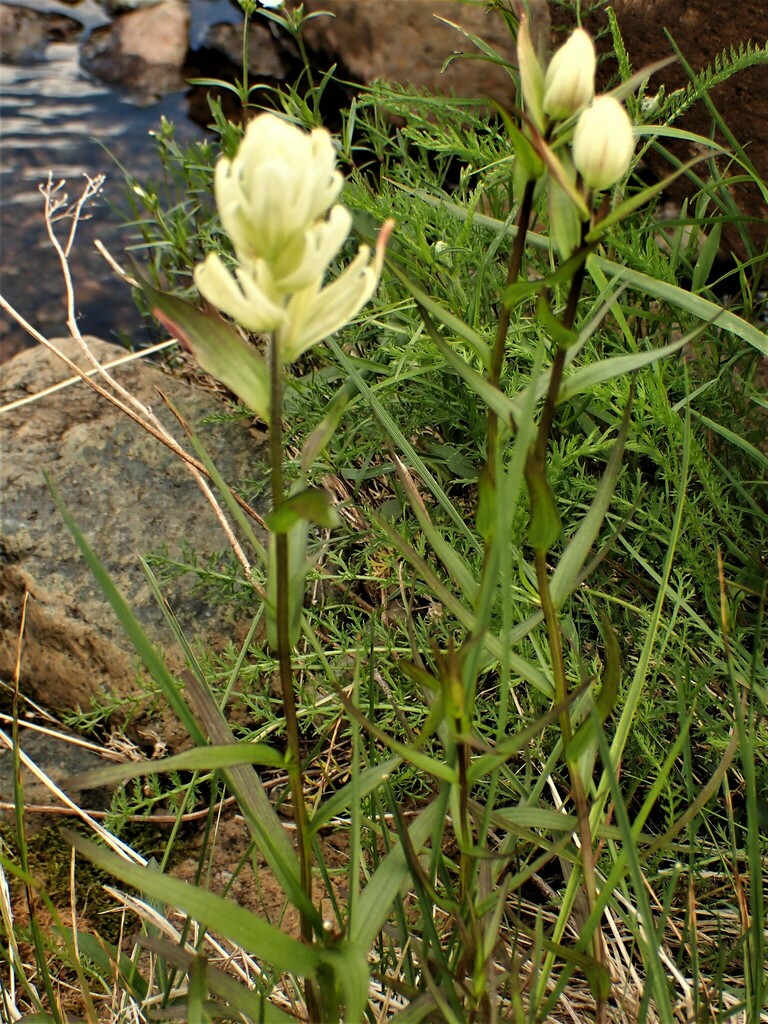
northern paintbrush
Castilleja septentrionalis
Castilleja septentrionalis is a species of Indian paintbrush known by several common names, including northern paintbrush, sulfur paintbrush, and pale painted cup. There is taxonomic disagreement as to if it is one species widely distributed in mountain and alpine environments of North America or if there is a second species, Castilleja sulphurea, in the Rocky Mountains.
According to the White Mountain National Forest botanist Chris Mattrick, "The stunning beauty of the inflorescence stands out in sharp contrast to the green and gray background of the alpine habitats in New England and elicits many complimentary remarks from the passerby."
From the article Castilleja septentrionalis on Wikipedia (CC BY-SA), quoted section by section
Description
Castilleja septentrionalis is a perennial herbaceous plant that usually grows to a height of 25–55 centimeters, though will sometimes be as short as 15 centimeters or as tall as 70 centimeters. It typically is found growing in small dense colonies. Like many other Castilleja species, it gets some of its nutrients from parasitizing the roots of other plants. The underground portions of the plant are a woody caudex atop either a single taproot or branched roots that may be either slender or thick. When mature each plant will produce a clump of stems varying in number that either grow straight upwards or curve outward from the base and then upwards. The stems of Castilleja septentrionalis can be either branch or unbranched and are covered in short stiff glandular hairs, though sometimes the base of the stem will be hairless or nearly hairless(glabrous or glabrate). The leaves of Castilleja septentrionalis are green to purplish in color with a narrow to broad spear-head shape (linear-lanceolate to lanceolate). Usually they are 2–7 centimeters long, though occasionally about 1 centimeters longer. The leaves are sometimes divided into as many as three lobes, each tip of a leaf or lobe will be bluntly pointed, not rounded or very sharp. The leaves are also very thin with very easy to see veins.
Flowering takes place from May to September, occasionally as early as April. …
Range & habitat
Castilleja septentrionalis is a very widespread species being found from the southern Rocky Mountains in New Mexico northwards to the Northwest Territories in Canada and throughout much of eastern Canada and the northern parts of New England. In the US. Rocky Mountain states it grows in Colorado, Idaho, Montana, New Mexico, Utah, and Wyoming with a somewhat disjunct population in the Black Hills of South Dakota. In Canada it is found in the Rocky Mountain provinces of Alberta and British Columbia, in the arctic in the Northwest Territories and Nunavut, and in Labrador, New Brunswick, Newfoundland, Ontario, and Québec. In New England it grows in Maine, New Hampshire, and Vermont while it is only found rarely in Michigan and Minnesota. In New Hampshire, it is an alpine obligate, typically found in patch communities associated with heavy late-melting snow, which provides not only moisture but also protection from weather. It is found only in northern regions or at high elevations. Castilleja septentrionalis was evaluated by NatureServe as a separate species from Castilleja sulphurea with a global status globally secure (G5) in 2015. At the state level they evaluated it as secure (S5) in Ontario, apparently secure (S4) on the Island of Newfoundland, in Labrador, and in Quebec. …
Wikipedia: “Habitat and range”
Where it lives
Recorded sightings
—
geo-referenced records in GBIF, from museums, herbaria and field observers.
Drag the globe to turn it. Dots are where records exist, not a range map; darker means more records.
In the stacks
Searching the stacks…
Every page naming Castilleja septentrionalis in the Biodiversity Heritage Library →
This page is assembled live from iNaturalist, GBIF, Wikipedia, the Source Library and the Internet Archive. It is not yet part of the hand-edited codex. iNaturalist taxon 160222.