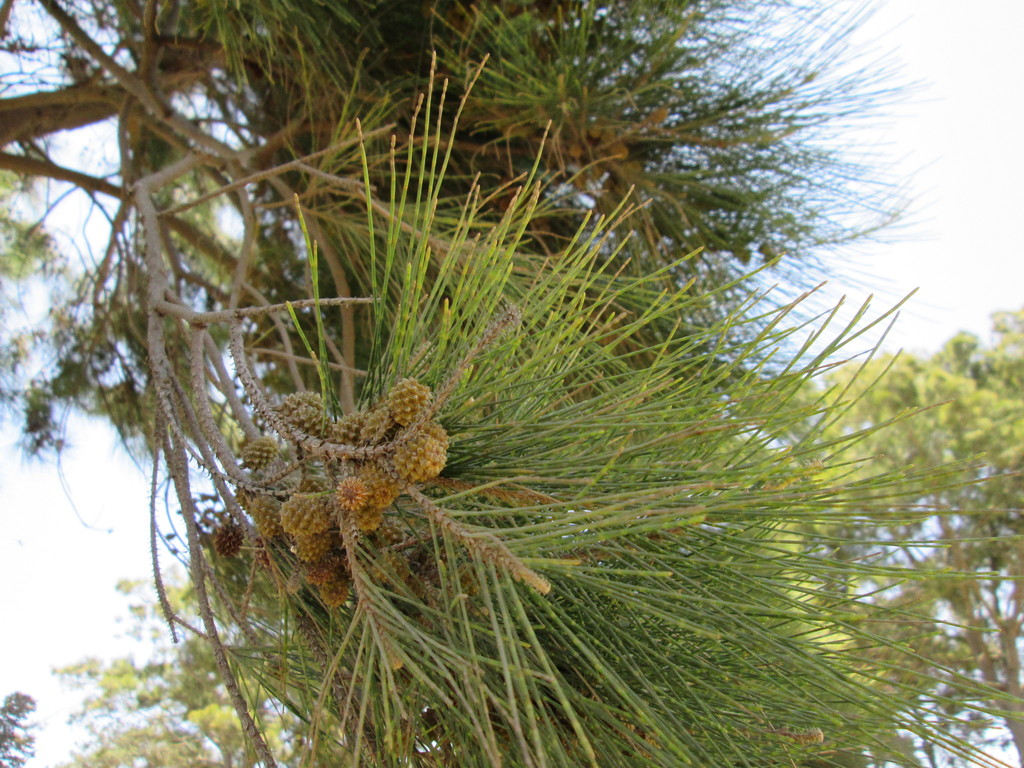
River sheoak
Casuarina cunninghamiana
Casuarina cunninghamiana, commonly known as river oak, river sheoak or creek oak, is a species of flowering plant in the family Casuarinaceae and is native to Australia and New Guinea. It is a tree with fissured and scaly bark, sometimes drooping branchlets, the leaves reduced to scales in whorls of 6 to 10, the fruit 7–14 mm (0.28–0.55 in) long containing winged seeds (samaras) 3–4 mm (0.12–0.16 in) long.
From the article Casuarina cunninghamiana on Wikipedia (CC BY-SA), quoted section by section
Description
Casuarina cunninghamiana is a dioecious tree that typically grows to a height of 15–35 m (49–115 ft), has a DBH of 0.5–1.5 m (1 ft 8 in – 4 ft 11 in). Its bark is finely fissured, scaly and greyish brown. The branchlets are often drooping, 100–250 mm (3.9–9.8 in) long, the leaves reduced to scale-like teeth 0.3–0.5 mm (0.01–0.02 in) long, arranged in whorls of 6 to 10 around the branchlets. The sections of branchlet between the leaf whorls (the "articles") are 4–9 mm (0.2–0.4 in) long and 0.4–0.7 mm (0.02–0.03 in) wide. The flowers on male trees are arranged in spikes 4–40 mm (0.2–1.6 in) long, the anthers 0.4–0.7 mm (0.02–0.03 in) long. The female cones are on a peduncle 2–9 mm (0.08–0.4 in) long and sparsely covered with soft hairs. Mature cones are usually 7–14 mm (0.3–0.6 in) long and 4–6 mm (0.16–0.24 in) in diameter, the samaras 3–4 mm (0.12–0.16 in) long.
Range & habitat
This casuarina mainly grows in pure stands in open forest on the banks of freshwater rivers and streams in Australia and New Guinea. Subspecies cunninghamiana occurs from Laura, Chillagoe and Augathella in Queensland to Condobolin and Narrandera in New South Wales, and the Australian Capital Territory. Subspecies miodon occurs between the Daly River in the north of the Northern Territory to the Gulf of Carpentaria in Queensland.
Wikipedia: “Distribution and habitat”
At the table
River oak is widely recognised as an important tree for stabilising riverbanks and for soil erosion prevention accepting wet and dry soils. The foliage is quite palatable to stock.
Wikipedia: “Uses”
Where it lives
Recorded sightings
—
geo-referenced records in GBIF, from museums, herbaria and field observers.
Drag the globe to turn it. Dots are where records exist, not a range map; darker means more records.
In the stacks
Searching the stacks…
Every page naming Casuarina cunninghamiana in the Biodiversity Heritage Library →
This page is assembled live from iNaturalist, GBIF, Wikipedia, the Source Library and the Internet Archive. It is not yet part of the hand-edited codex. iNaturalist taxon 160233.