- Plants
- ›Vascular Plants
- ›flowering plants
- ›Dicots
- ›Gentians, Dogbanes, Madders, and Allies
- ›madder family
- ›Cinchonoideae
- ›Cinchoneae
- ›Cinchona
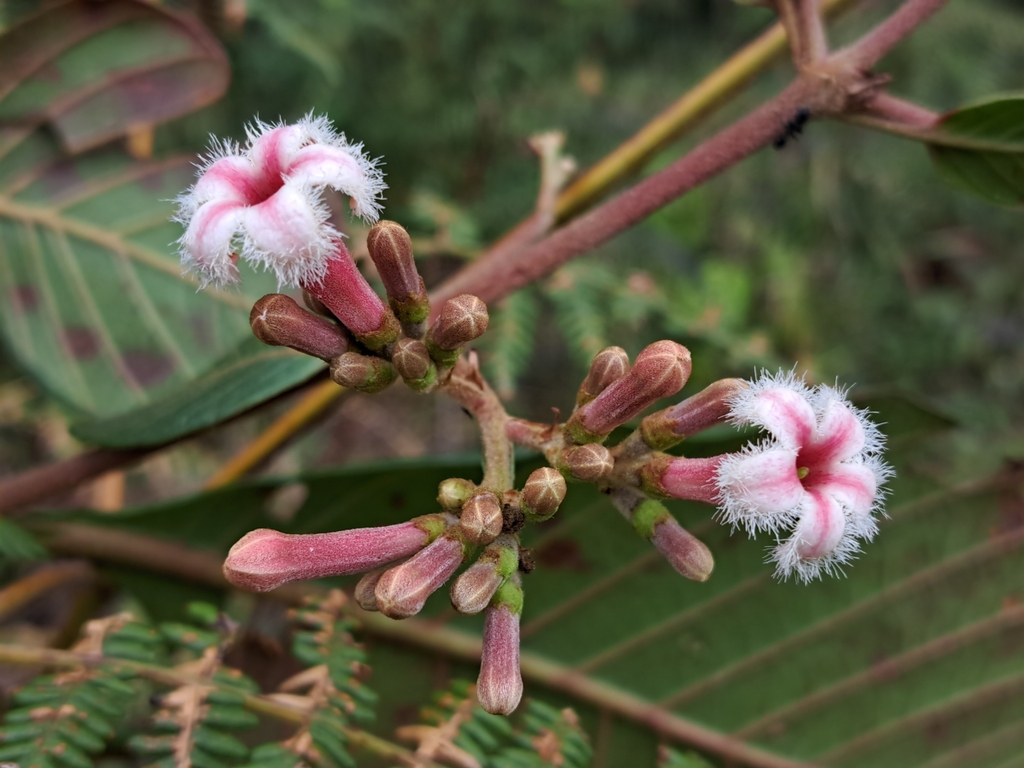
red cinchona
Cinchona pubescens
Cinchona pubescens, also known as red cinchona and quina (Quechua) ((in Spanish) Cascarilla, cinchona; (in Portuguese) quina-do-amazonas, quineira), is native to Central and South America. It is known as a medicinal plant for its bark's high quinine content- and has similar uses to Cinchona officinalis in the production of quinine, most famously used for treatment of malaria.
From the article Cinchona pubescens on Wikipedia (CC BY-SA), quoted section by section
Description
C. pubescens varies from small to large in size, growing to 10 metres (33 ft) in height. When cut, the bark tends to turn red. Leaves are elliptical to oblate and thin. The leaves have pubescent teeth that turn red when they are older, hence its nickname the red quinine tree. Its flowers form in large panicles. They are pink and fragrant, while in the Galapagos they are light pink.
Synonyms. Taxonomic synonyms include:
Cinchona caloptera Miq. Cinchona chomeliana Wedd. Cinchona coronulata Miq. Cinchona decurrentifolia Pav. Cinchona elliptica Wedd. Cinchona goudotiana Klotzsch ex Triana Cinchona govana Miq. Cinchona howardiana Kuntze Cinchona lechleriana Schltdl. Cinchona lutea Pav. Cinchona morado Ruiz Cinchona ovata Ruiz & Pav. Cinchona palescens Vell. Cinchona pelalba Pav. ex DC. Cinchona pelletieriana Wedd. Cinchona platyphylla Wedd. Cinchona pubescens var. cordata DC. Cinchona pubescens var. ovata (Ruiz & Pav.) DC. Cinchona purpurascens Wedd. Cinchona purpurea Vell. Cinchona purpurea Ruiz & Pav. Cinchona rosulenta Howard ex Wedd. Cinchona rotundifolia Pav. ex Lamb. Cinchona rubicunda Tafalla ex Wedd. Cinchona rufinervis Wedd. Cinchona rugosa Pav. ex DC. Cinchona subsessilis Miq. Cinchona succirubra Pav. ex Klotzsch Cinchona tucujensis H.Karst. Quinquina obovata (Pav. …
What it does
C. pubescens has the widest distribution of all Cinchona species, with the native range spanning Costa Rica, Panama, Venezuela, Colombia, Ecuador, Peru, and Bolivia. In Ecuador it is distributed within an altitude from 300–3,900 metres (980–12,800 ft). It also grows well in volcanic soil with high nutrient levels. C. pubescens is a resilient species that is able to recover from even extreme damage. If the tree is felled but the stump is left, it can grow back new stalks. If the bark is removed and the xylem is exposed to the elements, the tree will grow the bark back. The tree can even grow back if roots that are left in the ground are larger than 2 cm in diameter. It reproduces rapidly and spreads its seeds via wind. It reaches maturity and begins seeding in 4 years. Growing at a rate of 1–2 m per year, it quickly reaches a tall height where it can shade out the rest of the native plants. Adult trees grow much slower than juveniles.
Wikipedia: “Ecology”
Where it lives
Recorded sightings
—
geo-referenced records in GBIF, from museums, herbaria and field observers.
Drag the globe to turn it. Dots are where records exist, not a range map; darker means more records.
In the stacks
Searching the stacks…
Every page naming Cinchona pubescens in the Biodiversity Heritage Library →
This page is assembled live from iNaturalist, GBIF, Wikipedia, the Source Library and the Internet Archive. It is not yet part of the hand-edited codex. iNaturalist taxon 160578.