- Plants
- ›Vascular Plants
- ›flowering plants
- ›Dicots
- ›Buttercups, Poppies, and Allies
- ›moonseed family
- ›Cissampelos
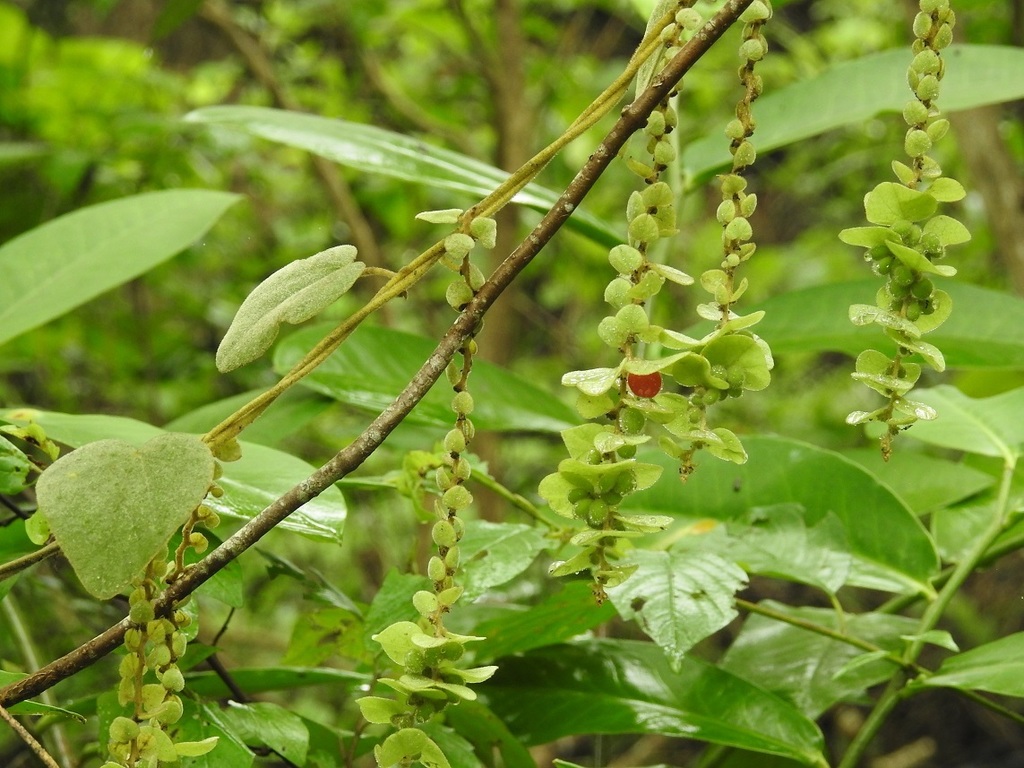
Velvetleaf
Cissampelos pareira
Cissampelos pareira (velvetleaf) is a species of flowering plant in the family Menispermaceae.
From the article Cissampelos pareira on Wikipedia (CC BY-SA), quoted section by section
Description
It is a slender tomentose climber. The leaves are peltate, 2.5–12 cm long, 2.5–11.5 cm broad, triangularly broad-ovate, or orbicular, obtuse, mucronate, base cordate or truncate, ± tomentose on both sides; petiole pubescent. Flowers are small in size, pedicels filiform. Male flowers clustered in the axil of a small leaf; sepals are 4 in number, obovate-oblong, hairy outside; petals 4 in number, united to form a 4-toothed cup, hairy outside; stamens 4, column short, anthers connate, encircling the top of the column. Female flowers clustered in the axils of orbicular, hoary imbricate bracts, on 5–10 cm long racemes; sepal 1, petal 1; carpel 1, densely hairy; style shortly 3-fid. Drupes 4–6 mm long, 3–4 mm broad, subglobose, compressed, hairy-pubescent, red when fresh, black when dry, endocarp transversely ribbed, tuberculate. Seeds are horseshoe-shaped.
Wikipedia: “Morphology”
At the table
Cissampelos pareira is used in Chinese herbology, where it is called xí shēng téng (Chinese: 锡生藤) or yà hū nú (Chinese: 亞乎奴). The species is also known as abuta and called laghu patha in Ayurvedic medicine. In Tamil Nadu it is called ponmusutai and it is used for a number of medicinal purposes. Some attention has been paid to it in Kenya, Tanzania, and other places for its purported antimalarial properties in particular, as well as in India for its antiviral properties, especially against Dengue virus.
Wikipedia: “Medicinal uses”
Where it lives
Recorded sightings
—
geo-referenced records in GBIF, from museums, herbaria and field observers.
Drag the globe to turn it. Dots are where records exist, not a range map; darker means more records.
In the old herbals & bestiaries

In the stacks
Searching the stacks…
Every page naming Cissampelos pareira in the Biodiversity Heritage Library →
This page is assembled live from iNaturalist, GBIF, Wikipedia, the Source Library and the Internet Archive. It is not yet part of the hand-edited codex. iNaturalist taxon 160643.