- Plants
- ›Vascular Plants
- ›flowering plants
- ›Dicots
- ›Buttercups, Poppies, and Allies
- ›buttercup family
- ›Anemones, buttercups, larkspurs and allies
- ›anemones and allies
- ›Clematis
- ›Viticella
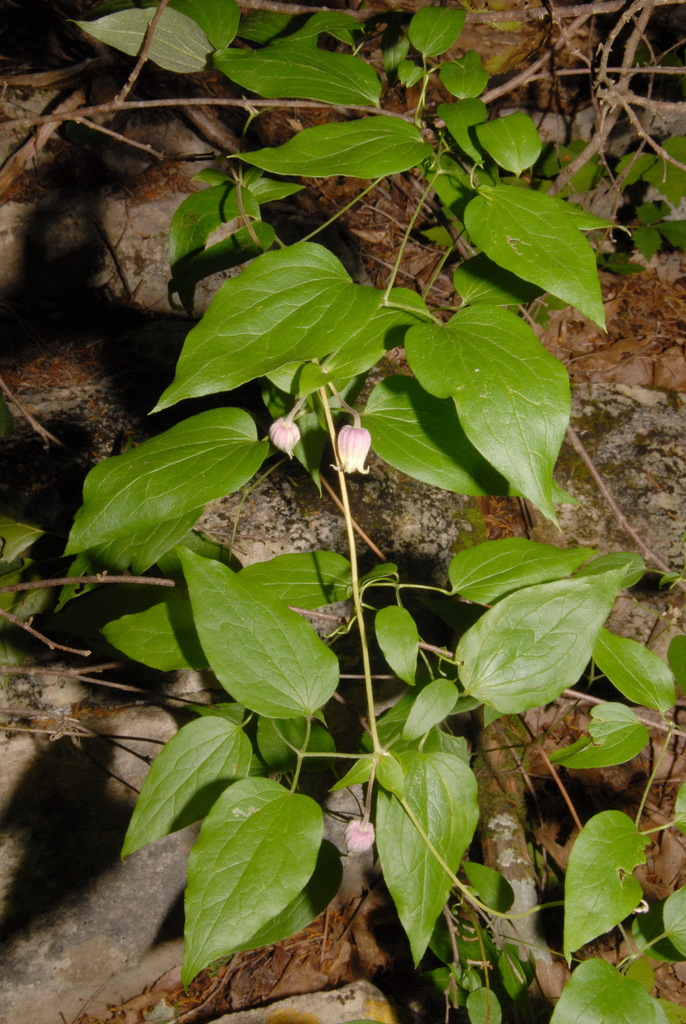
Morefield's Leather Flower
Clematis morefieldii
Clematis morefieldii is a rare species of flowering plant in the buttercup family known by the common names Morefield's leather flower and Huntsville vasevine.
It is endemic to northern Alabama and southern Tennessee, where it is known from about 22 populations currently, most of which are small. Many of the populations are threatened, and some have been recently extirpated. It is a federally listed endangered species, listed in 1992.
From the article Clematis morefieldii on Wikipedia (CC BY-SA), quoted section by section
Description
Clematis morefieldii produces woolly-haired vine runners up to 5 metres (16 ft) long. The leaves are compound, each made up of several leaflets and one or more tendrils for grabbing objects around the plant. The leaflets have velvety undersides. The inflorescences occur in the axils of the leaves. Each has up to five flowers which have green-tinged pink sepals with curling tips arranged in an urn shape. The flower is thick and hairy in texture. There are no petals. The flower is up to 2.5 centimeters in length. The plant yields fruits which may reach 3.5 centimeters long including their plume-like tips.
Range & habitat
This species of Clematis was discovered in 1982, in a vacant lot on Round Top Mountain in Madison County, Alabama, by 21-year-old botany student James Morefield. It was described as a new species in 1987 and named for him. The plant was believed to be an Alabama endemic when it was given endangered status in 1992. Collections were later made in adjacent southern Tennessee. It grows in wooded habitat dominated by smoketree (Cotinus obovatus), often near streams or seeps. It is a climbing plant which attaches to shrubs and rocks for support. The limestone substrate is very rocky with large boulders.
Wikipedia: “Distribution and habitat”
Where it lives
Recorded sightings
—
geo-referenced records in GBIF, from museums, herbaria and field observers.
Drag the globe to turn it. Dots are where records exist, not a range map; darker means more records.
In the stacks
Searching the stacks…
Every page naming Clematis morefieldii in the Biodiversity Heritage Library →
This page is assembled live from iNaturalist, GBIF, Wikipedia, the Source Library and the Internet Archive. It is not yet part of the hand-edited codex. iNaturalist taxon 160690.