- Plants
- ›Vascular Plants
- ›flowering plants
- ›Dicots
- ›Mustards, Capers, and Allies
- ›Spider Flower Family
- ›Cleome
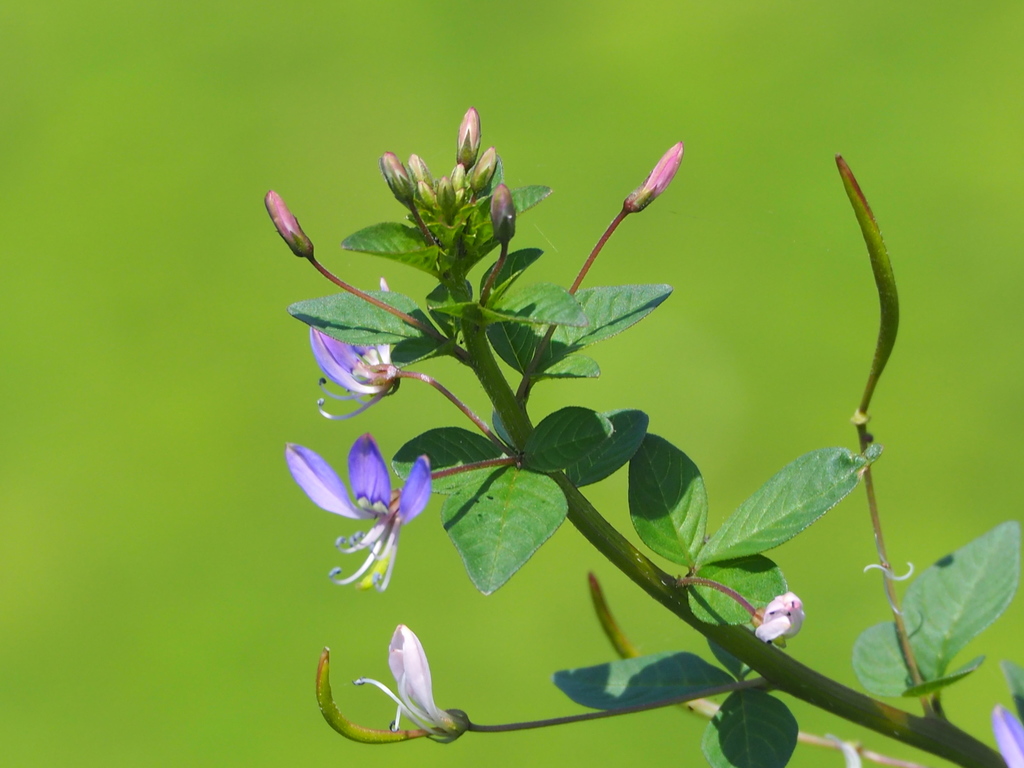
Purple Cleome
Cleome rutidosperma
Cleome rutidosperma, commonly known as fringed spider flower or purple cleome, is a species of flowering plant in the genus Cleome of the family Cleomaceae, native to tropical Africa. This species is an invasive weed throughout most lowland wet tropical areas of Asia and Australia. It is a very common weed of lawns.
From the article Cleome rutidosperma on Wikipedia (CC BY-SA), quoted section by section
Description
Cleome rutidosperma is a small herbaceous plant usually growing up to 50 to 70 cm (20 to 28 in) but can reach up to 1 m (3.3 ft) in height. The leaves are trifoliate. Cleome rutidosperma grows rapidly and can produce numerous viable seeds quickly. Their seeds are produced inside pods that split open when dry. They are black in color and vary in size from 7 to 16 millimetres (0.28 to 0.63 in) in length. They also contain elaiosomes, fleshy structures rich in protein and lipids. The seeds are collected and stored underground by ants. The elaiosomes are eaten, but the seed remains untouched and will eventually sprout from underground. This hastens the spread of the plants.
Range & habitat
Cleome rutidosperma is native to West Africa, where its habitat is usually along coastal regions but can extend to inland areas. It has been introduced to other parts of the world and is now found in tropical and subtropical regions of Africa, Asia, America, the Pacific, and Oceania. Cleome rutidosperma are usually found growing in recently disturbed soils, including gardens, roadsides, and fields. They can also grow as epiphytes on rock faces and trees.
Wikipedia: “Distribution and habitat”
Where it lives
Recorded sightings
—
geo-referenced records in GBIF, from museums, herbaria and field observers.
Drag the globe to turn it. Dots are where records exist, not a range map; darker means more records.
In the stacks
Searching the stacks…
Every page naming Cleome rutidosperma in the Biodiversity Heritage Library →
This page is assembled live from iNaturalist, GBIF, Wikipedia, the Source Library and the Internet Archive. It is not yet part of the hand-edited codex. iNaturalist taxon 160705.