- Plants
- ›Vascular Plants
- ›flowering plants
- ›monocots
- ›Spiderworts and Allies
- ›Spiderworts
- ›Commelinoideae
- ›Commelineae
- ›Dayflowers and relatives
- ›Commelina
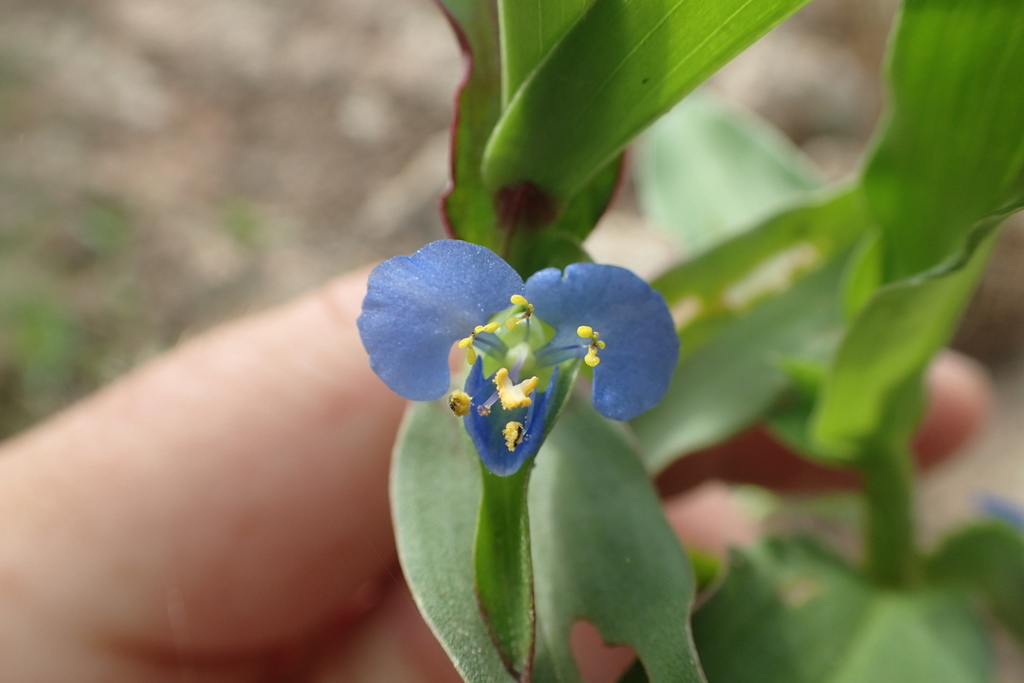
Indian dayflower
Commelina caroliniana
Commelina caroliniana, sometimes known as the Carolina dayflower, is an herbaceous plant in the dayflower family native to India and Bangladesh. Both the scientific name and the common name are misleading as the plant was described based on specimens found in the southeastern United States before it was known that the plant had in fact been introduced from India. It was most likely introduced to South Carolina in the late 17th century along with rice seed from India. The plant has also been recently reported from South Korea. Its flowers emerge from summer to fall and rarely into the winter.
From the article Commelina caroliniana on Wikipedia (CC BY-SA), quoted section by section
Description
Commelina caroliniana is an annual herb with a diffusely spreading growth habit. It will readily root at the nodes when they come into contact with the soil. The stems are decumbent (i.e. lying on the ground with rising tips) to scandent (i.e. climbing). The glabrous (i.e. hairless) leaves have blades that are lanceolate to lanceolate-elliptic or lanceolate-oblong in shape, measuring 2.5 to 10.5 cm in length by 0.7 to 2.4 cm in width. The leaf margins are scabrous (i.e. with rough projections), while the apex is acute to acuminate in outline. The inflorescences are important for making a proper identification, and especially for distinguishing it from Commelina diffusa. The upper cyme, also called a cincinnus, is typically vestigial and included inside the spathe, though it is can be rarely 1-flowered and exserted. The spathes are solitary and bright green in colour, though becoming paler towards the base. Unlike Commelina communis, it lacks veins with contrasting colour. They are pedunculate (i.e. supported on a stalk), with the peduncles measuring 0.6 to 2.3 cm. They are generally not falcate (i.e. sickle-shaped), though they may be slightly so (cf. Commelina diffusa). They measure 1.2 to 3 cm in length, and rarely up to 3.7 cm long, by 0.5 to 1 cm in width. Their margins are not fused and are usually ciliate (i.e. …
Range & habitat
Commelina caroliniana is native to India and Bangladesh. It was introduced to South Carolina via the port of Charleston in or around 1696 when rice was first brought to the colonies from India, whence it spread across much of the southeastern United States. Today it can be found from North Carolina south along the coastal plain to Florida and west along the Gulf Coast to eastern Texas, with a few outlying populations in Maryland, Arkansas and Missouri. It has also been reported from the Philippines and Guam, where it was also most likely introduced. C. caroliniana has been reported to exist in Jongdal-ri, Jeju Island in South Korea. It is considered an invasive species there, due to its strong fertility by which it can outcompete native grasses and destabilise the grassland ecosystem. It is most commonly found in fields, yards, waste places, along roadsides or railroad rights-of-way, or rarely in forests. It is also a weed in crops, especially those involving heavy irrigation such as rice, sugar cane and corn.
Wikipedia: “Distribution and habitat”
Where it lives
Recorded sightings
—
geo-referenced records in GBIF, from museums, herbaria and field observers.
Drag the globe to turn it. Dots are where records exist, not a range map; darker means more records.
In the stacks
Searching the stacks…
Every page naming Commelina caroliniana in the Biodiversity Heritage Library →
This page is assembled live from iNaturalist, GBIF, Wikipedia, the Source Library and the Internet Archive. It is not yet part of the hand-edited codex. iNaturalist taxon 160816.