- Plants
- ›Vascular Plants
- ›flowering plants
- ›monocots
- ›grasses, sedges, cattails, and allies
- ›grasses
- ›Pooideae
- ›Poeae
- ›Airinae
- ›Corynephorus
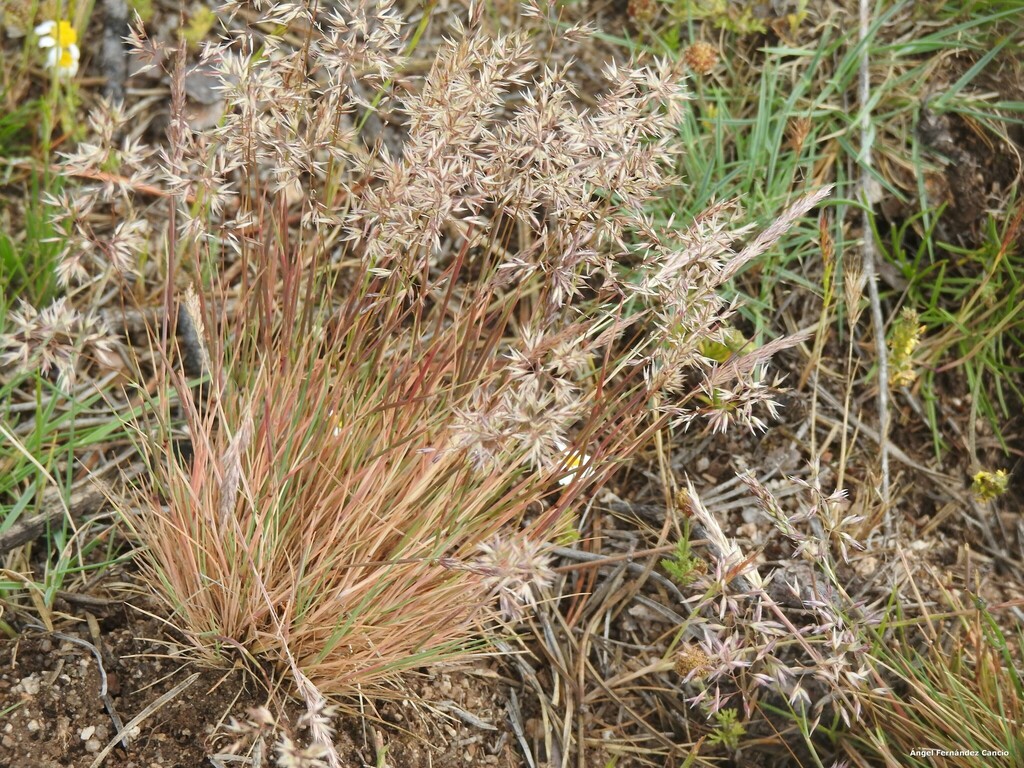
Gray Hairgrass
Corynephorus canescens
Corynephorus canescens, common name grey hair-grass or gray clubawn grass, is a species of plants in the grass family, native to Europe, the Middle East, and North Africa but widely naturalized in North America. In the United Kingdom it is rare. It can be found at sites such as Wangford Warren and Carr, a Site of Special Scientific Interest in the Breckland area of Suffolk.
From the article Corynephorus canescens on Wikipedia (CC BY-SA), quoted section by section
Description
It has panicles which are 1.5–8 centimetres (0.59–3.15 in) long and 0.5–1.5 centimetres (0.20–0.59 in) wide. Its pedicels are 1–3 millimetres (0.039–0.118 in) in length while the leaf blades are 2–6 centimetres (0.79–2.36 in) long and 0.3–0.5 millimetres (0.012–0.020 in) wide. Both the upper and lower glumes are shiny, lanceolate, and membranous. The lemma have a dorsal awn and dentate apex with obscure lateral veins. Its fertile lemma is ovate, keelless, membranous and is 1.8–2.2 millimetres (0.071–0.087 in) long. The floret callus is hairy with rhachilla internodes being pilose. The flowers have three stamens which are 1.2–1.6 millimetres (0.047–0.063 in) long.
== References ==
Where it lives
Recorded sightings
—
geo-referenced records in GBIF, from museums, herbaria and field observers.
Drag the globe to turn it. Dots are where records exist, not a range map; darker means more records.
In the stacks
Searching the stacks…
Every page naming Corynephorus canescens in the Biodiversity Heritage Library →
This page is assembled live from iNaturalist, GBIF, Wikipedia, the Source Library and the Internet Archive. It is not yet part of the hand-edited codex. iNaturalist taxon 160927.