- Plants
- ›Vascular Plants
- ›flowering plants
- ›Dicots
- ›Heathers, Balsams, Primroses, and Allies
- ›primrose family
- ›primrose subfamily
- ›rock-jasmine tribe
- ›Androsace
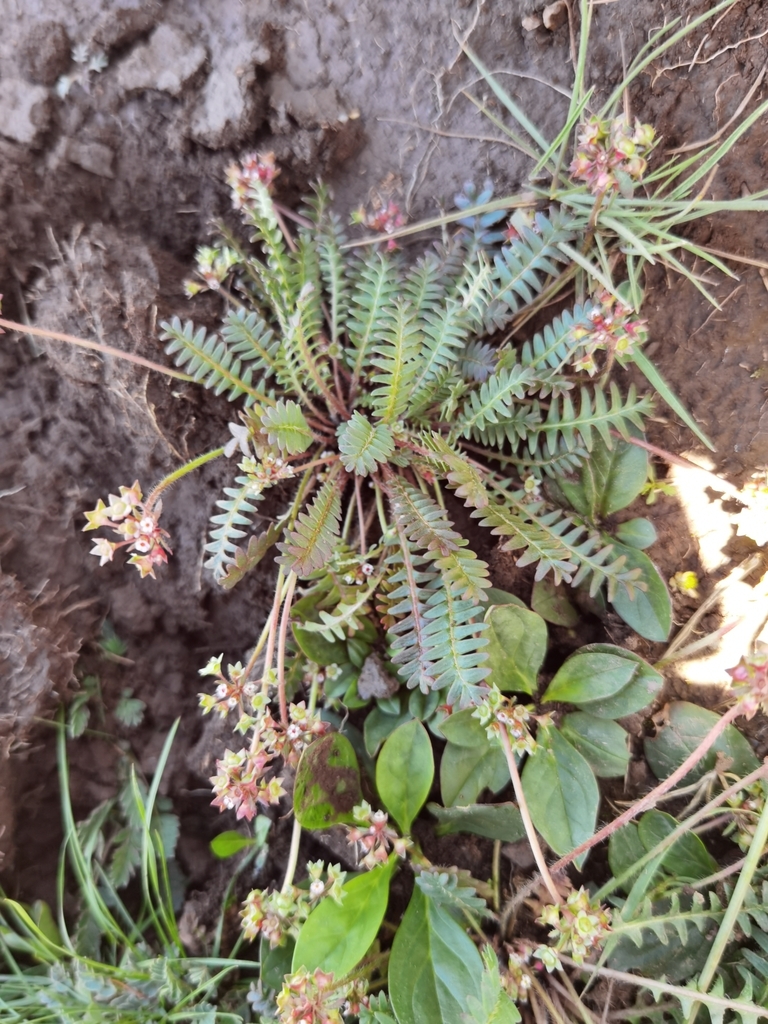
Androsace filicula
Androsace filicula is a species of flowering plant in the family Primulaceae, which was previously placed in its own genus, Pomatosace, endemic to the Qinghai–Tibetan Plateau in China.
From the article Androsace filicula on Wikipedia (CC BY-SA), quoted section by section
Description
Androsace filicula is a biennial plant that grows from rosettes of basal leaves, each 15–90 millimetres (0.6–3.5 in) long and 6–15 mm (0.2–0.6 in) wide and divided into lobes along its length; the leaves may be reminiscent of a fern, providing the species' epithet, filicula (diminutive of Latin filix, "fern"). The flowers are borne in umbels of 3–12 flowers on a stalk 1–16 centimetres (0.4–6.3 in) tall. Each flower is white, with five petals fused into a tube for around 2 mm (0.08 in). Seeds are produced in a capsule, which is approximately 4 mm (0.16 in) wide.
Range & habitat
Androsace filicula is only found in the north-eastern part of the Qinghai–Tibetan Plateau, in the Chinese provinces of Sichuan, Xizang (Tibet) and Qinghai. It grows in a variety of habitats, including alpine meadows and sand flats along rivers, at altitudes of 2,800–4,500 metres (9,200–14,800 ft). It flowers from May to June, and fruits from June to August. It is thought to have evolved to inhabit the open ground in front of the burrows of plateau pikas (Ochotona curzoniae) and other ground-dwelling mammals.
Wikipedia: “Distribution and ecology”
Where it lives
Recorded sightings
—
geo-referenced records in GBIF, from museums, herbaria and field observers.
Drag the globe to turn it. Dots are where records exist, not a range map; darker means more records.
In the stacks
Searching the stacks…
Every page naming Androsace filicula in the Biodiversity Heritage Library →
This page is assembled live from iNaturalist, GBIF, Wikipedia, the Source Library and the Internet Archive. It is not yet part of the hand-edited codex. iNaturalist taxon 1614523.