- Plants
- ›Vascular Plants
- ›flowering plants
- ›monocots
- ›grasses, sedges, cattails, and allies
- ›Sedges
- ›Cyperoideae
- ›Cypereae
- ›Cyperus
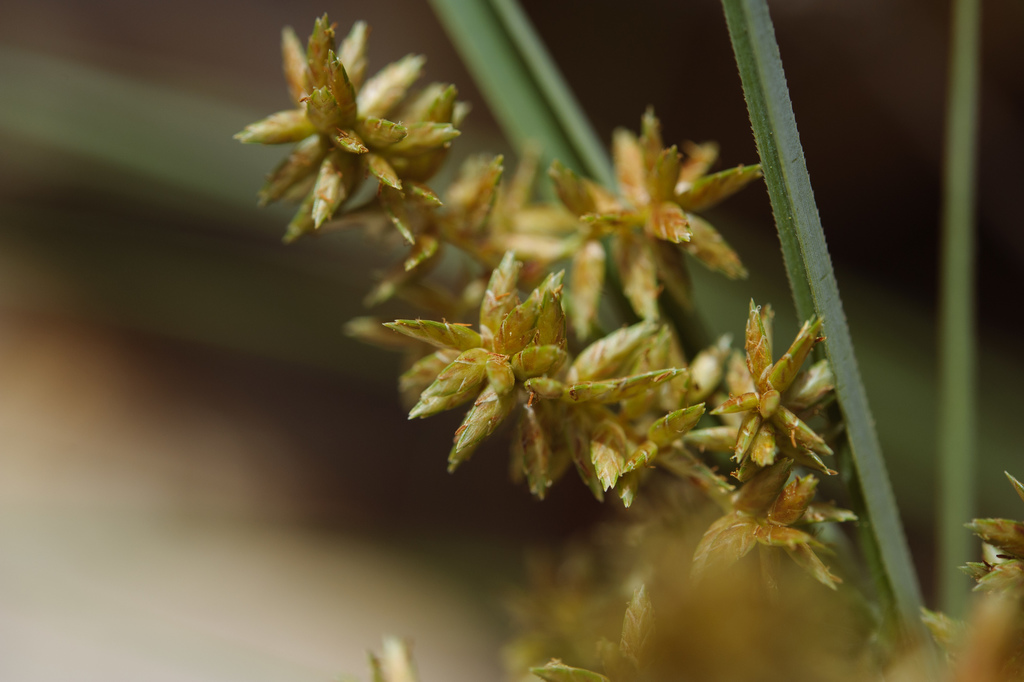
Javanese Flatsedge
Cyperus javanicus
Cyperus javanicus, also known as the Javanese flatsedge, is a sedge of the Cyperaceae family that is native to Indonesia and Australia.
From the article Cyperus javanicus on Wikipedia (CC BY-SA), quoted section by section
Description
The rhizomatous glaucous perennial sedge typically grows to a height of 0.6 to 1.2 metres (2.0 to 3.9 ft) and has a tufted habit. The plant blooms between January and August producing brown flowers. The culms are obtusely trigonous and densely papillose. The leaves are long and flat on top while folded at the base and around 2 to 13 millimetres (0.08 to 0.51 in) in width. The compound inflorescences have between six and twelve primary rays which are up to 8 cm 8 centimetres (3.1 in) in length./>
Range & habitat
In Western Australia it is found beside pools and along streams and rivers in the Kimberley region where it grows in sandy-clay soils. The species is also endemic to the Northern Territory and north east Queensland and the Cape York Peninsula. It is also native to the islands north of Australia including Papua New Guinea, Timor and Indonesia. The species has also been introduced into Hawaii and islands in the Pacific basin.
Wikipedia: “Distribution”
Where it lives
Recorded sightings
—
geo-referenced records in GBIF, from museums, herbaria and field observers.
Drag the globe to turn it. Dots are where records exist, not a range map; darker means more records.
In the stacks
Searching the stacks…
Every page naming Cyperus javanicus in the Biodiversity Heritage Library →
This page is assembled live from iNaturalist, GBIF, Wikipedia, the Source Library and the Internet Archive. It is not yet part of the hand-edited codex. iNaturalist taxon 161453.