- Plants
- ›Vascular Plants
- ›flowering plants
- ›Dicots
- ›pepper plants, birthworts, and allies
- ›birthwort family
- ›Asaroideae
- ›Asarum
- ›Heterotropa
- ›Hexastylis
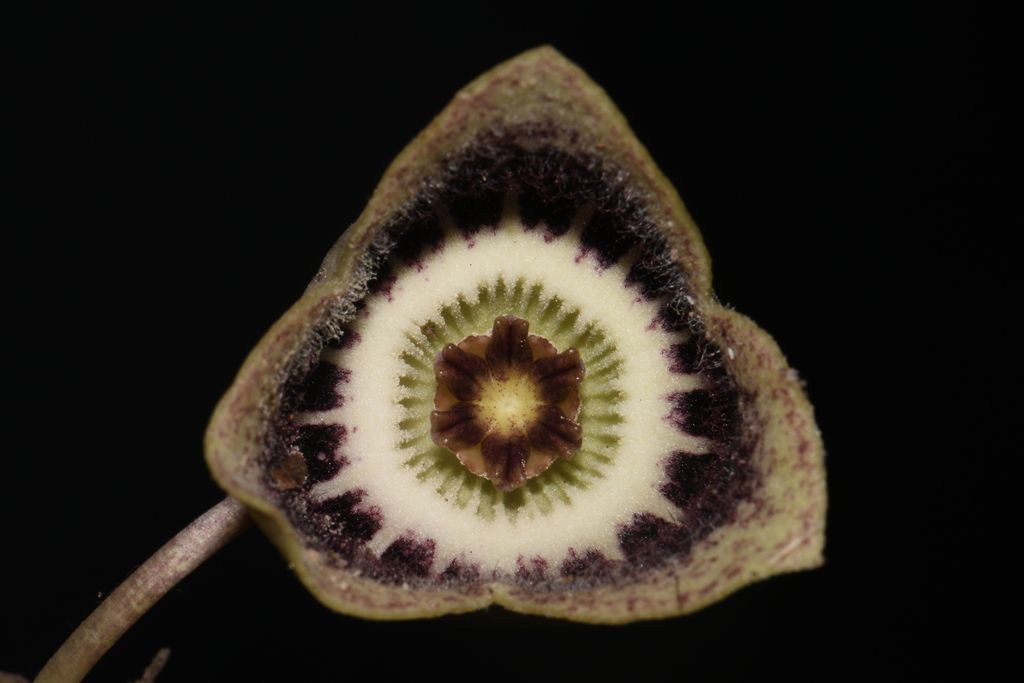
Finzel's Wild Ginger
Asarum finzelii
Asarum finzelii, or Finzel's wild ginger, is a species of flowering plant in the family Aristolochiaceae. It is endemic to Marshall County, Alabama. It was formerly known as Hexastylis finzelii.
From the article Asarum finzelii on Wikipedia (CC BY-SA), quoted section by section
Description
Asarum finzelii is a terrestrial, acaulescent perennial herb arising from a short rhizome. The leaf petioles are up to 23 cm long, and the blades are hastate-sagittate with rounded basal lobes, though sometimes triangular or nearly cordate; the largest leaves are 8–12(15) cm long and 8–10(12) cm wide. The flowers are borne on peduncles 2–5 cm long. The calyx is 25–30 mm long and 16–19 mm wide, rounded at the base, and divided into two parts by an abrupt outward flare. The lower calyx tube is campanulate and 4–7 mm long, while the upper tube is more or less cup-shaped or short-cylindric and 10–11 mm long. The three calyx lobes are erect, broadly triangular, wider than long, and 8–12 mm long by 15–16 mm wide. The flowers are similar to those of A. speciosum and A. arifolium, but differ from A. speciosum in having erect rather than recurved calyx lobes, a distinctly shorter lower calyx tube, and maroon rather than greenish style appendages; they differ from A. arifolium in having an open, cup-shaped calyx rather than an urceolate one. Hexastylis finzelii is visually similar to H. speciosa and H. arifolia, with the shape of the flowers being the only defining feature. The flowers are difficult to see as they bloom beneath the leaf litter, which is thought to explain why the species went undiscovered for so long. It is hypothesized that they are pollinated by beetles.
Range & habitat
Asarum finzelii is known only from two populations on Bishop Mountain in Marshall County, Alabama. The type locality is along the north side of the Tennessee River, west of Hambrick Hollow, northwest of Guntersville. There are thought to only be around 1,000 individuals in the wild. The species occurs in the Plateau Escarpment portion of the southwestern Appalachians, near the boundary of the Pennington Formation and Bangor Limestone, including Bishop Mountain, with occasional Pottsville Sandstone debris. Its habitat is slightly mesic, with rocky, well-drained soil in regenerated forest several decades old. The canopy is composed mostly of hardwoods, including oaks, hickories, sweetgum, and tulip poplar, with occasional cedar and pine. It is found growing out of leaf litter in moist, hardwood forests. Soils are rocky and well-draining. The populations are protected as they exist on federal Tennessee Valley Authority lands.
Wikipedia: “Distribution and habitat”
In human culture
The specific epithet honors Brian Finzel, a photographer who discovered the species in 2019. It was formally described by botanist Brian Keener in 2020. Keener proposed the common name "Finzel's wild ginger".
Wikipedia: “Etymology”
Where it lives
Recorded sightings
—
geo-referenced records in GBIF, from museums, herbaria and field observers.
Drag the globe to turn it. Dots are where records exist, not a range map; darker means more records.
In the stacks
Searching the stacks…
Every page naming Asarum finzelii in the Biodiversity Heritage Library →
This page is assembled live from iNaturalist, GBIF, Wikipedia, the Source Library and the Internet Archive. It is not yet part of the hand-edited codex. iNaturalist taxon 1616285.