- Plants
- ›Vascular Plants
- ›flowering plants
- ›monocots
- ›grasses, sedges, cattails, and allies
- ›grasses
- ›Panicums, Bluestems, Paspalums, and Allies
- ›bristle, rosette, and barnyard grasses, and allies
- ›Dichantheliinae
- ›Dichanthelium
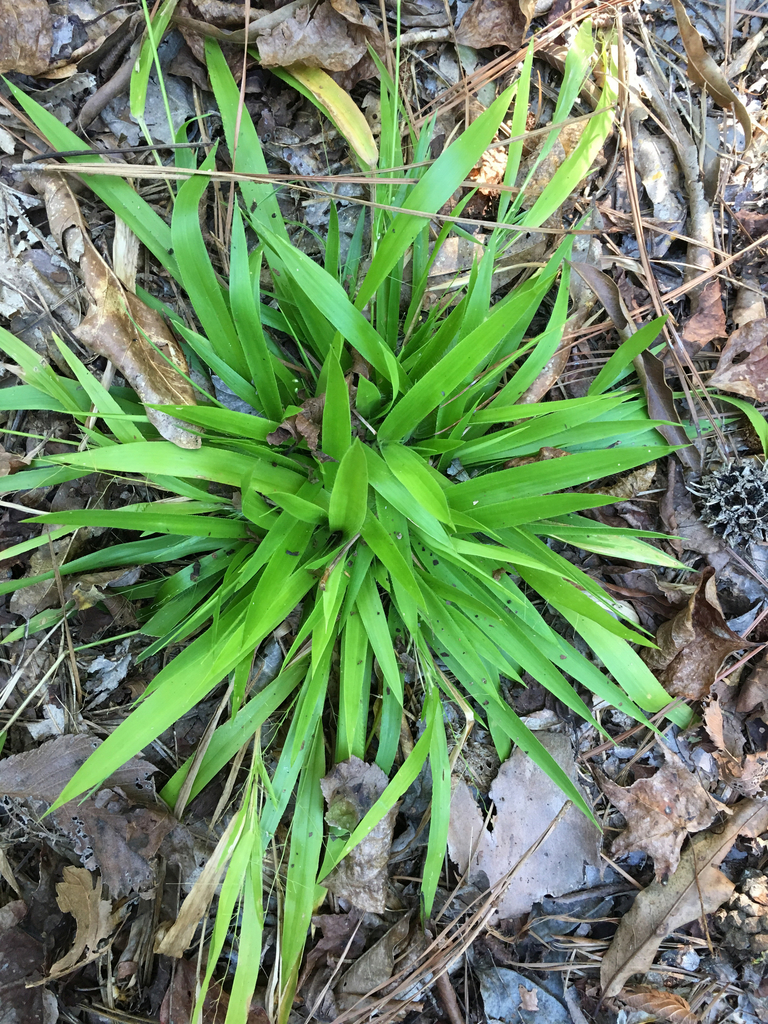
open-flower witchgrass
Dichanthelium laxiflorum
Dichanthelium laxiflorum, commonly known as open-flower witchgrass, is a perennial graminoid in the family Poaceae that is found throughout the Americas.
From the article Dichanthelium laxiflorum on Wikipedia (CC BY-SA), quoted section by section
Description
Dichanthelium laxiflorum is a tufted perennial grass with culms 15–45 cm tall, featuring usually bearded nodes and glabrous to slightly roughened internodes. Leaves are primarily located on the lower stem, with blades up to 16 cm long and 4–15 mm wide, generally glabrous or rough-textured, and sometimes bearing appressed to spreading soft hairs. Ligules are ciliate and measure 0.5–1 mm long. The vernal panicle is 4–9 cm long and 3–6 cm wide, with smooth or nearly smooth pedicels ranging from 1–10 mm in length. Spikelets are ellipsoid, 1.6–2.3 mm long. The first glume is scarious, acute, nerveless or 1-nerved, and 1.6–2.3 mm long. The sterile palea is also scarious and measures 1.2–1.6 mm. Fertile lemmas and paleas are hardened, usually nerveless or faintly nerved, lustrous, yellowish to brownish, and 1.5–2 mm long. Grains are broadly ellipsoid, 1–1.5 mm long, and whitish to yellowish.
Range & habitat
In the United States, D. laxiflorum is found from Maryland south to Florida west to Texas and north to Indiana. It is also found in Mexico, Central America, and the West Indies. It grows in open or shaded woodlands, often in moist soil.
== References ==
Wikipedia: “Distribution and habitat”
Where it lives
Recorded sightings
—
geo-referenced records in GBIF, from museums, herbaria and field observers.
Drag the globe to turn it. Dots are where records exist, not a range map; darker means more records.
In the stacks
Searching the stacks…
Every page naming Dichanthelium laxiflorum in the Biodiversity Heritage Library →
This page is assembled live from iNaturalist, GBIF, Wikipedia, the Source Library and the Internet Archive. It is not yet part of the hand-edited codex. iNaturalist taxon 161791.