- Plants
- ›Vascular Plants
- ›flowering plants
- ›monocots
- ›grasses, sedges, cattails, and allies
- ›grasses
- ›Panicums, Bluestems, Paspalums, and Allies
- ›bristle, rosette, and barnyard grasses, and allies
- ›Dichantheliinae
- ›Dichanthelium
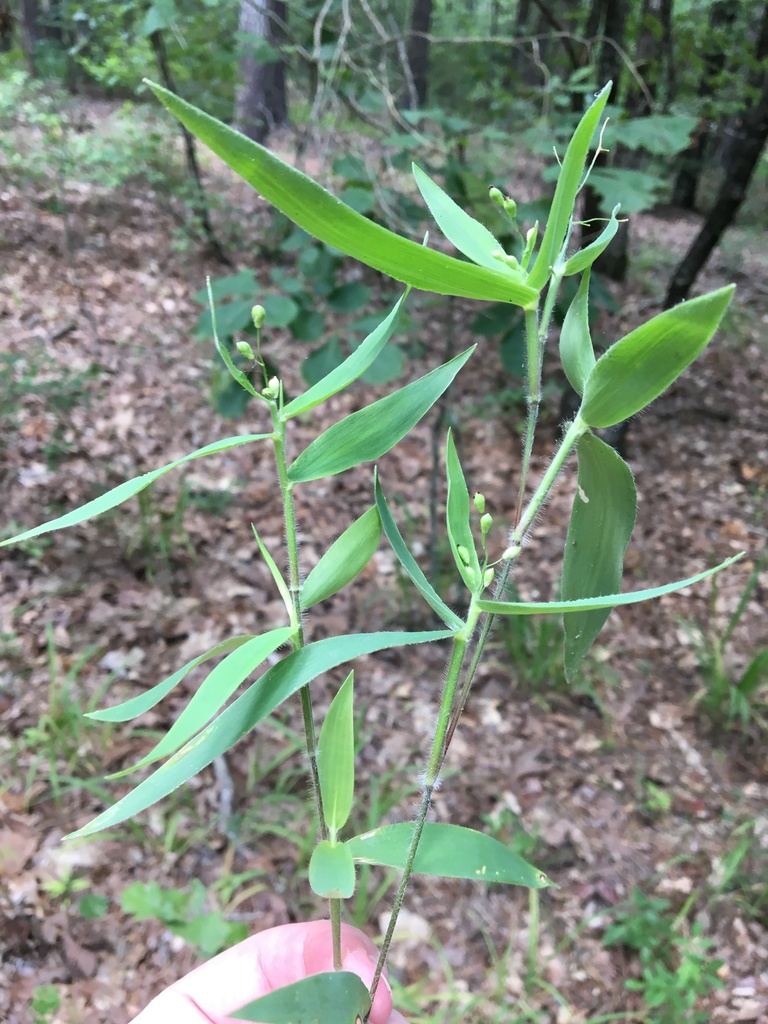
Ravenel's Rosette Grass
Dichanthelium ravenelii
Dichanthelium ravenelii, commonly known as Ravenel's witchgrass, is a perennial graminoid in the family Poaceae native to the United States.
From the article Dichanthelium ravenelii on Wikipedia (CC BY-SA), quoted section by section
Description
Dichanthelium ravenelii is characterized by prominent basal leaf rosettes and occasional branching from nodes above the base. It produces both spring and fall foliage, with stems reaching 25–60 cm in height. The nodes are densely bearded, and the stem internodes are finely hairy or slightly rough. Leaf blades are up to 12 cm long and 2.5–19 mm wide, glabrous above and softly hairy below, with scabrous, ciliate margins and heart-shaped, hairy bases. Sheaths are covered with soft hairs, ligules are densely ciliate and 3–5 mm long, and the collars are also densely pubescent. The inflorescence is a broad panicle (6–7 cm long, 5–6 cm wide) with short-hairy branches and rachis. Spikelets are obovoid to broadly ellipsoid and measure 3.8–4.2 mm long, with hairy glumes and lemmas. The fertile floret is smooth, yellowish to brownish when mature, and either nerveless or faintly nerved. Grains are broadly ellipsoid to nearly round, 1.2–2 mm long, and yellowish or purplish.
Range & habitat
Dichanthelium ravenelii is found from New Jersey south to Florida, west to eastern Texas, and north to Iowa. It grows in dry sandy or rocky thin woods and openings and sometimes in moist soils.
== References ==
Wikipedia: “Distribution and habitat”
Where it lives
Recorded sightings
—
geo-referenced records in GBIF, from museums, herbaria and field observers.
Drag the globe to turn it. Dots are where records exist, not a range map; darker means more records.
In the stacks
Searching the stacks…
Every page naming Dichanthelium ravenelii in the Biodiversity Heritage Library →
This page is assembled live from iNaturalist, GBIF, Wikipedia, the Source Library and the Internet Archive. It is not yet part of the hand-edited codex. iNaturalist taxon 161801.