On eBird ↗
White-faced Nunbird
Live sightings near you, the range map, bar charts of when it is seen, and Macaulay Library photos and recordings.
White-faced Nunbird
Hapaloptila castanea
The white-faced nunbird (Hapaloptila castanea) is a species of puffbird in the family Bucconidae. Its genus Hapaloptila is monotypic. It is found in Colombia, Ecuador, and Peru. Its natural habitat is subtropical or tropical moist montane forests.
From the article White-faced nunbird on Wikipedia (CC BY-SA), quoted section by section
Description
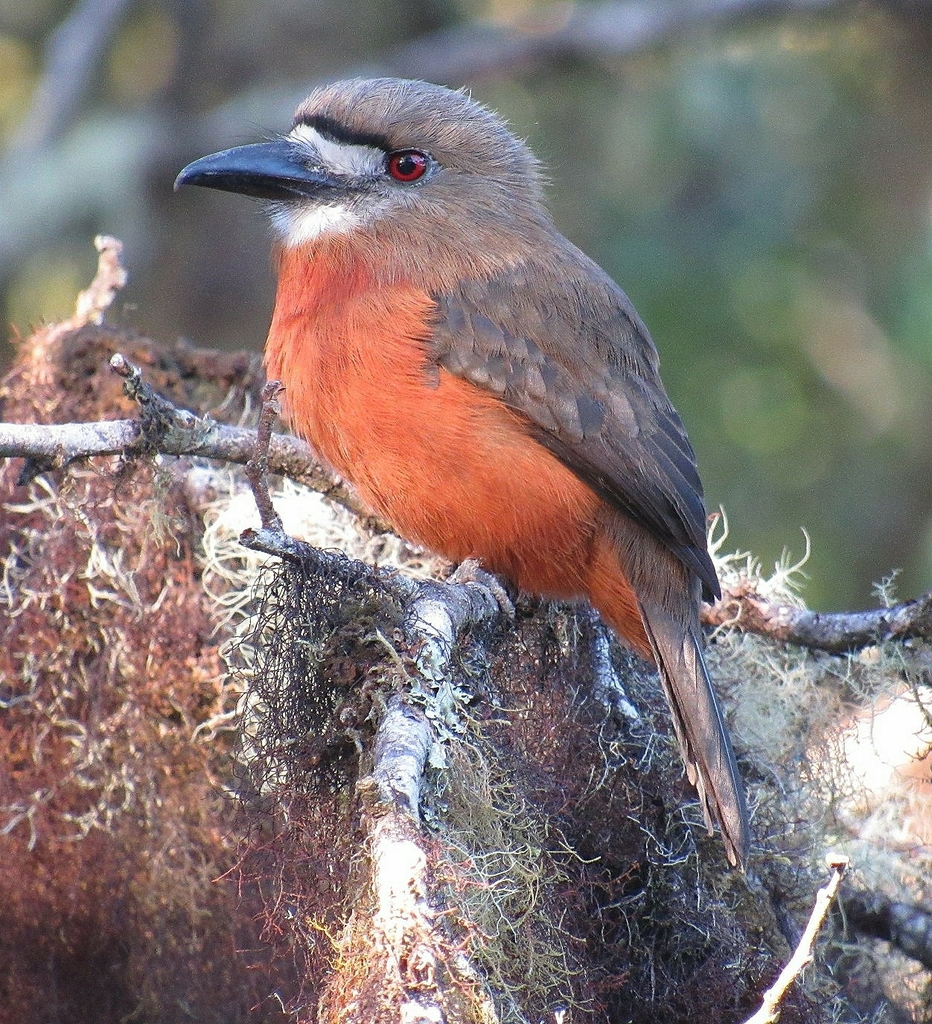
The white-faced nunbird is 23 to 25 cm (9.1 to 9.8 in) long and weighs 75 to 84 g (2.6 to 3.0 oz). It has a large white patch above the bill with a narrow black border at its top. The crown is gray-brown, the mantle and sides of the face dark brown, and the rest of the upperparts including wings and tail an even darker brown. The chin and throat are white and the rest of the underparts bright chestnut. The bill is black, the eye red, and the legs and feet gray. The sexes are essentially the same, with the female perhaps having paler underparts.
Range & habitat
The white-faced nunbird is found on the east slope of the Andes from western Colombia through eastern Ecuador into northwestern and central Peru. It inhabits the interior and edges of humid to wet forest and cloudforest, often on steep slopes and in ravines. It is usually seen from the midstory to the subcanopy. In Colombia and Ecuador it typically ranges from 1,500 to 2,900 m (4,900 to 9,500 ft) of elevation but has been recorded as low as 750 m (2,500 ft). In Peru it is found only between 1,800 to 2,600 m (5,900 to 8,500 ft).
Wikipedia: “Distribution and habitat”
What it does
The white-faced nunbird mostly forages in the canopy though it is active at all levels. Its diet is primarily insects and other arthropods but also includes some small vertebrates. It occasionally joins mixed-species foraging flocks.
Wikipedia: “Feeding”
Listen
Looking for field recordings…
Where it lives
Recorded sightings
—
geo-referenced records in GBIF, from museums, herbaria and field observers.
Drag the globe to turn it. Dots are where records exist, not a range map; darker means more records.
In the stacks
Searching the stacks…
Every page naming Hapaloptila castanea in the Biodiversity Heritage Library →
This page is assembled live from iNaturalist, GBIF, Wikipedia, the Source Library and the Internet Archive. It is not yet part of the hand-edited codex. iNaturalist taxon 1620.