- Plants
- ›Vascular Plants
- ›flowering plants
- ›Dicots
- ›Sunflowers, Bellflowers, Fanflowers, and Allies
- ›Sunflowers, Daisies, Asters, and Allies
- ›Asteroideae
- ›tarweeds, silverswords, and allies
- ›Dubautia
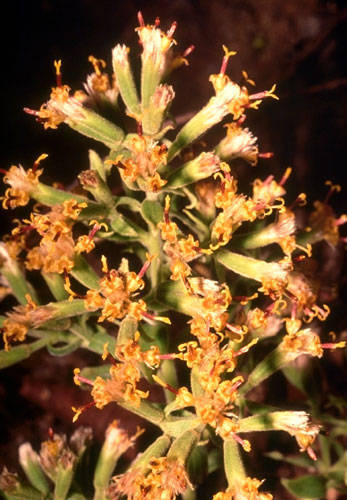
Koholapehu
Dubautia latifolia
Dubautia latifolia is a rare species of flowering plant in the family Asteraceae known by the common name koholapehu. It is endemic to Hawaii where it is known only from the west side of the island of Kauai. Like other Dubautia this plant is called na`ena`e.
From the article Dubautia latifolia on Wikipedia (CC BY-SA), quoted section by section
Description
Dubautia latifolia is a liana which can exceed 8 metres (26 ft) in length. It climbs trees, reaching several meters up into the canopy. Blooming occurs in September through November, when the plant produces panicles of yellow flowers. The fruit is a cypsela, but could be mistaken for an achene. Dubautia latifolia can be distinguished from other species in its genus by its vine growing habits, and having different petioles and net-veins of the leaves.
Range & habitat
Dubautia latifolia, a member of the silversword alliance, grows in scattered locations in the moist and wet forests near Waimea Canyon on Kauai. The habitat receives up to 190 centimeters of precipitation annually. The forest is dominated by koa (Acacia koa), ohia (Metrosideros polymorpha) and uluhe (Dicranopteris linearis). It is found in the Kokee area of northwestern Kauai, which is found in Kokee State Park. It grows at elevations from 3,200 to 3,900 ft (980 to 1,190 m). It was first collected in 1840. There are no more than 200 individuals remaining. There are about 18 occurrences, but most of these are made up of only one or two plants.
Wikipedia: “Distribution”
Where it lives
Recorded sightings
—
geo-referenced records in GBIF, from museums, herbaria and field observers.
Drag the globe to turn it. Dots are where records exist, not a range map; darker means more records.
In the stacks
Searching the stacks…
Every page naming Dubautia latifolia in the Biodiversity Heritage Library →
This page is assembled live from iNaturalist, GBIF, Wikipedia, the Source Library and the Internet Archive. It is not yet part of the hand-edited codex. iNaturalist taxon 162136.