- Plants
- ›Vascular Plants
- ›flowering plants
- ›Dicots
- ›begonias, gourds, and allies
- ›gourd family
- ›Bryonieae
- ›Ecballium
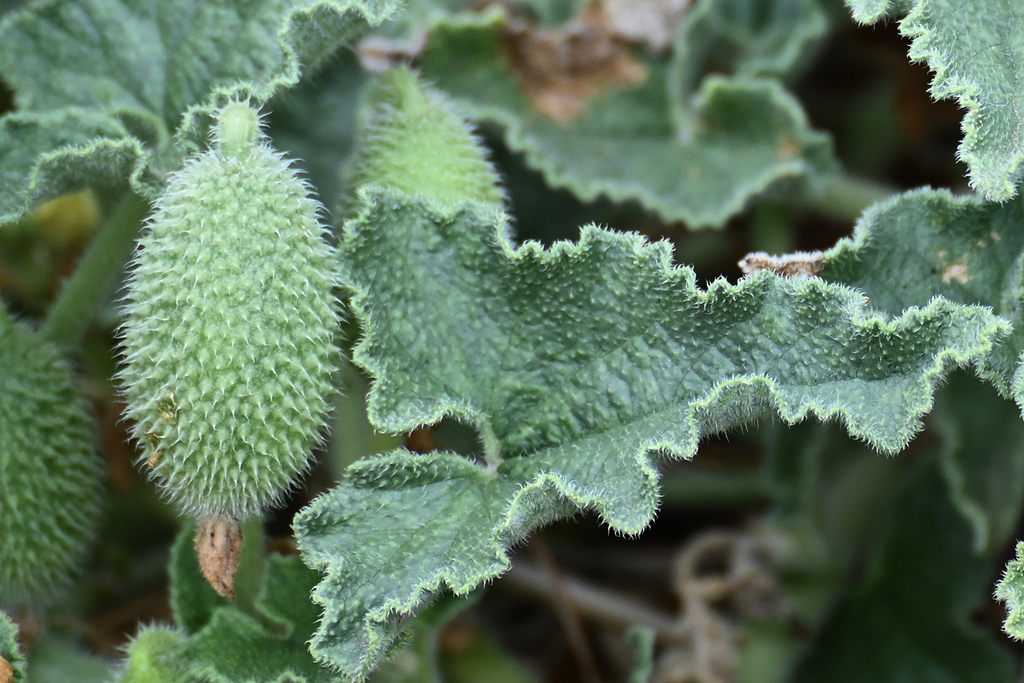
squirting cucumber
Ecballium elaterium
Ecballium is a genus of flowering plants in the family Cucurbitaceae containing a single species, Ecballium elaterium, also called the squirting cucumber or exploding cucumber (but not to be confused with Cyclanthera explodens). It gets its unusual name from the fact that, when ripe, it squirts a stream of mucilaginous liquid containing its seeds, which can be seen with the naked eye. It is thus considered to have rapid plant movement.
From the article Ecballium on Wikipedia (CC BY-SA), quoted section by section
Description
Ecballium elaterium is a herbaceous perennial plant with a tuberous root, usually trailing on the ground but sometimes shrubby, with bristly stems. The leaves are lobed, greyish-green, and rough-surfaced and bristly-hairy. The flowers have a five-lobed yellow corolla, 2–5 cm (0.79–1.97 in) diameter, maturing into an oval green or blue-green fruit about 5 cm (2.0 in) long, resembling a tiny but hairy cucumber.
Range & habitat
E. elaterium is native to southern Europe, northwestern Africa, and southwestern Asia. It is grown as an ornamental plant elsewhere, and has become naturalised locally in Australia, central and western Europe, central Asia, New Zealand, and eastern North America. It is considered an invasive species.
Wikipedia: “Distribution”
In medicine
Elaterine is the cucurbitacin extract used in ancient history as a purgative in folk medicine. Extracted from the juice of the fruit of E. elaterium, elaterine was discovered by Stirling in 1835. Elaterin is extracted from elaterium by chloroform and then precipitated by ether. It has the formula C32H44O7. It forms colourless scales which have a bitter taste, with evidence as a poison when consumed through the nose or mouth. The British pharmacopeia contained a preparation, the Pulvis Elaterini Compositus. According to the Encyclopædia Britannica Eleventh Edition, "[t]he action of this extract resembles that of the saline aperients, but is much more powerful. It is the most active hydragogue purgative known, 'causing also much depression and violent griping'. When injected subcutaneously, it is inert, as its action is entirely dependent upon its admixture with the bile. The drug is undoubtedly valuable in cases of dropsy and Bright's disease, and also in cases of cerebral haemorrhage, threatened or present. It must not be used except in urgent cases, and must invariably be employed with the utmost care, especially if the state of the heart be unsatisfactory." In the 21st century, elaterium and its constituents are considered a poison, with several case reports of hospitalisation, edema of the uvula, and necrosis of the nasal mucosa resulting from nasal or oral consumption.
Wikipedia: “History in folk medicine”
Where it lives
Recorded sightings
—
geo-referenced records in GBIF, from museums, herbaria and field observers.
Drag the globe to turn it. Dots are where records exist, not a range map; darker means more records.
In the old herbals & bestiaries

Notable Commentaries on the History of Plants
Leonhart Fuchs · 1542 · p.733

Discourses on the Six Books of Dioscorides
Dioscorides; Pietro Andrea Mattioli (comm.) · 1568 · p.1470

The Dutch Herbarium or Herbal
Petrus Nylandt · 1670 · p.212

Herbarium Portatile, Oder Behendes Kräuter- und Gewächs-Buch: Darinn nicht allein 1363. so wol Einheimische als Außländndische Kräuter mit Lateinisch und Deutscher Benennung abgebildet, sondern auch die meisten, so in der Medicin gebräuchlich, kürtzlich erkläret werden
Panckow, Thomas · 1656 · p.241
In the stacks
Searching the stacks…
Every page naming Ecballium elaterium in the Biodiversity Heritage Library →
This page is assembled live from iNaturalist, GBIF, Wikipedia, the Source Library and the Internet Archive. It is not yet part of the hand-edited codex. iNaturalist taxon 162161.