- Plants
- ›Vascular Plants
- ›flowering plants
- ›Dicots
- ›Woodsorrels, Quandongs, and Allies
- ›quandong family
- ›Elaeocarpus
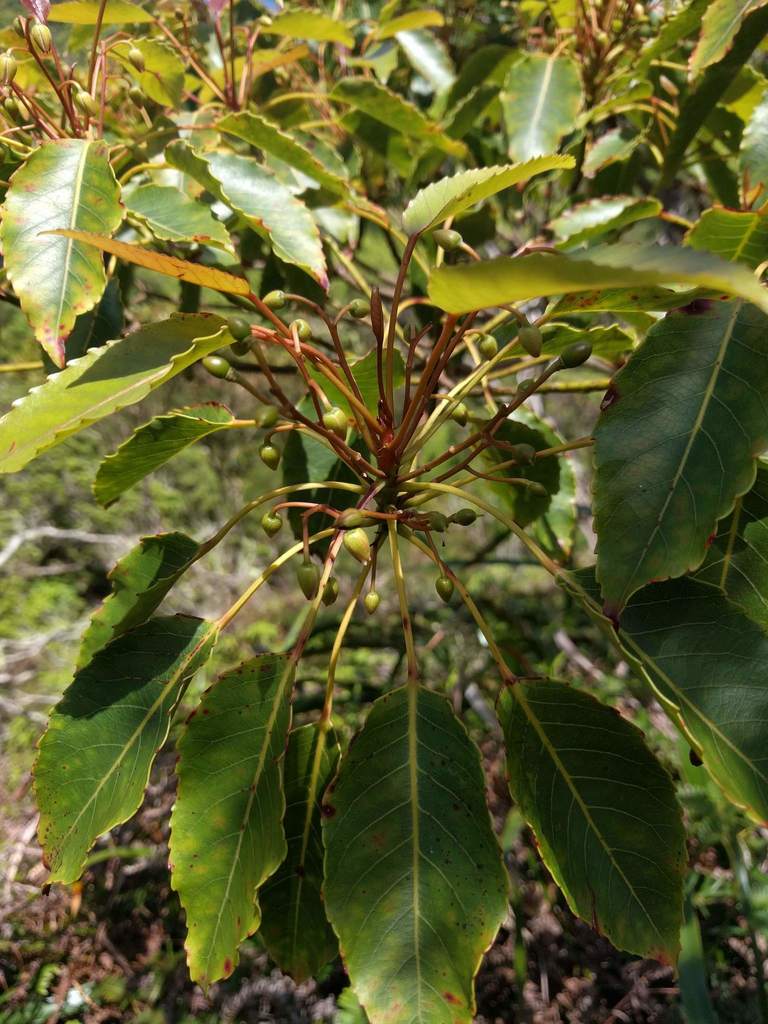
Kalia
Elaeocarpus bifidus
Elaeocarpus bifidus, known in Hawaiian as kalia, is a species of flowering plant in the family Elaeocarpaceae that is endemic to the islands of Kauaʻi and Oʻahu in Hawaiʻi
The kalia is a medium-sized evergreen tree, and has fruits that resemble olives. Formerly the bark was used to make rope, and the branches were used in the construction of thatched roofs.
From the article Elaeocarpus bifidus on Wikipedia (CC BY-SA), quoted section by section
Description
The texture of the leaves is similar to paper, and they are alternate. They are elongated at about 4–10 cm (1.6–3.9 in) long. The bottom of the leaf is covered in fine hairs. Blades are ovate to lancelote. They are 7.5–15 cm (3.0–5.9 in) long and 4–10 cm (1.6–3.9 in) wide. It has wavy-toothed edges. The tree bears bell-shaped flower clusters that are 3–8 cm (1.2–3.1 in) long and have a pale, greenish-yellow shade.
Range & habitat
Elaeocarpus bifidus is commonly found in wet forests at altitudes from 90 to 1,220 m (300 to 4,000 ft). It is native to the islands of Kaua’i and O’ahu.
Wikipedia: “Habitat and distribution”
Where it lives
Recorded sightings
—
geo-referenced records in GBIF, from museums, herbaria and field observers.
Drag the globe to turn it. Dots are where records exist, not a range map; darker means more records.
In the stacks
Searching the stacks…
Every page naming Elaeocarpus bifidus in the Biodiversity Heritage Library →
This page is assembled live from iNaturalist, GBIF, Wikipedia, the Source Library and the Internet Archive. It is not yet part of the hand-edited codex. iNaturalist taxon 162215.