- Animals
- ›Molluscs
- ›Gastropods
- ›Heterobranchs
- ›Euthyneura
- ›Ringipleura
- ›Nudipleura
- ›Nudibranchs
- ›Aeolidina
- ›Fionoidea
- ›Trinchesiidae
- ›Tenellia
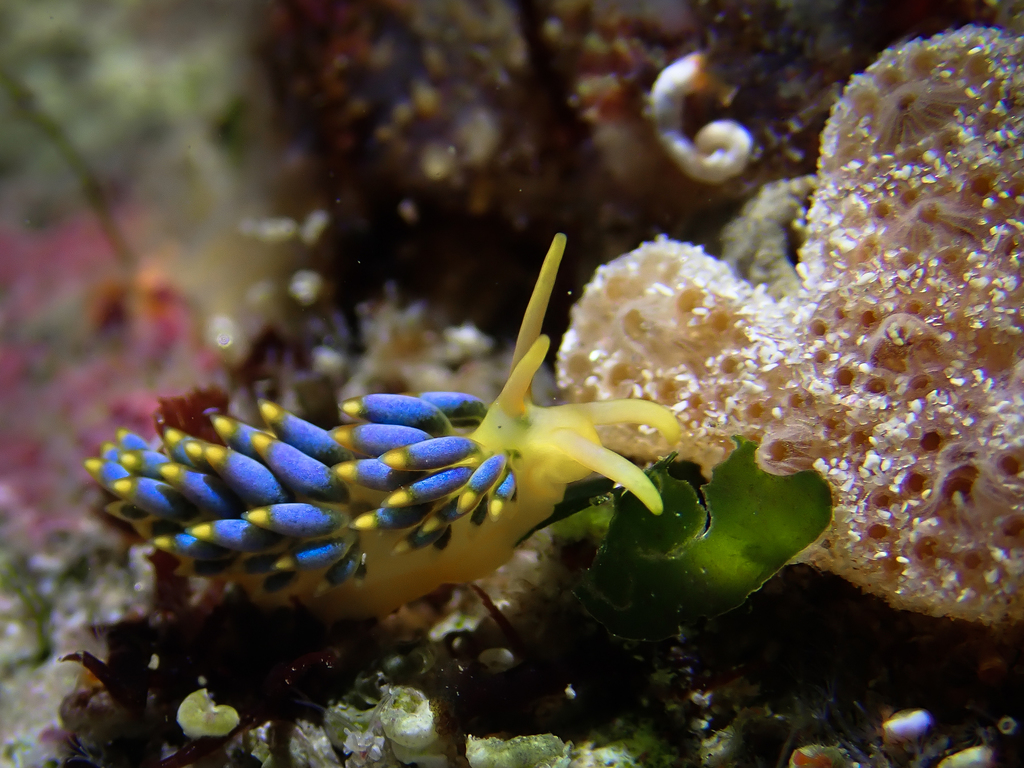
candy nudibranch
Tenellia speciosa
Trinchesia speciosa, common name the "candy nudibranch", is a species of sea slug, an aeolid nudibranch, a marine gastropod mollusc in the family Trinchesiidae.
From the article Trinchesia speciosa on Wikipedia (CC BY-SA), quoted section by section
Description
The candy nudibranch is a vividly coloured nudibranch, having a yellow-orange body and turquoise or purple cerata with yellow tips. It grows to 20 mm in length. The rhinophores are smooth and usually also yellow-orange, although they make take on the colours of the cerata. Three distinct colour forms exist, two with blue cerata and yellow to orange rhinophores and another form with lilac cerata and lilac coloured rhinophores and oral tentacles. The colour form or similar species with iridescent blue cerata was identified as Cuthona ornata (now Trinchesia ornata) by Gosliner and as Cuthona speciosa (now Tenellia speciosa) by Rudman, 2002.
Range & habitat
This species was described from two specimens, one found in a rock pool one mile south of Kalk Bay harbour and the other amongst barnacles at Dalebrook, both in False Bay, South Africa. The candy nudibranch is endemic to South Africa. It is found from the Atlantic coast of the Cape Peninsula to Port Elizabeth, intertidally to at least 30 m.
Wikipedia: “Distribution”
What it does
The candy nudibranch eats hydroids of the genus Sertularella. In common with other aeolid nudibranchs, the cerata of the candy nudibranch aid in respiration but also contain extensions of the digestive system. The candy nudibranch eats the hydroid and passes its nematocysts unharmed through its digestive system to the tips of its cerata. Here the nematocysts mature and are then used by the nudibranch for its own defence. It is probable that the bright colours of the candy nudibranch serve to advertise to predators that it is toxic. Candy nudibranchs are hermaphrodites. Their egg mass is a spiral collar of orange eggs.
== References ==
Wikipedia: “Ecology”
Where it lives
Recorded sightings
—
geo-referenced records in GBIF, from museums, herbaria and field observers.
Drag the globe to turn it. Dots are where records exist, not a range map; darker means more records.
In the stacks
Searching the stacks…
Every page naming Tenellia speciosa in the Biodiversity Heritage Library →
This page is assembled live from iNaturalist, GBIF, Wikipedia, the Source Library and the Internet Archive. It is not yet part of the hand-edited codex. iNaturalist taxon 1624640.