- Plants
- ›Vascular Plants
- ›flowering plants
- ›monocots
- ›grasses, sedges, cattails, and allies
- ›Sedges
- ›Cyperoideae
- ›Scirpeae
- ›Eriophorum
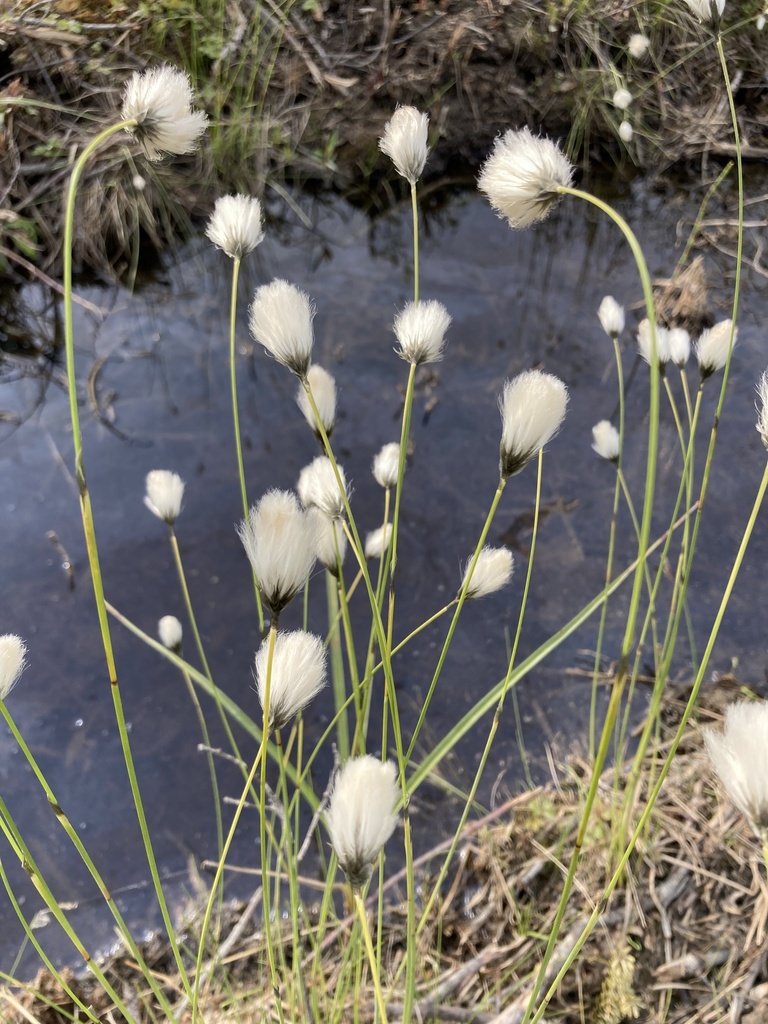
short-anther cottongrass
Eriophorum brachyantherum
Eriophorum brachyantherum, the closed-sheath cotton-grass, short-anthered cotton-grass or northland cottonsedge, is a species that is a part of the Cyperaceae or sedge family. It is commonly found in wet areas, such as bogs and cooler climate zones.
From the article Eriophorum brachyantherum on Wikipedia (CC BY-SA), quoted section by section
Description
Eriophorum brachyantherum is a perennial monocot with 30–60 cm long stems, 1–2 cm flowers, and 2–4 cm fruit. The root balls are very thick with a fibrous root system. The flower is a single, white, cotton ball-like, feathery flower. In the center of the flower there is an oval shaped fruit that contains short anthers. The fruit is an achene that has scales and is surrounded by perianth bristles. The bristles are extended within the fruit and tend to be silky. This plant grows in grass-like environments and blooms during the summer months of June, July, and August.
Range & habitat
The northland cottonsedge has a circumboreal distribution in North America, Europe, and Asia. In the United States it is primarily occurs in Alaska, though it has been recorded from Idaho and Washington as well. In Canada it occurs natively almost country-wide (AB, BC, MB, NL, NT, NU, ON, QC, SK, YT). It prefers to grow in wet areas, and is commonly found in or near bogs, tundra, muskeg, and fens.
Wikipedia: “Distribution”
At the table
The stem and root of this plant were previously used as food by Native Americans, albeit very seldom. The Native Americans would boil the root or simply eat it raw, and for the stem they would store it or fry it in seal oil. The Yupik people used an extract from the leaves as a medical treatment for a variety of gastrointestinal problems.
Wikipedia: “Uses”
Where it lives
Recorded sightings
—
geo-referenced records in GBIF, from museums, herbaria and field observers.
Drag the globe to turn it. Dots are where records exist, not a range map; darker means more records.
In the stacks
Searching the stacks…
Every page naming Eriophorum brachyantherum in the Biodiversity Heritage Library →
This page is assembled live from iNaturalist, GBIF, Wikipedia, the Source Library and the Internet Archive. It is not yet part of the hand-edited codex. iNaturalist taxon 162676.