- Plants
- ›Vascular Plants
- ›flowering plants
- ›Dicots
- ›Legumes, Milkworts, and Allies
- ›Legumes
- ›Faboideae
- ›Phaseoleae
- ›Erythrina
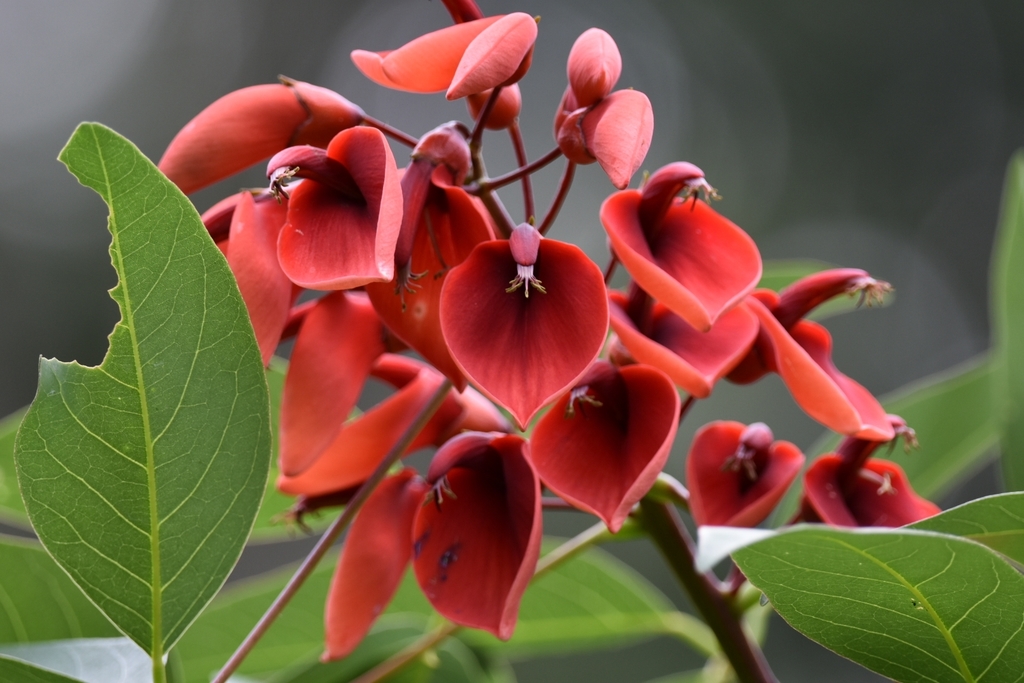
Cockspur coral tree
Erythrina crista-galli
Erythrina crista-galli, also known as the cockspur coral tree, ceibo (in Spanish) or corticeira (in Portuguese), is a species of flowering tree in the family Fabaceae, native to Argentina, Uruguay, Bolivia, southern Brazil and Paraguay. It is widely planted as a street or garden tree in other countries, notably in California. Its specific epithet crista-galli means "cock's comb" in Latin.
It is the national tree of Argentina, and its flower the national flower of Argentina and Uruguay.
From the article Erythrina crista-galli on Wikipedia (CC BY-SA), quoted section by section
Description
Erythrina crista-galli is a small tree, the girth of its trunk measuring 50 cm (20 in). Normally it grows 5–8 m (16–26 ft) tall, although some individuals, such as in the Argentine provinces of Salta, Jujuy and Tucumán, can grow up to 10 m (33 ft). The woody trunk of the tree is equipped with irregular and thorny branches and can reach 50 cm in circumference. The root is a taproot with nodules produced by nitrogen-fixing bacteria. The bacteria live in symbiosis with the tree, facilitating the tree's absorption of nitrogen in return for organic substances which the bacteria need. The tree's trunk is woody with irregular, spiny branches. These branches form a layer without definite form and die after flowering.
Flowers and fruit. The red flower, arranged in inflorescences of the raceme type, is pentameric, complete, and of bilateral symmetry. Its calyx is gamosepalous, like a little red thimble. The corolla, like that of other legumes like common beans, is butterfly-shaped; however, the largest petal, called the "standard", is arranged in the lower part. The two petals called "wings" are so small that they are practically hidden within the calyx. The remaining two petals partially fuse together on occasion and form the flower's keel or "carina"; this protects its reproductive organs. …
Range & habitat
It is distributed throughout northeastern and central western Argentina, eastern Bolivia, southern Brazil, much of Paraguay, and almost all of Uruguay. It lives in low, flood-prone places, and along the watercourses of the Chaco and the Eastern Region. It does not inhabit high forests or dry places without floods, as it tolerates water-saturated soils very well. This species characteristically grows wild in gallery forest ecosystems along watercourses, as well as in swamps and wetlands. It is naturalised in parts of Australia where it is a declared weed in some areas.
Wikipedia: “Distribution”
At the table
It has dyeing and medicinal applications: its bark is used to treat rheumatism wounds and serves as a diuretic antispasmodic; its resin can cure intestinal diseases; Its leaves contain camphor, that helps wound healing and has anti-inflammatory properties for tumors.
Wikipedia: “Uses”
How it is grown
In cultivation in the United Kingdom this plant has gained the Royal Horticultural Society's Award of Garden Merit. In urban settings, it is often planted in parks for its bright red flowers.
Wikipedia: “Cultivation”
Where it lives
Recorded sightings
—
geo-referenced records in GBIF, from museums, herbaria and field observers.
Drag the globe to turn it. Dots are where records exist, not a range map; darker means more records.
In the stacks
Searching the stacks…
Every page naming Erythrina crista-galli in the Biodiversity Heritage Library →
This page is assembled live from iNaturalist, GBIF, Wikipedia, the Source Library and the Internet Archive. It is not yet part of the hand-edited codex. iNaturalist taxon 162718.