- Plants
- ›Vascular Plants
- ›flowering plants
- ›monocots
- ›lilies, supplejacks, and allies
- ›lily family
- ›true lily subfamily
- ›true lilies and allies
- ›Erythronium
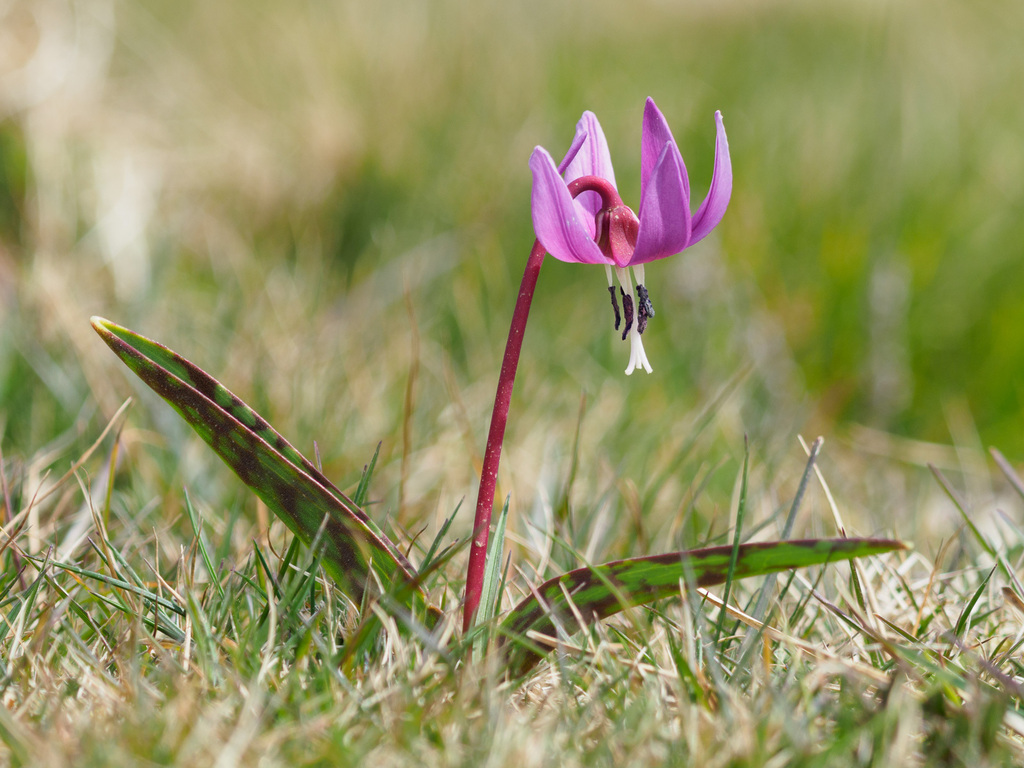
Dog's-tooth-violet
Erythronium dens-canis
Erythronium dens-canis, the dog's-tooth-violet is a bulbous herbaceous perennial flowering plant in the family Liliaceae. It is native to central and southern Europe from Portugal to Ukraine, and locally naturalised north to Germany, Great Britain, and Ireland. It, and the closely related Erythronium caucasicum in the extreme southeast of Europe, are the only naturally occurring species of Erythronium in Europe. Despite its common name, it is not closely related to the true violets of genus Viola.
From the article Erythronium dens-canis on Wikipedia (CC BY-SA), quoted section by section
Description
Erythronium dens-canis grows to 6–30 cm (2–12 in) tall, flowering at the beginning of spring from February to April. The flowers are solitary, pink or lilac (rarely white), with six tepals around 3 cm long; these are reflexed at the top and yellow tinted at the base, and with dark purple anthers. The leaves are marbled in glaucous green and pinkish-brown or purple, and are ovate to lanceolate; they grow in pairs. The white bulb is oblong and resembles a dog's tooth, hence the common name "dog's-tooth-violet" and the Latin specific epithet dens-canis, which translates as "dog's tooth".
What it does
Erythronium dens-canis is found in damp, sunny or lightly shaded settings such as meadows and open woodland, mainly growing at altitudes of 500–2,000 m.
Wikipedia: “Ecology”
At the table
It is grown as a garden plant for its attractive flowers. It was first introduced to Britain in 1596, with naturalised plants first noted in 1965. Its leaves may be consumed raw in salad, or boiled as a leaf vegetable. The bulb is also the source of a starch used in making vermicelli.
Wikipedia: “Uses”
Where it lives
Recorded sightings
—
geo-referenced records in GBIF, from museums, herbaria and field observers.
Drag the globe to turn it. Dots are where records exist, not a range map; darker means more records.
In the old herbals & bestiaries


In the stacks
Searching the stacks…
Every page naming Erythronium dens-canis in the Biodiversity Heritage Library →
This page is assembled live from iNaturalist, GBIF, Wikipedia, the Source Library and the Internet Archive. It is not yet part of the hand-edited codex. iNaturalist taxon 162719.