- Plants
- ›Vascular Plants
- ›flowering plants
- ›Dicots
- ›Sunflowers, Bellflowers, Fanflowers, and Allies
- ›Sunflowers, Daisies, Asters, and Allies
- ›Asteroideae
- ›asters and allies
- ›Machaerantherinae
- ›Eurybia
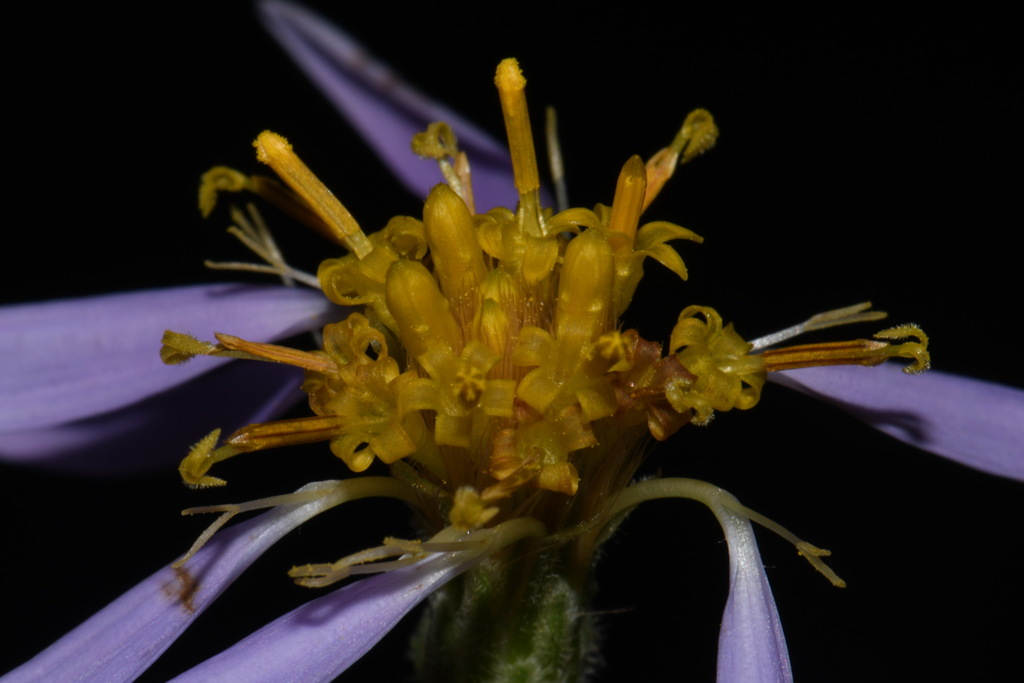
Jones' aster
Eurybia jonesiae
Eurybia jonesiae, commonly known as Jones's aster or Almut's wood aster, is a North American species of herbaceous perennial native to the Southeastern United States, primarily in the state of Georgia with a few populations in eastern Alabama. It is found mostly in the Piedmont Region in rich oak-hickory-pine forest. Within these rich woods, it has an affinity for moist soils with habitats that include ravines, rocky ridges, and wooded slopes in the vicinity of rivers and streams. Due to its restricted range it is considered threatened by the Nature Conservancy. It has often been misidentified as Eurybia spectabilis and was declared a separate species quite recently in 1988. The flowers emerge in the late summer and persist into the fall bearing cream-coloured ray florets that become purple and yellow disc florets.
From the article Eurybia jonesiae on Wikipedia (CC BY-SA), quoted section by section
Range & habitat
Eurybia jonesiae grows only in the Piedmont Region south of the Appalachian Mountains. In this relatively small area, ranging from 100 to 400 metres (330–1330 feet) above sea level, it is found in rich oak-hickory-pine forests in moist soils. It is most common along the wooded slopes of rivers or streams, in moist ravines and on rocky ridges.
Wikipedia: “Distribution and habitat”
Where it lives
Recorded sightings
—
geo-referenced records in GBIF, from museums, herbaria and field observers.
Drag the globe to turn it. Dots are where records exist, not a range map; darker means more records.
In the stacks
Searching the stacks…
Every page naming Eurybia jonesiae in the Biodiversity Heritage Library →
This page is assembled live from iNaturalist, GBIF, Wikipedia, the Source Library and the Internet Archive. It is not yet part of the hand-edited codex. iNaturalist taxon 162884.