- Plants
- ›Vascular Plants
- ›flowering plants
- ›Dicots
- ›pinks, cactuses, and allies
- ›knotweed family
- ›Polygonoideae
- ›Fagopyreae
- ›Fagopyrum
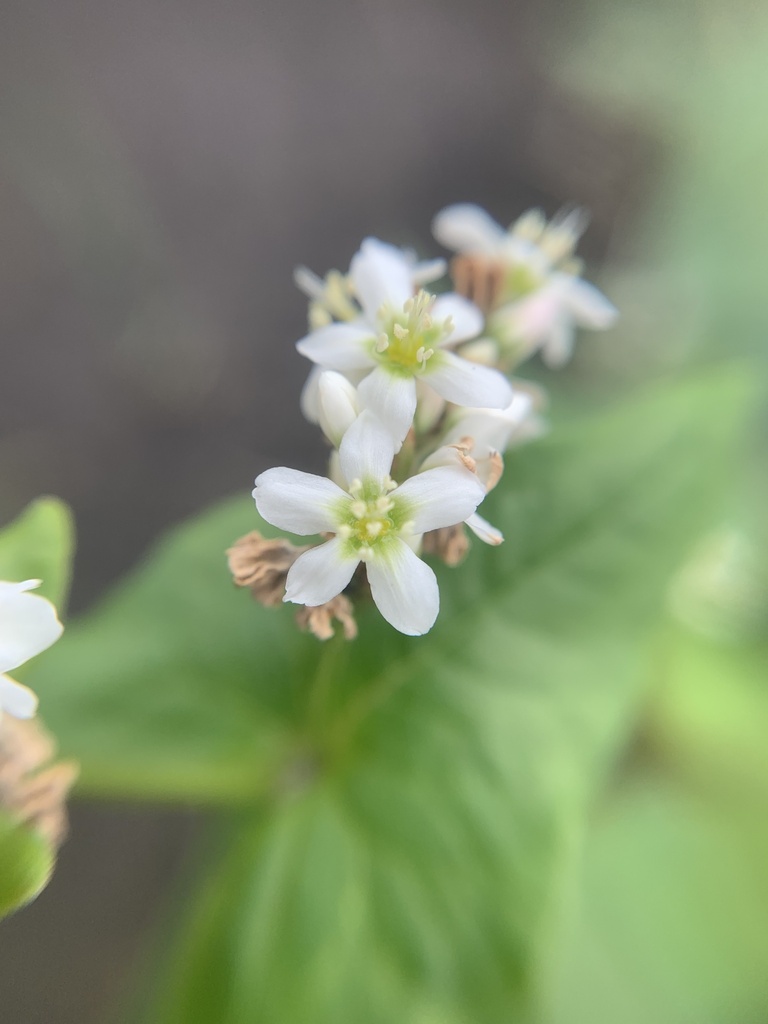
Tartarian Buckwheat
Fagopyrum tataricum
Fagopyrum tataricum, also known as Tartary buckwheat, green buckwheat, ku qiao, Tatar buckwheat, or bitter buckwheat, is a domesticated food plant in the genus Fagopyrum in the family Polygonaceae. With another species in the same genus, common buckwheat, it is often counted as a cereal, but the buckwheats are not closely related to true cereals.
Tartary buckwheat is more bitter and contains more rutin than common buckwheat. It also contains other bioactive components such as flavonoids, phenolic acids, 2-hydroxybenzylamine and quercitrin.
From the article Fagopyrum tataricum on Wikipedia (CC BY-SA), quoted section by section
At the table
Known in Chinese as "bitter buckwheat" (Chinese: 苦荞麦; pinyin: kǔqiáomài) and in Japan as dattan-soba (韃靼蕎麦/ダッタンソバ; 'Tartary buckwheat'), the plant was domesticated as a crop in East Asia and is also being cultivated in Europe and North America. While it is an unfamiliar food in the West, it is common in the Himalayan region today, as well as other regions in Southwest China such as Sichuan province. Tartary buckwheat is commonly roasted to make buckwheat tea, and it can also be distilled to make alcohol. While not traditionally eaten in Japan, due to its high rutin content it was briefly popular as a health fad in Japan in the late 1990s. The plant has been cultivated in many parts of the world; however, when found among other crops it is considered a weed. Less bitter varieties are now commercially available.
Wikipedia: “Uses”
Where it lives
Recorded sightings
—
geo-referenced records in GBIF, from museums, herbaria and field observers.
Drag the globe to turn it. Dots are where records exist, not a range map; darker means more records.
In the stacks
Searching the stacks…
Every page naming Fagopyrum tataricum in the Biodiversity Heritage Library →
This page is assembled live from iNaturalist, GBIF, Wikipedia, the Source Library and the Internet Archive. It is not yet part of the hand-edited codex. iNaturalist taxon 162931.