- Plants
- ›Vascular Plants
- ›flowering plants
- ›Dicots
- ›Legumes, Milkworts, and Allies
- ›Legumes
- ›Faboideae
- ›Robinieae
- ›Gliricidia
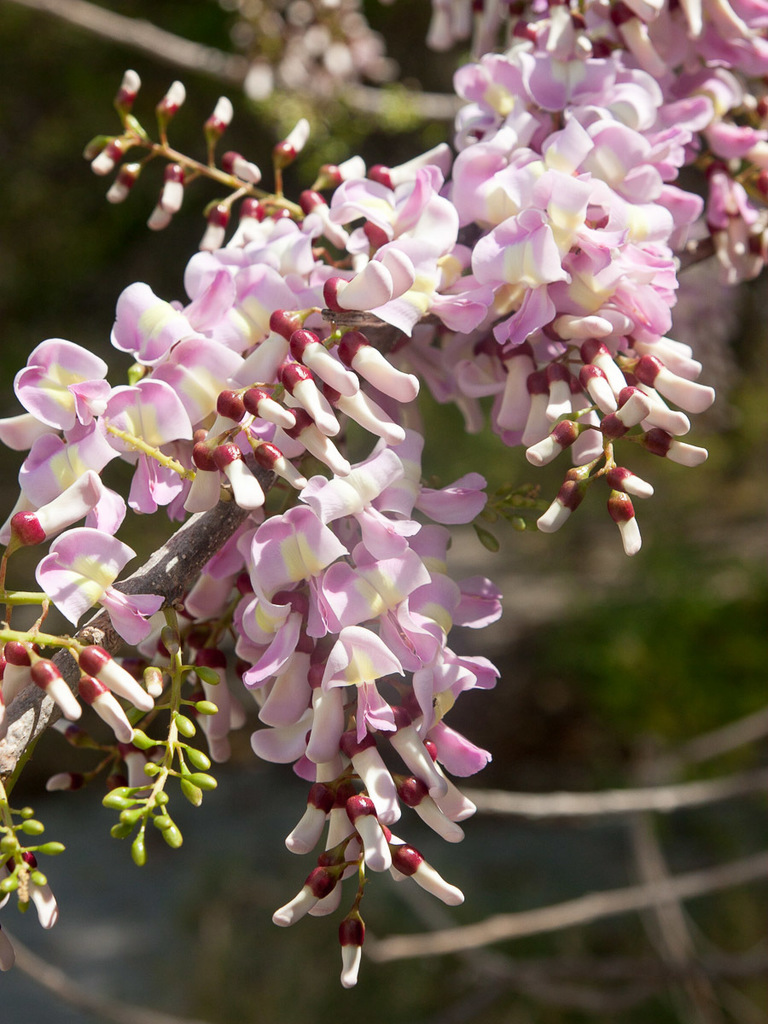
Fence Post Tree
Gliricidia sepium
Gliricidia sepium, often simply referred to as Gliricidia (common names: quickstick, mata ratón; cacao de nance, cachanance; piñon Cubano in the Dominican Republic; madreado in Honduras; kakawate in the Philippines; madre xacao or madre de cacao in the Philippines and Guatemala; and madero negro in Nicaragua); wetahiriya in Sinhala ,is a medium size leguminous tree belonging to the family Fabaceae.
From the article Gliricidia sepium on Wikipedia (CC BY-SA), quoted section by section
Description
Gliricidia sepium is a medium-sized tree that grows 10–12 m (33–39 ft) high. The bark is smooth, and its color can range from a whitish gray to deep red-brown. The flowers are located on the end of branches that have no leaves. These flowers have a bright pink to lilac color that is tinged with white. A pale yellow spot is usually at the flower's base. The tree's fruit is a pod about 10–15 cm (4–6 in) long. It is green when unripe and becomes yellow-brown when it reaches maturity. The pod produces four to ten round brown seeds.
Range & habitat
G. sepium has been cultivated extensively by indigenous American cultures in North, Central, and South America since the pre-Columbian era, which makes it difficult to ascertain its original native distribution. Genetic studies have identified the center of genetic diversity of G. sepium as the dry zones of southern Mexico and northern Central America, which is now generally regarded as its true native range. G. sepium was first introduced to the Philippines from Mexico via the Manila galleons along with 200 other tropical American plant species from as early as the early 1600s. Their use as a shade tree for cacao, coffee, and tea plantations led to their further spread. These later introductions include the Caribbean before 1850; Sri Lanka in the 1800s; India and Indonesia at around 1900; and West Africa, Uganda, and Kenya in the early 1900s. Other introductions followed in the 20th century and G. sepium now has a pantropical distribution. G. sepium grows well in acidic soils with a pH of 4.5–6.2. The tree is found on volcanic soils in its native range in Central America and Mexico. However, it can also grow on sandy, clay, and limestone soils.
Wikipedia: “Distribution and spread”
At the table
G. sepium was spread from its native range throughout the tropics to shade plantation crops such as coffee. Today it is used for many other purposes including live fencing, fodder, firewood, green manure, intercropping, and rat poison. Its use expanded following the widespread defoliation of Leucaena by psyllid in the 1980s. In the charsutri method of paddy cultivation, leaves of glyricidia are incorporated in soil during ploughing.
Salinity tolerance and nitrogen fixation. The tree possesses high level of Nitrogen fixation[2] and tolerance to salinity[3].
Fodder. G. sepium is used as cut and carry forage for cattle, sheep, and goats. Its high protein content allows it to complement low-quality tropical forages. G. sepium can tolerate repeated cutting, every 2 to 4 months depending on the climate. Cutting G. sepium causes it to retain its leaves during the dry season when many forage crops have lost their leaves. In some cases it is the only source of feed during the dry season.
Intercropping. G. sepium trees are used for intercropping in part because they fix nitrogen in the soil and tolerate low soil fertility, so when they are interplanted with crops they can boost crop yields significantly, without the need of chemical fertilizers. G. sepium tolerates being cut back to crop height, and can even be coppiced, year after year. …
Wikipedia: “Uses”
Where it lives
Recorded sightings
—
geo-referenced records in GBIF, from museums, herbaria and field observers.
Drag the globe to turn it. Dots are where records exist, not a range map; darker means more records.
In the stacks
Searching the stacks…
Every page naming Gliricidia sepium in the Biodiversity Heritage Library →
This page is assembled live from iNaturalist, GBIF, Wikipedia, the Source Library and the Internet Archive. It is not yet part of the hand-edited codex. iNaturalist taxon 163327.