- Animals
- ›Arthropods
- ›Hexapods
- ›Insects
- ›Winged and Once-winged Insects
- ›Flies
- ›Brachyceran Flies
- ›Cyclorrhaphan Flies
- ›Schizophoran Flies
- ›Calyptrate Flies
- ›Bot Flies, Blow Flies, and Allies
- ›Blow Flies
- ›Calliphorinae
- ›Calliphora
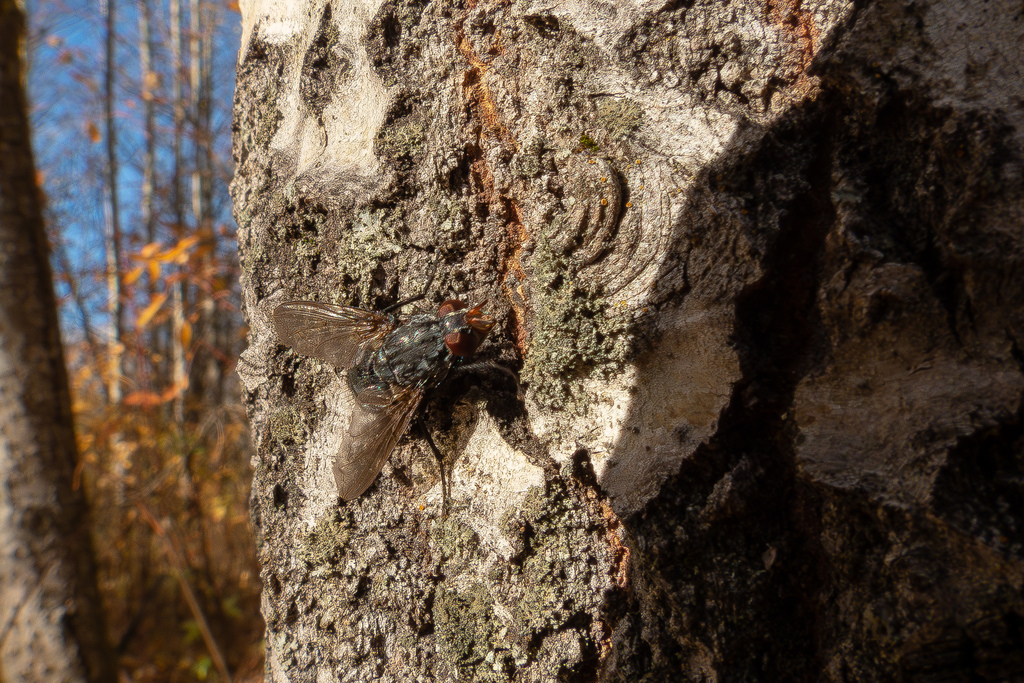
Calliphora loewi
Calliphora loewi is part of the family Calliphoridae, which consisted of bottle flies and blowflies, and in the genus Calliphora, blue bottle flies. The genus can be deceiving since C. loewi is not blue. Though this species is rare, it can play an important part in forensic entomology, spreading disease, and decomposing carrion. The life cycle of C. loewi is similar to the life cycle of the genus Calliphora. Since this species is rare there has not been much research on it.
From the article Calliphora loewi on Wikipedia (CC BY-SA), quoted section by section
Description
Günther Enderlein, a German entomologist, first described Calliphora loewi in 1903. Calliphora loewi ranges in length from 6–14 mm. C. loewi is a rare species that can be confused with C. terraenovae because some species have a similar reddish genal groove. The head is typically a black color with the exception of the lower facial edge. The posterior of the head is concave with 3 to 5 rows of black setae, centrally with pale hairs. The frontal area of the males head is narrower than the females. The cerci in the males are long and narrow. Males also have bordering frontal orbital plates, whereas the females have frontal vita about three times the width of the frontal orbital plates. The females have very large antennae compared to normal sized antennae in males.
Range & habitat
Calliphora loewi is a very rare species but can be found in all parts of the world. C. loewi is widespread in Fennoscandia and Denmark and can be found limited in numbers in other parts of northern and central Europe. Specimens have been found as far east as Mongolia and Japan. The only recorded findings of the species in North America were in Alaska and Canada. C. loewi is also thought to avoid human settlements.
Wikipedia: “Distribution”
What it does
The life cycle of C. loewi has six stages: the egg, three larval stages (instars), pupae, and adult fly. The adults will lay their eggs in suitable habitats, usually carrion. Larvae will hatch within 6–48 hours after eggs have been deposited. They shed their skins three times during their larval stage. The time it takes to molt into the next instar is fairly consistent; however, temperature can be a factor. Colder weather will slow down the amount of time it takes for each developmental stage, and warmer weather will speed it up. The life cycle from egg to adult can be anywhere from 16–35 days, depending on environmental conditions.
Eggs to Larvae. The eggs of this genus are white, slightly curved, cylinder shaped and have blunt ends. Once the eggs hatch the larva stage begins. The three instars of the maggots have different characteristics. The first is less than 2 mm long and is a twelve segment skeleton with mouthparts present. The second instar has spines located on the dorsal side and has two posterior spiracle slits from which it breathes. During the third instar, the mouthparts are fully developed. The mouth-hook tooth becomes longer, and the maggot now has three posterior spiracles.
Larvae to Pupae. When the third-instar larva has finished growing (12–18 mm), it leaves the corpse and burrows into the ground where it develops into a hardened, capsule-like pupa. …
Wikipedia: “Life cycle”
At the table
The maggots have hook-like mouth parts that tear apart the tissues where they live. The adults have sponge-like mouth parts in which they will first coat their food with digestive enzymes and then suck up the matter. C. loewi primarily feeds on dead animals but can be occasionally found on vegetation.
Wikipedia: “Food source”
In medicine
In the epidemiological sense, blowflies are of concern due to being possible mechanical vectors of disease. Blowfly breeding and feeding hosts tend to be decomposing animals and dung, which are covered with bacteria that consequentially come in contact with the fly. Lab studies have shown that blowflies coming in contact with agar have produced cultures that contain pathogens. Although C. loewi does breed in carrion and possibly in human feces, it remains uncertain whether it carries or transmits disease.
Wikipedia: “Medical”
Listen
Looking for field recordings…
Where it lives
Recorded sightings
—
geo-referenced records in GBIF, from museums, herbaria and field observers.
Drag the globe to turn it. Dots are where records exist, not a range map; darker means more records.
In the stacks
Searching the stacks…
Every page naming Calliphora loewi in the Biodiversity Heritage Library →
This page is assembled live from iNaturalist, GBIF, Wikipedia, the Source Library and the Internet Archive. It is not yet part of the hand-edited codex. iNaturalist taxon 1638897.