- Plants
- ›Vascular Plants
- ›flowering plants
- ›monocots
- ›grasses, sedges, cattails, and allies
- ›grasses
- ›Panicums, Bluestems, Paspalums, and Allies
- ›bluestems, lemon grasses, silvergrasses, and allies
- ›bluestems, thatching grasses, and allies
- ›Hyparrhenia
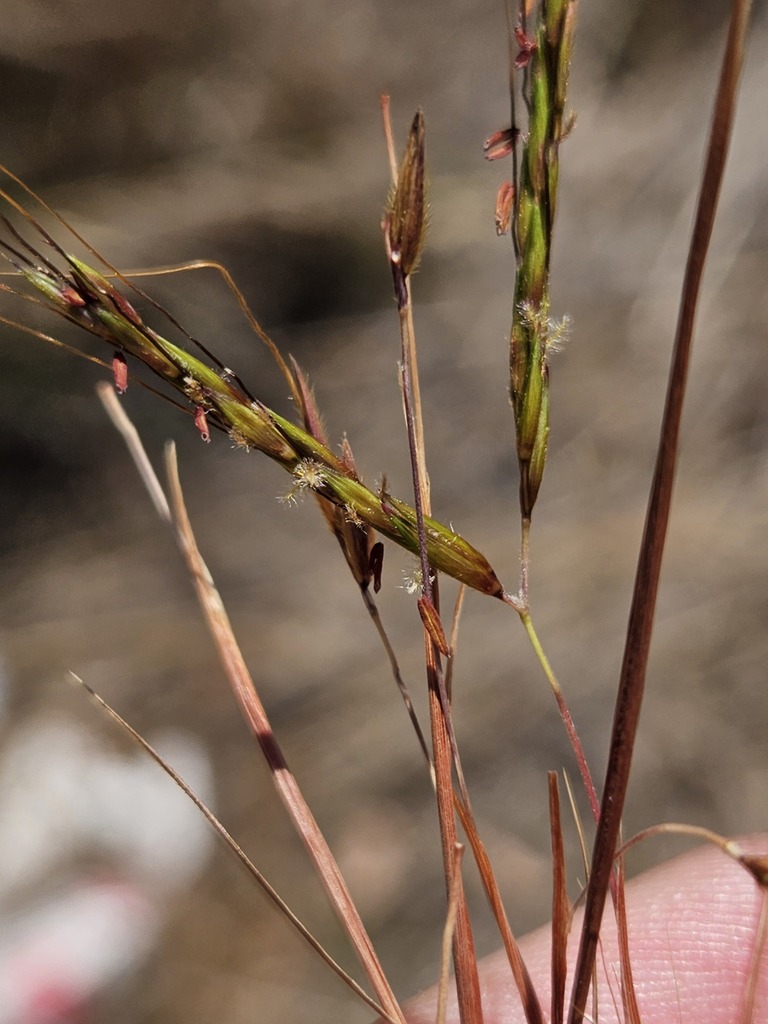
thatching grass
Hyparrhenia rufa
Hyparrhenia rufa is a species of grass known by the common names jaragua, jaragua grass, and giant thatching grass. It is native to Africa and it is widespread in the world as a cultivated forage and fodder for livestock and a naturalized and sometimes invasive species.
From the article Hyparrhenia rufa on Wikipedia (CC BY-SA), quoted section by section
Description
This is usually a perennial grass, but it sometimes grows as an annual, and it is variable in form. It usually forms dense tufts of stems from a short rhizome. The stems can be 30 centimeters to 3.5 meters tall. The leaf sheaths enclose the stem at intervals, making it appear banded. Flowering stems have sparse leaves, but grazing increases leaf production. The leaf blades are 30 to 60 centimeters long. The panicle is up to 80 centimeters long and is made up of many short, yellowish or red-tinged racemes all subtended by a narrow, reddish spathe a few centimeters long. The racemes are lined with pairs of spikelets, the red-haired fertile spikelets without stalks and the smaller sterile spikelets on stalks. The rough-haired seeds are dispersed in the fur of animals, on the wind, and on vehicles and machinery such as graders.
What it does
In its native range the grass grows in woodlands and seasonally flooded grasslands. It is also tolerant of drought and easily naturalizes in disturbed habitat sites. Several species of leafcutter ants have been observed foraging on jaragua, including Atta capiguara and A. laevigata. The grass is susceptible to the plant pathogenic nematodes Helicotylenchus pseudopaxilli, Pratylenchus brachyurus, and Longidorus laevicapitatus. It can also host the phytoplasma bacterium which causes stunting in Napier grass (Pennisetum purpureum), and its infection has been dubbed Hyparrhenia grass white leaf disease.
Wikipedia: “Ecology”
At the table
This tall grass can be used as thatching, as straw, and as pulp for making paper. In East Africa it is planted as a border grass to prevent erosion.
Wikipedia: “Other uses”
Where it lives
Recorded sightings
—
geo-referenced records in GBIF, from museums, herbaria and field observers.
Drag the globe to turn it. Dots are where records exist, not a range map; darker means more records.
In the stacks
Searching the stacks…
Every page naming Hyparrhenia rufa in the Biodiversity Heritage Library →
This page is assembled live from iNaturalist, GBIF, Wikipedia, the Source Library and the Internet Archive. It is not yet part of the hand-edited codex. iNaturalist taxon 163952.