- Plants
- ›Vascular Plants
- ›flowering plants
- ›Dicots
- ›nightshades, bindweeds, gooseweeds, and allies
- ›bindweed family
- ›Bindweeds, Morning-glories and Allies
- ›Ipomoeeae
- ›Ipomoea
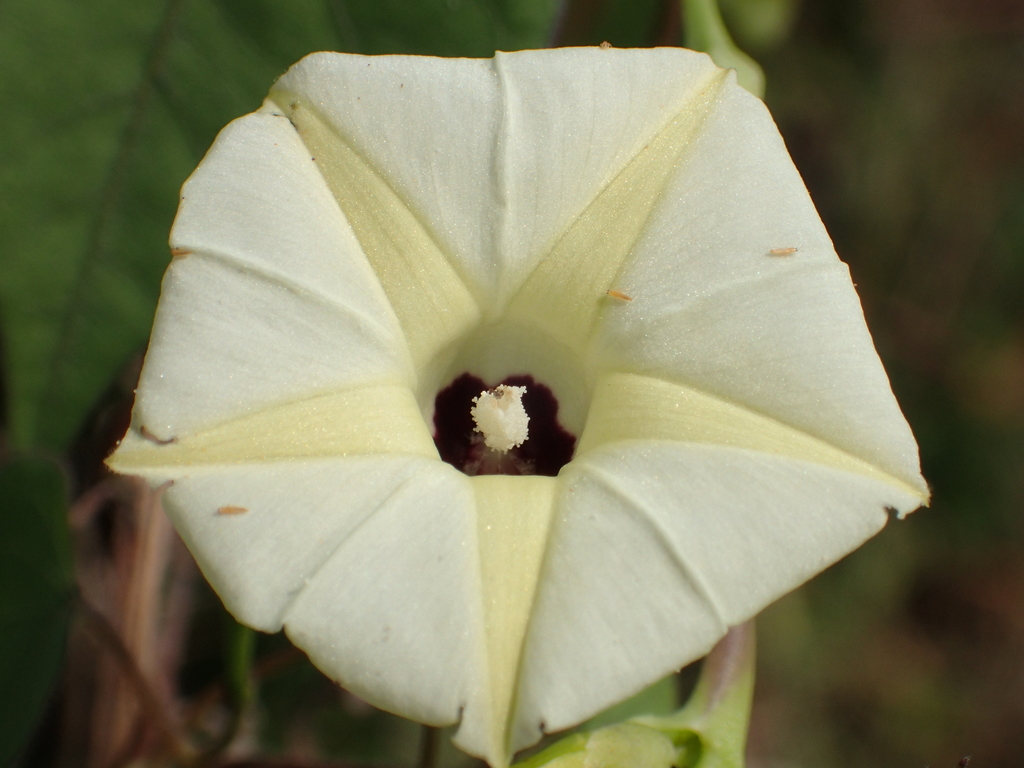
Obscure Morning Glory
Ipomoea obscura
The Ipomoea obscura, commonly known as the obscure morning glory or the small white morning glory, is a species of the genus Ipomoea. It is an invasive species native to parts of Africa, Asia, and certain Pacific Islands. While the plant's seeds are toxic, the leaves can be used for many different medicinal purposes.
From the article Ipomoea obscura on Wikipedia (CC BY-SA), quoted section by section
Description
The petals of Ipomoea obscura are white or pale yellow. They have darker midpetaline bands and a purple center. Its seeds can be black or brown, and they are 4–5 mm. When it is able to grow, it becomes a twining vine with a stem that grows 2 to 3 meters long.
Range & habitat
Ipomoea obscura perennial vine that is found in disturbed areas, cultivated fields, natural grasslands, shrublands, coastal areas, savanas, forest edges, and open fields. It can be found from sea level to 1800 m. In addition to being cultivated by humans, it is dispersed naturally as an escape from cultivation. The introduction of Ipomoea obscura into new habitats has many different causes, such as garden waste disposal, disturbance, and medicinal use. Ipomoea obscura is found as a weed in certain plants, such as tobacco and maize. In India, it infests fields of sugar cane, cotton, maize, and soybeans. In Thailand, it infests pineapple fields.
Wikipedia: “Habitat”
At the table
The dried leaves of Ipomoea obscura contain an extract that can be used as a source of antioxidant and as an anti-inflammatory. This extract has also been found to inhibit the growth and proliferation of tumor cells.
Wikipedia: “Medicinal uses”
In human culture
The name Ipomoea comes from the Greek root íps, or ipós, meaning "woodworm", and the Greek adjective homoios,meaning "same as". Obscura comes from the Latin word obscurus, meaning obscure.
Wikipedia: “Etymology”
Where it lives
Recorded sightings
—
geo-referenced records in GBIF, from museums, herbaria and field observers.
Drag the globe to turn it. Dots are where records exist, not a range map; darker means more records.
In the stacks
Searching the stacks…
Every page naming Ipomoea obscura in the Biodiversity Heritage Library →
This page is assembled live from iNaturalist, GBIF, Wikipedia, the Source Library and the Internet Archive. It is not yet part of the hand-edited codex. iNaturalist taxon 164092.