- Plants
- ›Vascular Plants
- ›flowering plants
- ›Dicots
- ›Sunflowers, Bellflowers, Fanflowers, and Allies
- ›Sunflowers, Daisies, Asters, and Allies
- ›Asteroideae
- ›asters and allies
- ›Baccharidinae
- ›Laennecia
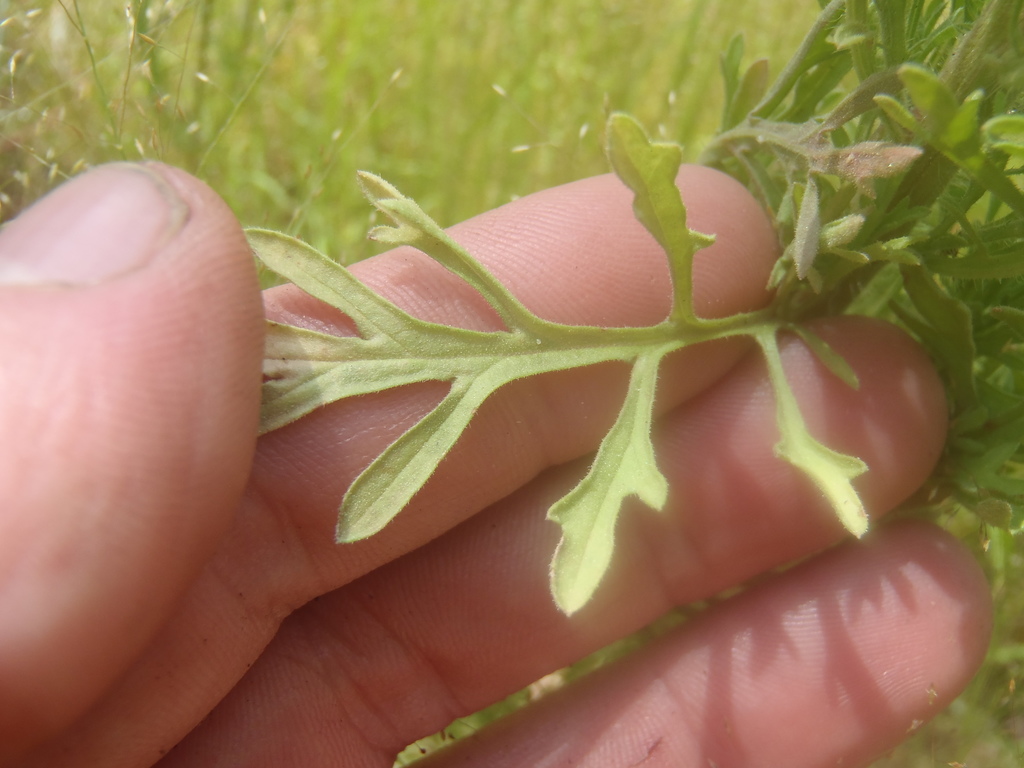
Leafy Horseweed
Laennecia sophiifolia
Laennecia sophiifolia, commonly known as leafy horseweed, is a species of annual plant native to the New World, belonging to the family Asteraceae.
From the article Laennecia sophiifolia on Wikipedia (CC BY-SA), quoted section by section
Description
Leafy horseweed is similar to many other members of the aster family producing very many small, closely grouped floral heads. Here are some notable features distinguishing the species from similar ones:
Stems up to 1.5 m (4 ft 11 in) tall and sometimes higher may be branched from the bases. Leaves are once or twice divided into slender to very sender lobes, though upper ones may appear to be simple slender blades. Overall blade shape varies considerably, reaching 50 mm (2 in) and more in length, and to about 20 mm (3⁄4 in) wide. Both sides of the leaf are variously hairy, at least on the margins, accompanied by tiny glands which may be stalked or not. Floral heads are borne in branched, more-or-less corymb-type arrays on the main stem and side branches, causing the whole branched stem to look like a slender, congested mixture of floral heads and leaves. Individual florets within the heads number up to 40. Though most lack stamens, they all have pistils and produce fruits. One-seeded, cypsela-type 'fruits' are pale pinkish tan and up to 0.8 mm (1⁄32 in) long. Atop each cypsela arises a fragile pappus which readily falls off and consists of up to 20 white to tawny bristles up to 3 mm (1⁄8 in) long.
Range & habitat
Leafy horseweed occurs in widely disjunct populations in the Americas. In the USA it is native to the southwestern states of Arizona, New Mexico and Texas. In Mexico it occurs nearly throughout, while in Central America it is limited to Guatemala, El Salvador and Honduras. In South America, it appears in Colombia, Venezuela, and farther south in Ecuador, Bolivia and Argentina.
Wikipedia: “Distribution”
In medicine
In Argentina many medicinal uses have been documented for leafy horseweed, including as a diuretic, to counteract the effects of poison, venom and infection, and against rheumatism and rabies.
Wikipedia: “In traditional medicine”
In human culture
The genus name Laennecia, sometimes written Laënnecia, honors René-Théophile-Hyacinthe Laënnec. The species name sophiifolia is a New Latin compound with the ending -folio deriving from Latin folio, a form of folium, meaning "leaf." In sophiifolia, the suffix folia means "a leaf like Sophia," with Sophia being a genus name proposed in 1763, but which was rejected, and now is regarded as a synonym of the genus Descurainia. That genus, though in the Mustard Family, incorporates species known as tansymustards. The type species of Sophia was a plant now known as Descurainia sophia, whose leaves are quite similar to Laennecia sophiifolia.
== References ==
Wikipedia: “Etymology”
Where it lives
Recorded sightings
—
geo-referenced records in GBIF, from museums, herbaria and field observers.
Drag the globe to turn it. Dots are where records exist, not a range map; darker means more records.
In the stacks
Searching the stacks…
Every page naming Laennecia sophiifolia in the Biodiversity Heritage Library →
This page is assembled live from iNaturalist, GBIF, Wikipedia, the Source Library and the Internet Archive. It is not yet part of the hand-edited codex. iNaturalist taxon 164411.