- Plants
- ›Vascular Plants
- ›flowering plants
- ›Dicots
- ›Sunflowers, Bellflowers, Fanflowers, and Allies
- ›Sunflowers, Daisies, Asters, and Allies
- ›chicories, dandelions, and allies
- ›Lettuce, Chicory, Dandelion and Salsify Tribe
- ›Hyoseridinae
- ›Launaea
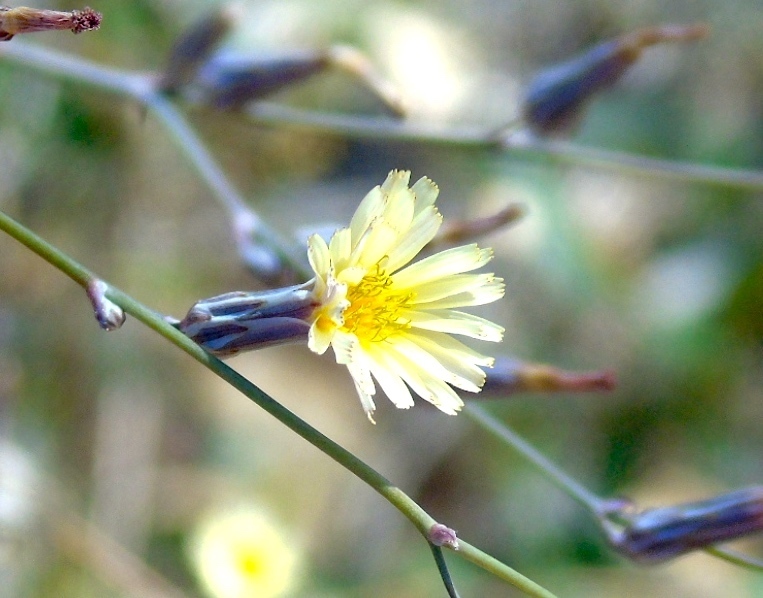
wild lettuce
Launaea intybacea
Launaea intybacea, with numerous English names, and often sharing the names wild lettuce and bitter lettuce with several other species, is a flowering plant of the family Asteraceae.
From the article Launaea intybacea on Wikipedia (CC BY-SA), quoted section by section
Description
Launaea intybacea is an erect annual or biennial herb growing up to 1 m (3 ft 3 in) tall. During its early stages of development it may form a rosette of basal leaves. The hairless stems can be branched or unbranched. Leaves often are purple on the lower surface, up to 28 cm (11 in) long and 11 cm (4.3 in) wide, and have margins which are shallowly to deeply toothed. Leaf tips taper to a slender point, and the bases taper to the stem forming a "winged" petiole. Flowering heads appear alone or as a few in a cluster on a short peduncle. Each head contains 15-35 reduced flowers known as florets, which have to pale to bright yellow corollas up to 9 mm (0.35 in) long. All the corollas are long, slender and tongue-shaped, not cylindrical. The florets arise from within a green, pear-shaped to cylindrical structure known as an involucre, which consists of overlapping bracts, the inner ones 2-3 times longer than the outer. The bracts' margins are noticeably thin and pale. Each floret produces a dry, one-seeded, cypsela-type fruit which, when mature, bears atop it numerous, spreading, white bristles up to 9 mm (0.35 in) long.
Range & habitat
The iNaturalist page documenting locations of observations of Launaea intybacea by citizen scientists worldwide indicates that the species occurs in warmer parts of the world, from the Americas to southern Europe, Africa and the Indian subcontinent. It is noticeably missing from southeastern Asia and Australia. The species is a native of Africa introduced to the Caribbean area and Central America during the early trans-Atlantic slave trade from West Africa,
Wikipedia: “Distribution”
At the table
In Ethiopia, Launaea intybacea is regarded as a "famine food" which in normal times is uprooted as a weed, but during famines the leaves are boiled to reduce their natural bitterness. Green Deane, author of the popular book Eat the Weeds with Green Deane, warns that the raw plants are bitter, needing to be cooked: "Don't be surprised if you have to boil leaves 40 minutes or so in a lot of water to make it edible."
Wikipedia: “As food”
In medicine
In Saudi Arabia, all parts of the plant are use in traditional medicine for a variety of ailments, from jaundice and skin diseases to liver disorders and dry coughs. It is thought to aid digestion and, in women, to promote lactation. Laboratory analyses have revealed that in fact its compounds show anti-inflammatory, antithrombotic and antitumor effects. A study using albino rats specifically validated the traditional use of Launaea intybacea for liver disorders.
Wikipedia: “In traditional medicine”
In human culture
The genus name Launaea is a New Latin construct commemorating J.C.M. Mordant de Launay (1750?-1816), a French lawyer and later librarian of the Museum d'Histoire Naturelle in Paris. The species name intybacea in New Latin based on the Ancient Greek entybon, a name applied to endive, chicory, and other similar plants with edible leaves.
Wikipedia: “Etymology”
Where it lives
Recorded sightings
—
geo-referenced records in GBIF, from museums, herbaria and field observers.
Drag the globe to turn it. Dots are where records exist, not a range map; darker means more records.
In the old herbals & bestiaries

Maria Sibylla Merian — Der rupsen begin, voedzel en wonderbaare verandering (1712)
Maria Sibylla Merian · 1717 · p.129

Commentaries on the Six Books of Pedanius Dioscorides on Medical Matter
Pietro Andrea Mattioli · 1565 · p.692

Garden of Health (Hortus Sanitatis)
Jacob Meydenbach · 1491 · p.332

Notable Commentaries on the History of Plants
Leonhart Fuchs · 1542 · p.335

Book of Herbs
Hieronymus Bock (Tragus) · 1546 · p.230

Notable Commentaries on the History of Plants
Leonhart Fuchs · 1549 · p.333

On the Names of Plants
Hieronymus Bock (Tragus) · 1552 · p.331

De medicinali materia libri sex
Dioscorides · 1552 · p.307

Commentaries on the Six Books of Dioscorides
Pietro Andrea Mattioli · 1560 · p.415

History of Plants in Four Books
Valerius Cordus · 1561 · p.335

Commentaries on the Six Books of Dioscorides on Medical Matter
Pietro Andrea Mattioli · 1563 · p.400

Stirpium adversaria nova
Matthias de Lobel · 1571 · p.111
In the stacks
Searching the stacks…
Every page naming Launaea intybacea in the Biodiversity Heritage Library →
This page is assembled live from iNaturalist, GBIF, Wikipedia, the Source Library and the Internet Archive. It is not yet part of the hand-edited codex. iNaturalist taxon 164445.