- Plants
- ›Vascular Plants
- ›flowering plants
- ›Dicots
- ›Legumes, Milkworts, and Allies
- ›Legumes
- ›Faboideae
- ›Desmodieae
- ›Lespedezinae
- ›Lespedeza
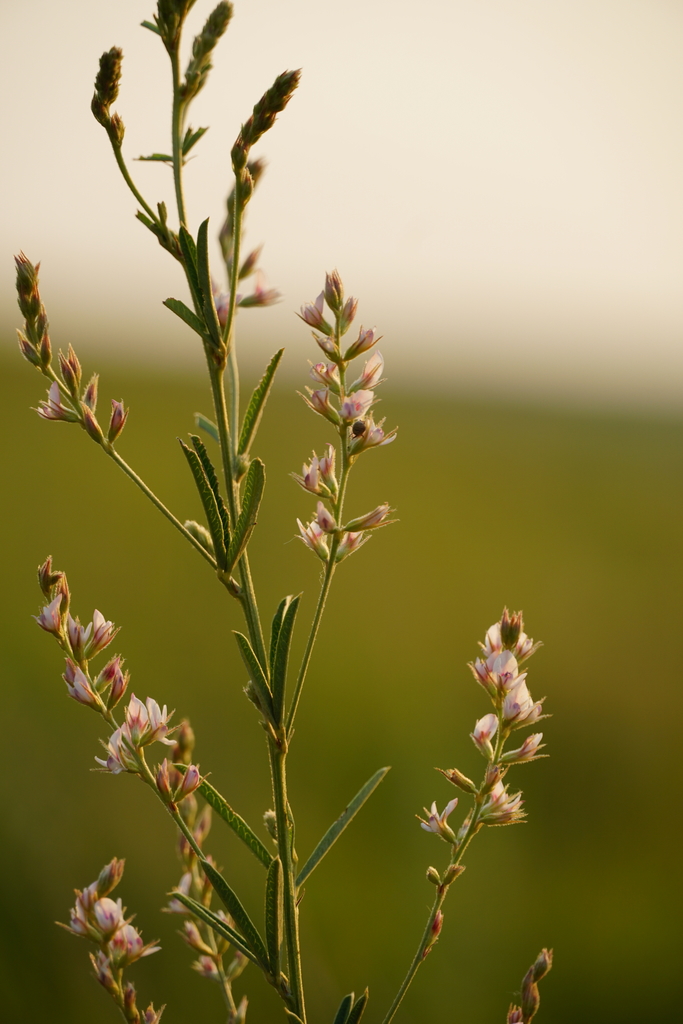
prairie lespedeza
Lespedeza leptostachya
Lespedeza leptostachya is a rare species of flowering plant in the legume family known by the common names prairie lespedeza and prairie bush-clover. It is endemic to the Upper Midwest region of the United States, where it occurs in the Upper Mississippi Valley in the states of Minnesota, Iowa, Wisconsin, and Illinois. Most occurrences are in northern Iowa and southern Minnesota, and it is rare across its known range. It is federally listed as a threatened...
From the article Lespedeza leptostachya on Wikipedia (CC BY-SA), quoted section by section
Description
Lespedeza leptostachya is a long-lived perennial herb growing up to a meter tall. The pubescent leaves are compound, each made up of three linear or linear-oblong shaped leaflets. The herbage is coated in whitish hairs, giving the plant a silvery look. The inflorescence is a terminal spike of cream to yellowish or pale pink flowers. Each flower is only half a centimeter long. There are both cleistogamous flowers which never open, and chasmogamous flowers which open and allow insects inside; both types produce seed. Blooming occurs in July through September, with peak bloom in mid-July. The plant does not produce flowers until its maturity at the age of 6 to 9 years. The fruit is a legume pod. One plant can produce over 500 pods, however, many of them contain no viable seeds.
Range & habitat
It is endemic to the Upper Midwest, where it occurs in the Upper Mississippi Valley in the states of Minnesota, Iowa, Wisconsin, and Illinois. Most occurrences are in northern Iowa and southern Minnesota, and it is rare across its known range. It is federally listed as a threatened species in the US. Lespedeza leptostachya grows only in the tallgrass prairie, mainly in dry areas. The soils may be gravelly, sandy, and/or calcareous, and are generally well-drained. It prefers sloped areas that are north-facing. It is found in association with other plants including big bluestem (Andropogon gerardi), little bluestem (Schizachyrium scoparium), yellow Indian grass (Sorghastrum nutans), side-oats grama (Bouteloua curtipendula), prairie dropseed (Sporobolus heterolepis), porcupine grass (Stipa spartea), Penn sedge (Carex pennsylvanica), copper-shouldered sedge (Carex bicknellii), sand-bracted sedge (Carex muhlenbergii), flowering spurge (Euphorbia corollata), prairie phlox (Phlox pilosa), lead plant (Amorpha canescens), rough blazing star (Liatris aspera), purple prairie clover (Dalea purpurea), showy goldenrod (Solidago speciosa), grass-leaved goldenrod (S. …
Wikipedia: “Distribution and habitat”
Where it lives
Recorded sightings
—
geo-referenced records in GBIF, from museums, herbaria and field observers.
Drag the globe to turn it. Dots are where records exist, not a range map; darker means more records.
In the stacks
Searching the stacks…
Every page naming Lespedeza leptostachya in the Biodiversity Heritage Library →
This page is assembled live from iNaturalist, GBIF, Wikipedia, the Source Library and the Internet Archive. It is not yet part of the hand-edited codex. iNaturalist taxon 164570.