- Plants
- ›Vascular Plants
- ›flowering plants
- ›Dicots
- ›Sunflowers, Bellflowers, Fanflowers, and Allies
- ›Sunflowers, Daisies, Asters, and Allies
- ›Asteroideae
- ›bonesets, blazingstars, and allies
- ›Liatrinae
- ›Liatris
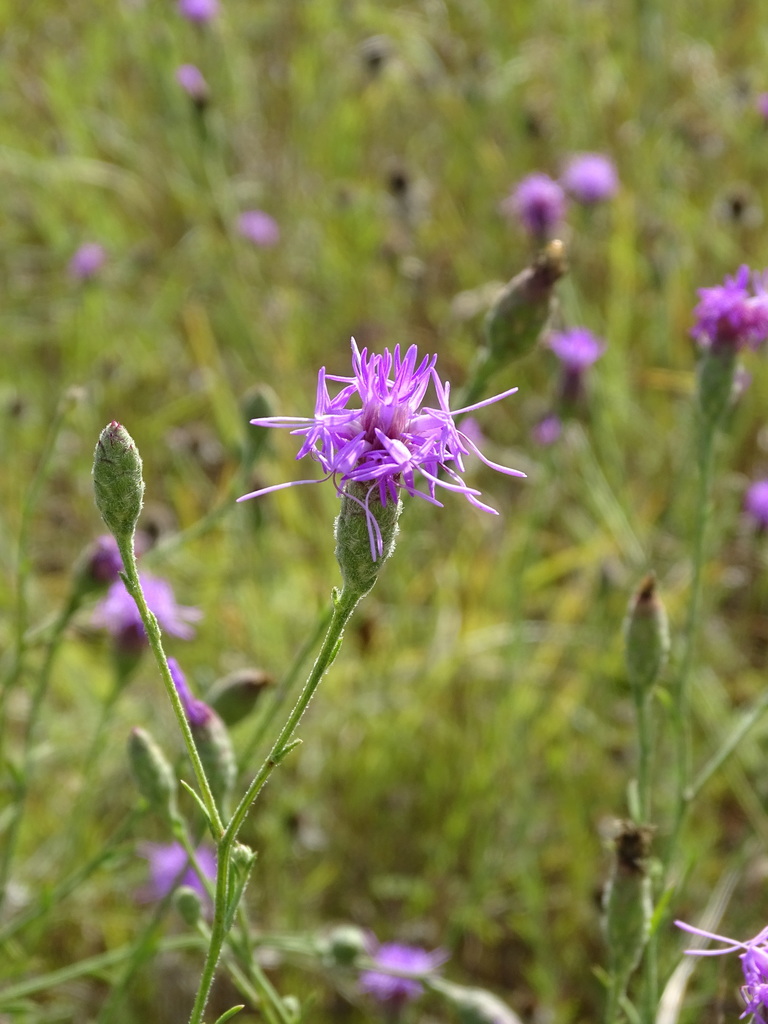
branched gayfeather
Liatris cymosa
Liatris cymosa (also known as Aggie-land gayfeather, branched gayfeather, or branched blazing star) is a plant species in the family Asteraceae and genus Liatris. It is native to east central Texas in North America, where it is found in habitats such as post oak woodlands, fields, fence rows, woodland openings and edges, in clay soils. It blooms in mid to late summer with purple flower heads. It is of conservation concern due to habitat loss.
From the article Liatris cymosa on Wikipedia (CC BY-SA), quoted section by section
Description
Liatris cymosa grows from rounded or sometimes elongated corms, that produce stems 20 to 75 centimeters tall. The upright growing stems have appressed hairs that point in the same direction. The basal and cauline leaves have one nerve. The leaves are long and thin, ranging from 8 to 12 centimeters long and 2 to 5 millimeters wide. The foliage is mostly hairless or may have some hairs on the margins; the leaves are gradually reduced in size as they ascend the stem or abruptly reduced halfway up the stem. The flowers are in dense heads with 20 to 25 florets, and the heads have stems that are 20 to 70 millimeters long. The heads are produced in loose cyme-like clusters of 2 to 20, sometimes more, terminating the widely branched stems. The seed is produced in a cypselae (a type of fruit) that is 6 to 7 millimeters long with feathery pappi.
Range & habitat
Liatris cymosa is native to Texas and is found growing in grasslands, in open post oak woodlands, in fields, in fencerows, and other open areas and edges; it grows in clay, chalky, and gravel soils. It is of conservation concern, and populations have been lost do to development.
== References ==
Wikipedia: “Habitat”
Where it lives
Recorded sightings
—
geo-referenced records in GBIF, from museums, herbaria and field observers.
Drag the globe to turn it. Dots are where records exist, not a range map; darker means more records.
In the stacks
Searching the stacks…
Every page naming Liatris cymosa in the Biodiversity Heritage Library →
This page is assembled live from iNaturalist, GBIF, Wikipedia, the Source Library and the Internet Archive. It is not yet part of the hand-edited codex. iNaturalist taxon 164686.