- Animals
- ›Arthropods
- ›Hexapods
- ›Insects
- ›Winged and Once-winged Insects
- ›Ants, Bees, Wasps, and Sawflies
- ›Narrow-waisted Wasps, Ants, and Bees
- ›Ants, Bees, and Stinging Wasps
- ›Scoliid Wasp Superfamily
- ›Scoliid Wasps
- ›Scoliini
- ›Regiscolia
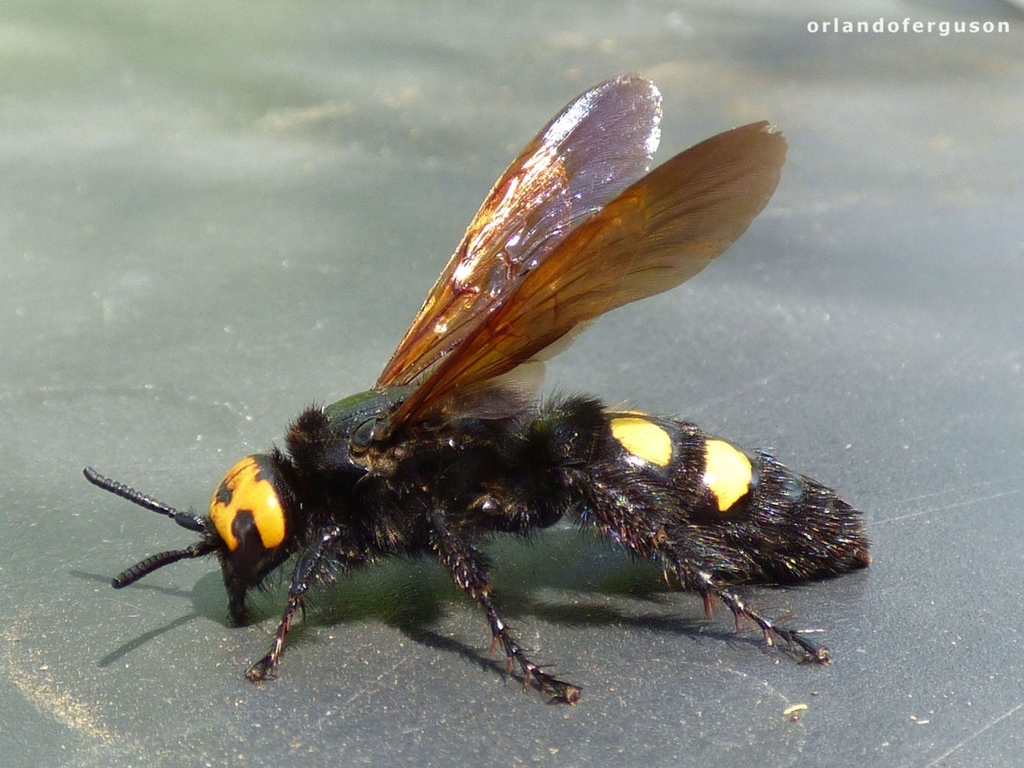
Mammoth Scoliid Wasp
Regiscolia maculata
Regiscolia maculata, sometimes known as the mammoth wasp, is a species of wasp belonging to the family Scoliidae in the order Hymenoptera. It is a parasitoid on scarab beetles and is found in Europe and Asia and is the largest wasp found in Europe. In central Europe they fly from June to about mid-July.
From the article Regiscolia maculata on Wikipedia (CC BY-SA), quoted section by section
Description
The mammoth wasp resembles a very large, elongated bumble bee. The female is larger than the male and has a yellow head, the male has a black head. Its body is covered in downy hair and is glossy black in colour with two yellow bands across its abdomen which are sometimes divided to form four yellow spots. Females have shorter antennae than males. The females may reach a length of 4.5 cm (1.8 in) and the males are smaller than the females. It may be confused with Scolia hirta which is however smaller, and has a black head.
Range & habitat
The mammoth wasp occurs in southern Europe as far north as Belgium, where it was first recorded in 2018, into Russia, North Africa and the near east. It has been recorded in southern Great Britain but as its prey does not occur in Britain it will be unable to establish there.
Wikipedia: “Distribution”
In human culture
It is suggested as the insect model used for the gold "Malia Pendant", a jewel of high quality gold-smithery of the Minoan times.
Wikipedia: “In culture”
Listen
Looking for field recordings…
Where it lives
Recorded sightings
—
geo-referenced records in GBIF, from museums, herbaria and field observers.
Drag the globe to turn it. Dots are where records exist, not a range map; darker means more records.
In the stacks
Searching the stacks…
Every page naming Regiscolia maculata in the Biodiversity Heritage Library →
This page is assembled live from iNaturalist, GBIF, Wikipedia, the Source Library and the Internet Archive. It is not yet part of the hand-edited codex. iNaturalist taxon 1647283.