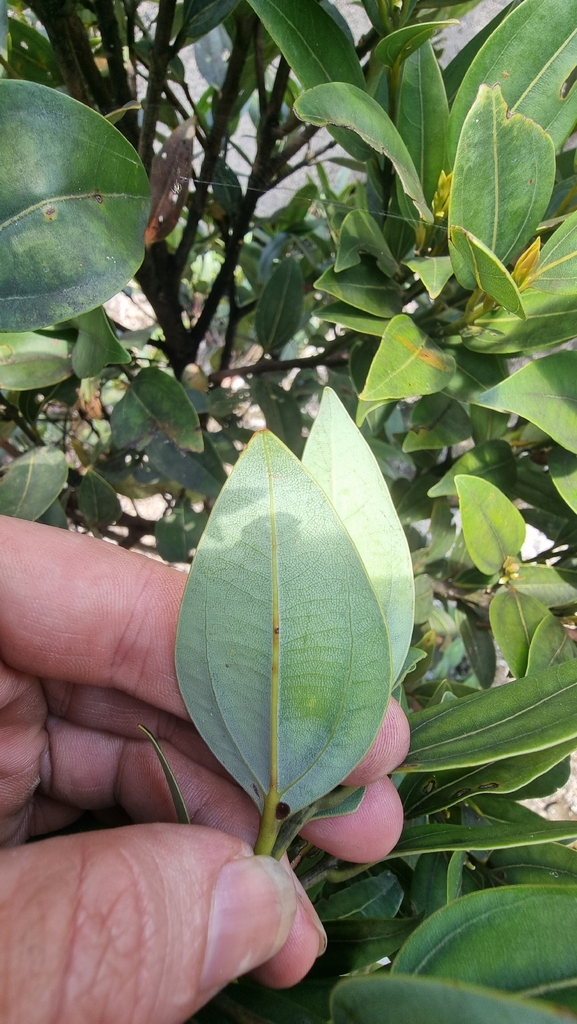
Cinnamomum propinquum
Cinnamomum propinquum, commonly known as pepperwood, is a species of plant in the family Lauraceae native to the Wet Tropics bioregion of Queensland, Australia. It is a rainforest tree, first described in 1901, and is critically endangered, being found only on the highest peaks of the region.
From the article Cinnamomum propinquum on Wikipedia (CC BY-SA), quoted section by section
Description
Cinnamomum propinquum is a tree growing to a height of 12 m (39 ft). The twigs give off a peppery odour when broken, giving rise to the common name. The leaves are arranged in opposite pairs and measure up to 10 cm (3.9 in) long and 4 cm (1.6 in) wide. The lower side of the leaf blade is glaucous. The inflorescence is a panicle about the same length as the leaves. The fragrant flowers have six green to cream tepals measuring up to 5 mm (0.20 in) long. The fruit is a dark blue to purple drupe about 14 mm (0.6 in) long and 12 mm (0.5 in) wide. It contains one brown seed about 9 mm (0.4 in) long.
Range & habitat
This is a rare species that grows in rainforest above about 700 m (2,300 ft) on Mount Bellenden Ker and Mount Bartle Frere. Both peaks are in the Wooroonooran National Park about 40–50 km (25–31 mi) south of Cairns.
Wikipedia: “Distribution and habitat”
Where it lives
Recorded sightings
—
geo-referenced records in GBIF, from museums, herbaria and field observers.
Drag the globe to turn it. Dots are where records exist, not a range map; darker means more records.
In the stacks
Searching the stacks…
Every page naming Cinnamomum propinquum in the Biodiversity Heritage Library →
This page is assembled live from iNaturalist, GBIF, Wikipedia, the Source Library and the Internet Archive. It is not yet part of the hand-edited codex. iNaturalist taxon 1649433.