- Plants
- ›Vascular Plants
- ›flowering plants
- ›Dicots
- ›Heathers, Balsams, Primroses, and Allies
- ›primrose family
- ›Cape Myrtle subfamily
- ›Lysimachia
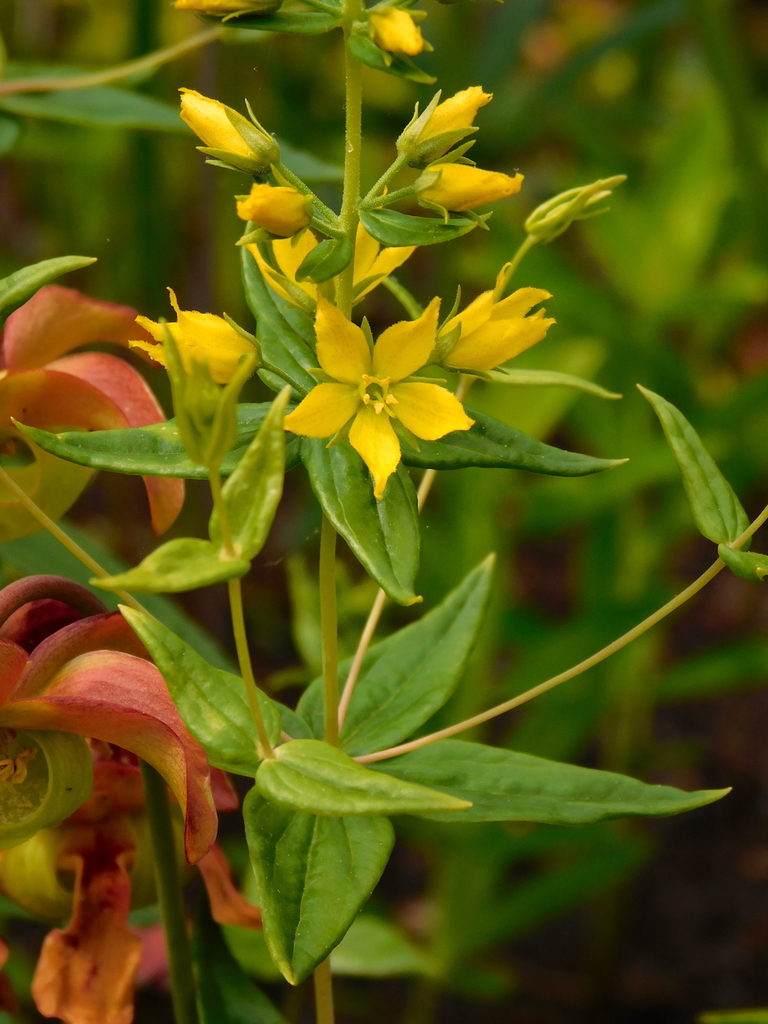
roughleaf loosestrife
Lysimachia asperulifolia
Lysimachia asperulifolia (orth. var. L. asperulaefolia) is a rare species of flowering plant in the Primulaceae known by the common name rough-leaved loosestrife and roughleaf yellow loosestrife. It is endemic to the Atlantic coastal plain in North Carolina and northern South Carolina in the United States, where there are 64 known populations. It is a federally listed endangered species of the United States.
From the article Lysimachia asperulifolia on Wikipedia (CC BY-SA), quoted section by section
Description
This plant is a rhizomatous perennial herb growing erect to a maximum height around 60 to 70 centimeters. The lower stem is pinkish in color and ribbed, and the upper stem is yellowish and lacks ribs. The stem in the inflorescence is covered in reddish glands. The leaves are green, lance-shaped, and up to 5 centimeters long by 2 wide. They are borne in whorls of three or four around the stem, or sometimes in opposite pairs. The leaves are not rough in texture as the common name would suggest. Smaller, tougher, brown-colored leaves are opposite or borne in whorls of up to 7 near the stem base. The top of the stem is occupied by the inflorescence, which is a raceme of star-shaped yellow flowers interspersed with leaflike green bracts. Each flower has 4 to 7, but usually five, yellow petals with wide bases and pointed, ragged tips. The petals and green sepals are dotted with red glands and streaked with reddish resin canals. The fruit is a red-mottled straw-colored capsule a few millimeters in length.
Range & habitat
This herb grows in a number of plant communities on the coastal plains of southern North Carolina and northern South Carolina, including pocosins, sandhills, pine flatwoods and pine savannas. It is most commonly found in open areas in the ecotone between longleaf pine uplands and pond pine pocosins. The soil is seasonally wet to waterlogged or submerged, low in nutrients, rich in peat over sandy substrates. The plant is found in sections of these habitat types which, in their pristine state, are openings in a dense layer of shrubs which are kept open by severe periodic wildfires. Fire prevents ecological succession, maintaining a type of ecosystem in which the taller vegetation is kept small and sparse, allowing the herb layer to flourish in the sun. Trees, shrubs, and ferns in the area include Aronia arbutifolia (chokeberry), Clethra alnifolia (summersweet), Cyrilla racemiflora (titi), Fothergilla gardenii (dwarf fothergilla), Ilex glabra (Appalachian tea), Magnolia virginiana (sweetbay), Osmunda cinnamomea (cinnamon fern), Persea palustris (swampbay), Symplocos tinctoria (yellowwood), and Vaccinium species (wild blueberries). …
Wikipedia: “Habitat”
Where it lives
Recorded sightings
—
geo-referenced records in GBIF, from museums, herbaria and field observers.
Drag the globe to turn it. Dots are where records exist, not a range map; darker means more records.
In the stacks
Searching the stacks…
Every page naming Lysimachia asperulifolia in the Biodiversity Heritage Library →
This page is assembled live from iNaturalist, GBIF, Wikipedia, the Source Library and the Internet Archive. It is not yet part of the hand-edited codex. iNaturalist taxon 164992.