- Plants
- ›Vascular Plants
- ›flowering plants
- ›Dicots
- ›Legumes, Milkworts, and Allies
- ›Legumes
- ›Faboideae
- ›Phaseoleae
- ›Phaseolinae
- ›Macroptilium
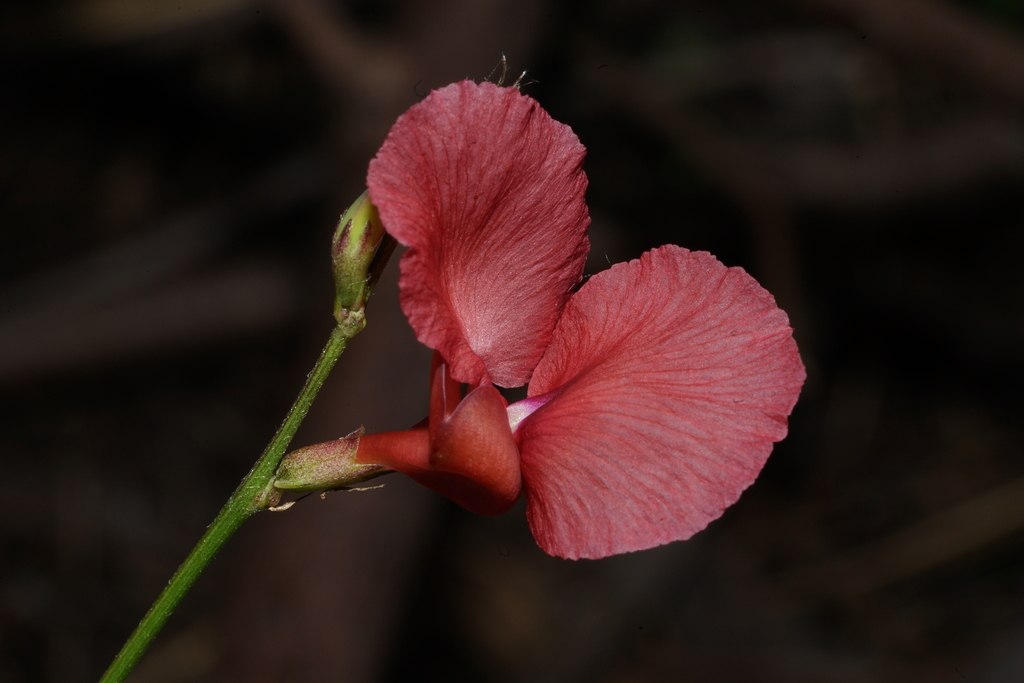
Phasey Bean
Macroptilium lathyroides
Macroptilium lathyroides is a species of plant in the legume family (Fabaceae) commonly known as the phasey bean. It is the type species of genus Macroptilium. Herbaceous annual or short-lived perennial growing up to 1 m high, it is native to the tropical and subtropical areas of Central and South America, and naturalized throughout the tropics. It is cultivated for forage or as a green manure or cover crop in rotation. As it quickly spreads on disturbed soils, it is considered an environmental weed in some areas.
From the article Macroptilium lathyroides on Wikipedia (CC BY-SA), quoted section by section
Description
M. lathyroides is a herbaceous annual or short-lived perennial, 0.6–1 m tall. The leaves are compound with three ovate to lanceolate leaflets, 3–8 cm long and 1–3.5 cm wide. Red to purple flowers, with wing petals larger than the lower petals, develop on long stalks. They grow paired long pods, 5.5–12 cm long, 2.5–3 mm wide, which readily shatter when mature, containing numerous seeds dispersed by winds. Seads are obliquely oblong, about 3 mm long, mottled light and dark grey-brown or black. The plant spreads readily from seed under moist conditions.
What it does
M. lathyroides is native to much of tropical and subtropical America, from Mexico to Argentina. It is adapted to a wide range of altitudes (up to 2000 m in Ecuador), soil types from deep sands to heavy clays, and with a pH range of (5.0–) 6.0–7.0 (–8.0). It is found in areas with annual rainfall range of 750–2,000 mm. It can tolerate moderate frost and moderate salinity. Plants tend to form dense monocultures, but once established, they combine well with open grasses, particularly under fertile conditions. Especially in shade, they readily twin with each other or other plants, reaching up to 1.5 m. M. lathyroides is widely naturalized across the tropical areas of the world, cultivated for forage or as a green manure or cover crop in rotation. It is regarded as a good pioneer species since it spreads easily without competition and exhibits good early growth. In some areas it is considered a minor weed of rice. In Queensland and the Northern Territory in Australia it is regarded as an environmental weed.
Wikipedia: “Ecology”
Where it lives
Recorded sightings
—
geo-referenced records in GBIF, from museums, herbaria and field observers.
Drag the globe to turn it. Dots are where records exist, not a range map; darker means more records.
In the stacks
Searching the stacks…
Every page naming Macroptilium lathyroides in the Biodiversity Heritage Library →
This page is assembled live from iNaturalist, GBIF, Wikipedia, the Source Library and the Internet Archive. It is not yet part of the hand-edited codex. iNaturalist taxon 165060.