- Plants
- ›Vascular Plants
- ›flowering plants
- ›Dicots
- ›Roses, Elms, Figs, and Allies
- ›rose family
- ›Amygdaloideae
- ›Maleae
- ›Malus
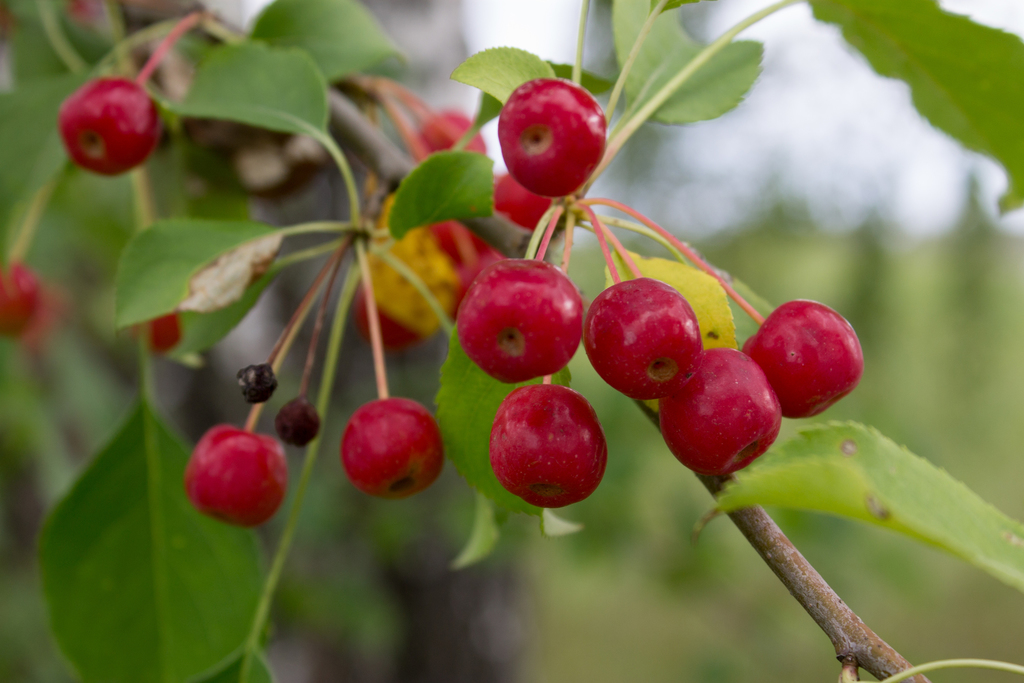
Siberian crabapple
Malus baccata
Malus baccata is an Asian species of apple known by the common names Siberian crab apple, Siberian crab, Manchurian crab apple and Chinese crab apple. It is native to many parts of Asia, but is also grown elsewhere as an ornamental tree and for rootstock. It is used for bonsai. It bears plentiful, fragrant, white flowers and edible red to yellow fruit of about 1 cm (3⁄8 in) diameter.
From the article Malus baccata on Wikipedia (CC BY-SA), quoted section by section
Description
The trees grow up to 10–14 m (33–46 ft) high. They have arching or overhanging red-brown branches and red-brown buds. The petioles are 2–5 cm (3⁄4–2 in) long, with few glands. Leaves are elliptical or egg-shaped, 3 cm–8 cm × 2 cm–3.5 cm (1+1⁄4 in–3+1⁄4 in × 3⁄4 in–1+1⁄2 in). The pedicels are slender and 1.5–4 cm (5⁄8–1+5⁄8 in) long. They bear white, fragrant flowers of 3–3.5 cm (1+1⁄8–1+3⁄8 in) in diameter in groups of four to six. Petals are white and egg-shaped, about 2.0–2.5 cm (3⁄4–1 in) long. Fruits are red to yellow and spherical, only about 1 cm (3⁄8 in) in diameter; they form dense clusters and resemble cherries from a distance. Flowering occurs in spring, with fruits appearing in September and October.
Range & habitat
The species is native to Russia, Mongolia, China, Korea, Bhutan, India, and Nepal, where it is common to mixed forests on hilly slopes at elevations up to 1,500 m (4,900 ft). The tree is found in Japan, and it has also been introduced to Europe and North America, where it is found in the wild mostly in the Great Lakes Region and in the Northeastern United States.
Wikipedia: “Distribution and habitat”
At the table
The species is used as ornament for its flowers and fruit. The fruits are edible and are eaten fresh or dried. It is one of the tallest and most resistant to cold and pest species of its genus, thus is used for experimental breeding and grafting of other crab and domesticated apples. In particular, it is a common genetic source for M. pumila and M. asiatica in northern and northeastern China. M. b. var. mandshurica is used for bonsai.
Wikipedia: “Uses”
Where it lives
Recorded sightings
—
geo-referenced records in GBIF, from museums, herbaria and field observers.
Drag the globe to turn it. Dots are where records exist, not a range map; darker means more records.
In the stacks
Searching the stacks…
Every page naming Malus baccata in the Biodiversity Heritage Library →
This page is assembled live from iNaturalist, GBIF, Wikipedia, the Source Library and the Internet Archive. It is not yet part of the hand-edited codex. iNaturalist taxon 165104.