- Plants
- ›Vascular Plants
- ›flowering plants
- ›monocots
- ›Agaves, Orchids, Irises, and Allies
- ›iris family
- ›Iridoideae
- ›Tigridieae
- ›Nemastylis
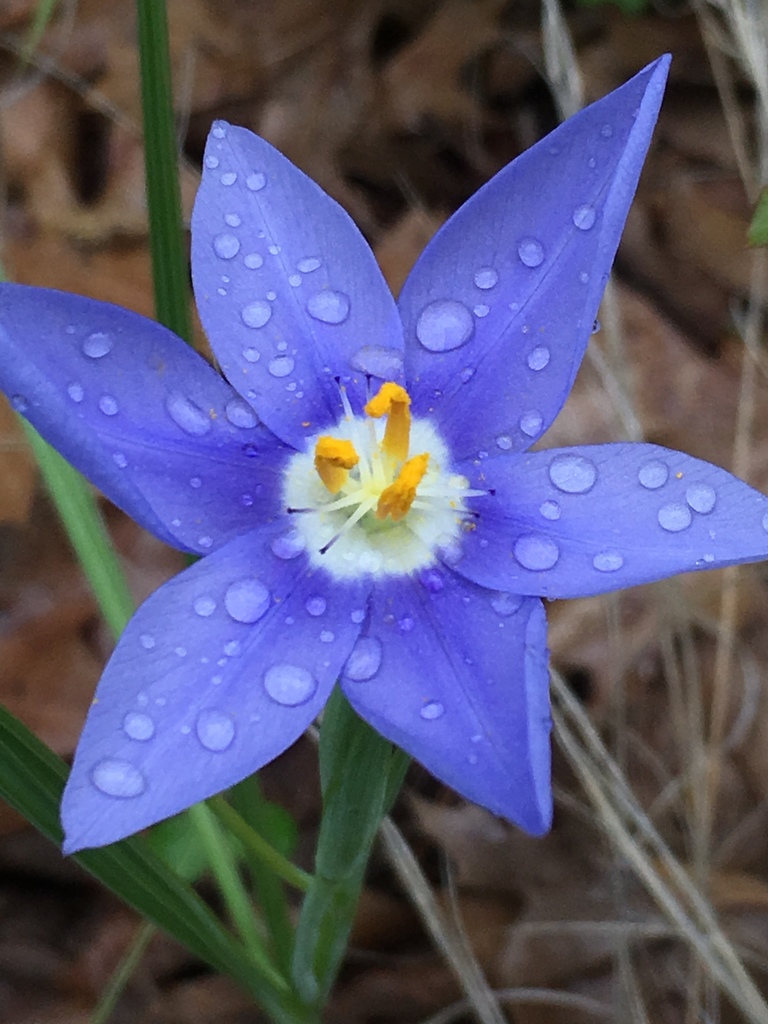
Prairie Pleatleaf
Nemastylis geminiflora
Nemastylis geminiflora is a perennial herb also known as the prairie celestial and prairie pleatleaf. It is common on the black soil prairies in Texas, and can also be found as far north as Missouri and as far east as Alabama. It has an inflorescence on stems 8-11 centimeters long, arising from a subterranean stem and bulb that is 2–3 cm in diameter.
From the article Nemastylis geminiflora on Wikipedia (CC BY-SA), quoted section by section
Description
N. geminiflora grows to a height of 30 centimetres (12 in), sometimes taller, with stems growing from a bulb deep in the ground. Each stem is clasped by 1 to 4 narrow, linear leaves. The leaves are long and narrow, up to 11 centimetres (4 in) wide, folded lengthwise near the base and pleated along the veins or flat near the top. Flowers are 6.5 centimetres (2.6 in) long, in the shape of a star with 6 blue-violet or blue pointed petals and sepals. 1 or 2 flowers emerge from a common spathe, or sheath. Each flower lasts only one day, opening up in the late morning and closing mid-afternoon.
Range & habitat
The plant is native to Alabama, Arkansas, Kansas, Louisiana, Missouri, Mississippi, Oklahoma, Tennessee, and Texas. The plant occurs in limestone glades, prairies, and rocky slopes.
Wikipedia: “Distribution and habitat”
What it does
N. geminiflora is pollinated by bees, flies, and other insects, which gather nectar from the flowers. Flowers appear in April and May.
== References ==
Wikipedia: “Ecology”
Where it lives
Recorded sightings
—
geo-referenced records in GBIF, from museums, herbaria and field observers.
Drag the globe to turn it. Dots are where records exist, not a range map; darker means more records.
In the stacks
Searching the stacks…
Every page naming Nemastylis geminiflora in the Biodiversity Heritage Library →
This page is assembled live from iNaturalist, GBIF, Wikipedia, the Source Library and the Internet Archive. It is not yet part of the hand-edited codex. iNaturalist taxon 165669.