- Plants
- ›Vascular Plants
- ›Ferns
- ›Leptosporangiate Ferns
- ›Polypod Ferns
- ›Pteridineae
- ›brake family
- ›lip fern subfamily
- ›Notholaena
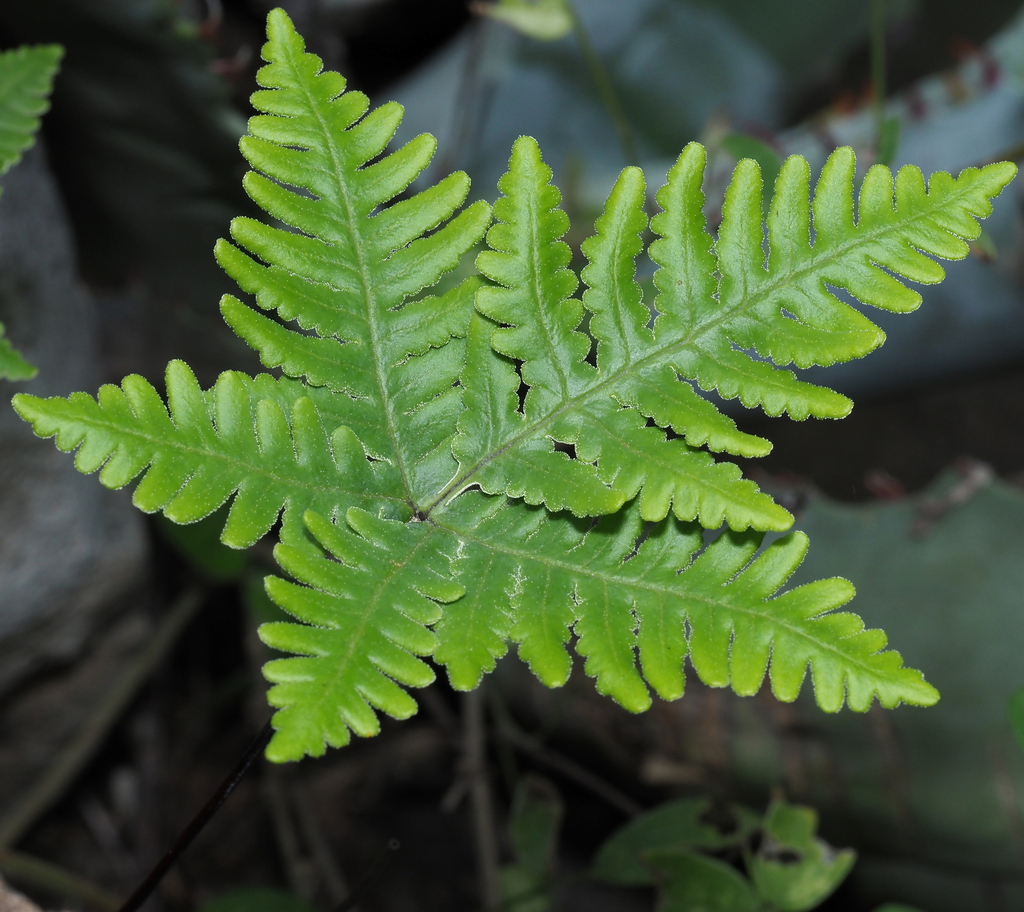
star cloak fern
Notholaena standleyi
Notholaena standleyi, also known as star cloak fern and Standley's cloak fern, is a fern that is native to the United States and Mexico. It is a member of the Notholaena genus, which is part of the Cheilanthoideae subfamily of Pteridaceae family. It is distinguished by the pentagonal shape formed by the blades of its frond, a property other members of the Notholaena genus do not possess.
From the article Notholaena standleyi on Wikipedia (CC BY-SA), quoted section by section
Description
Individuals of this species have brown petioles and green fronds. The ferns are erect and grow to a height of 25 centimetres (9.8 in). The petioles grow to a length of 5 to 13 centimetres (2.0 to 5.1 in). The individual fronds are usually 3 to 7 centimetres (1.2 to 2.8 in) wide as well as long. The frond is light green when young, becoming darker green as it matures, and usually contains five blades arranged in a pentagonal fashion. The blades are bipinnately or tripinnately compound, and each of them is triangular and pointed. The abaxial side of the frond is covered by powdery farina, with a function that is still unclear. The color of the farina differs between species growing in different geographic locations. These are referred to as chemotypes, of which there are four. These chemotypes also have different number of complete chromosome sets. Gold and yellow farina are diploids, pallid and yellow/green are tetraploids. Its prothallus contains glandular trichomes. It usually has 32 spores per sporangium, but many with only 16 have been observed, produced from eight 2n mother cells. It is diploid and has 60 chromosomes in its root tip cells.
Wikipedia: “Morphology”
Range & habitat
Notholaena standleyi is indigenous to southwestern United States and parts of north and central Mexico. It specifically grows in Arizona, Colorado, New Mexico, Oklahoma, and Texas in the USA.
Wikipedia: “Distribution”
What it does
Notholaena standleyi is a perennial species that typically grows in desert regions at elevations from 300 to 2,100 meters (980 to 6,900 ft). It is found on rocky hillsides, usually in the crevices created by limestone and granite boulders that provide the partial shade the plant prefers. During periods of drought, the frond may curl and become brown until water is available, an adaptation to the semi-arid environments it inhabits. At lower elevations, it sometimes grows alongside Notholaena californica. It takes 13 days to germinate and sporulates from late spring to fall. It has the same life cycle as a typical fern, the sporophyte produces haploid spores by meiosis, which grows into a haploid gametophyte. The gametophyte produce gametes by mitosis. The fertilized egg when develop into the sporophyte by mitosis. The spore is transported by air and water.
Wikipedia: “Habitat and Ecology”
Where it lives
Recorded sightings
—
geo-referenced records in GBIF, from museums, herbaria and field observers.
Drag the globe to turn it. Dots are where records exist, not a range map; darker means more records.
In the stacks
Searching the stacks…
Every page naming Notholaena standleyi in the Biodiversity Heritage Library →
This page is assembled live from iNaturalist, GBIF, Wikipedia, the Source Library and the Internet Archive. It is not yet part of the hand-edited codex. iNaturalist taxon 165741.